Wednesday, August 30, 2006

Semper Dowland, semper ludens


1st voice
Humour, say, what makest thou here

In the presence of a queen?

2nd voice Princes hold conceit most dear,

All conceit in humour seen.

1st voice Thou art a heavy, leaden mood –

2nd voice Humour is Invention’s food.

Both But never Humour yet was true,

But that which only pleaseth you.

1st voice O, I am as heavy as lead,

Say then who is Humour now?

2nd voice I am now inclined to mirth,

Humour I as well as thou.

1st voice Why then 'tis I am drowned in woe.

2nd voice No no Wit is cherished so.

Both But never Humour yet was true,

But that which only pleaseth you.

1st voice Mirth then is drown’d in Sorrow’s brim,

O, in sorrow all things sleep.

2nd voice No, no Fool, the light’st things swim

Heavy things sink to the deep.

1st voice In her presence all things smile,

2nd voice Humour frolic then awhile.

Both But never Humour yet was true,

But that which only pleaseth you.

The closing sung dialogue in John Dowland’s Second Booke of Songs (1600). I have ventured to post an mp3 of this delightful piece on my academic web space, for purposes of comment only. I will take down this posting should objection be made:

http://personal.rhul.ac.uk/uhle/001/Humour%20%20say.mp3

“There can be little doubt that the song was written for a masque”, says Diana Poulton, in her study, John Dowland (1972). The musicologist’s curt comment may be right. The dialogue is complete, its little drama resolved within its three stanzas, but a masque ‘entry’ could be short and complete in itself. But I would rather see it as more properly a moment of courtly entertainment, to be staged as if impromptu. The Queen is going to take her exercise in a long gallery. She comes across a man in black, absorbed in thought (I’ve supplied a detail of Jan de Heem’s ‘A Student in his Study’ 1628, which, appropriately, is in the Ashmolean Museum, Oxford). Immediately, the first voice reproaches the Melancholic, who counter-argues that Princes approve of productive artistic melancholy. After the wonderful complimentary chorus, the speakers swap humours, with a continued defence of melancholy, and the little drama ends when both resolve to be glad in the Queen’s presence.

The Queen, whose purse was just as impenetrable as a more famous part of her person, no doubt expressed some general pleasure, and passed on in maiden meditation, fancy free, leaving her nation’s greatest melancholy artist (‘Semper Dowland, semper dolans’) unrewarded. That she had just heard something that sounds like a stray part of Cosi fan Tutti miraculously wafted into the wrong century would have been neither here nor there.

The text set might have been Dowland’s own, as he clearly wrote words for his own music. Published in 1600, the ayre must have been written during the vogue for ‘Humour’ pushed by Jonson and Chapman from 1597. Jonson himself might have written the words, as he was proprietorial about 'Humour'. The Entertainment he wrote for King James and Queen Anne at Althorpe in 1603 is another carefully staged and very flattering courtly impromptu (‘The invention was, to have a Satyre lodged in a little Spinney, by which her Majestie, and the Prince were to come, who (at the report of certayne Cornets that were divided in severall places of the Parke, to signifie her approach) advanced his head above the top of the wood, wondring, and (with his pipe in his hand) began as followeth. Satyre:Here? there? and every where? / Some solemnities are neere…’) with elaborate music: “whilst to the sound of excellent soft Musique, that was there concealed in the thicket…”

Sir John Davies’s A Lottery Presented before the late Queene's Majesty at the Lord Chancelor's House, 1601 gets us even closer to the kind of pleasant surprise poets and musicians tried to contrive to please their ageing Queen:
A Mariner with a box under his arm, containing all the several things following, supposed to come from the Carrick came into the Presence, singing this Song:
Cynthia Queene of Seas and Lands,
That Fortune euery where commands,
Sent forth Fortune to the Sea,
To try her fortune every way…

I haven’t been able to find other personifications of ‘Humour’. There’s something close in a poem by Samuel Rowlands, but the LION database produces no dramatic character simply named ‘Humour’ or ‘Melancholy’. The Consort of Musick's peerless performance is still available if you buy their complete Dowland on CD, there seems to be no separate recording of their Second Booke on the market. I'd include the precise link, but it will be too long to fit this column; easily found anyway on a site like Amazon.

Monday, August 28, 2006

Oh, come on, cheer up...


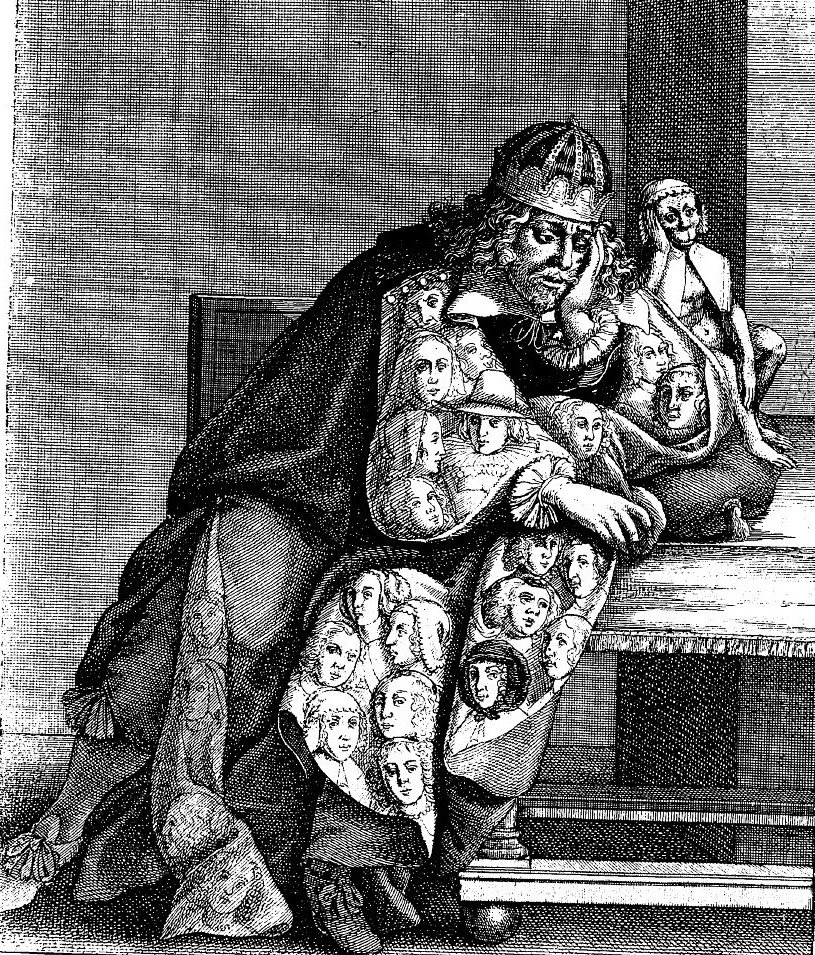
"Foole that I was, who had so faire a state
Fower or five thousant by the year at least
And waste it so as I have done of late
On Whores and Bawdes, and like a filthie beast
Caught foule diseases, which consume me sore.
And all proceedes from loving everie whore
As manie as I ere have laine withall
See here their faces how they face my gowne
Of all sortes: little, middle-sized and tall
Some Lovelie faire, some black, and some are browne
Some Wives, some Maidens, some rich and others poore
Some old, some young, yet everie one a whore
With all these sometime I have been acquainted
Which were they in their lively cullors limnd
Some should you see how they themselves have painted
How others with their borrowed hair are trimmd
How like this monkey sick themselves they faine
When in their bones, indeed, lies all the paine.
But since these daies are done, all warning take
How with their wealth they do their bodies wast
And then themselves to Hospitalls betake
Or Scorned Beggars do become at last.
Vice, by my example, then learn to flie
But most of all (the basest) LETCHERIE."

1642, and apparently a collaboration between Wencelaus Hollar and Thomas Killigrew. I've added some punctuation. A failed satire, blunted by the banality of Killigrew's text, and the benignity of Hollar's engraving. The repentent philanderer shows no sores or lesions, his nose hasn't collapsed with syphilis, he still looks wealthy, and he remains crowned (politically quite odd that he should be) in his masculinity, while the ape, which ought to signify his lechery, is in a woman's lace cap and falling band. Hollar had a special sensibility (which Gerald Hammond has identified as particularly akin to Cavalier poetry) for tertiary sexual characteristics in women, their clothes and accoutrements, as in his strange and wordless catalogues of the varieties of women's dress. Instead of pornographic parts of bodies, the artist has drawn rather uniformally attractive faces, and headdresses, and on the buttoned-on facings of the man's gown, as though he could slough off these memories in a moment: they are not inscribed on him. 'Everie one a whore', he mournfully announces - that slippiest of words in 17th century discourse about women, linking any unmarried partner, however faithful and long-term, to the sex professional. That the women all seem to be partners any man would be happy to be intimately involved with perhaps makes an unintended point about the effects of those Judeo-Christian inculcations of sexual guilt.

Hollar is not well served by the internet. His large output, too vast for book publication, would be ideally served by an Art History version of something like literature's commercial databases. In an ideal world... This single sheet print was presumably created (Hollar's engraving above his lettered version of Killigrew's text) as an up-market version of the illustrated ballad, for framing or simply pasting up as a wall decoration.

Thursday, August 24, 2006

Legislation on the Detestable Sins, 1650


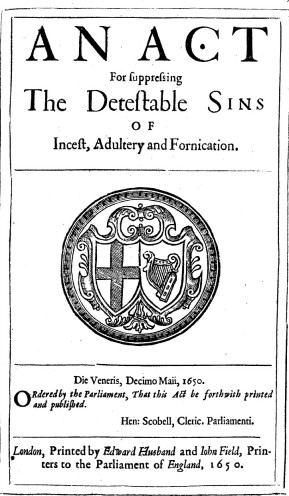
I had seen various references by social historians to the 1650 Act of Parliament by which the Puritan House of Commons sought to make fornication a felony punishable by death, but I’d never actually read the official publication, a brief and solemn black letter pamphlet, An Act For suppressing The Detestable Sins of Incest, Adultery and Fornication. The Act legislates first to make incest (both by blood and by marriage) a capital felony, and declares any children produced by an incestuous partnership (even if that marriage of relatives had previously been declared valid) illegitimate, and unable to inherit. The Act then continues, ‘That in case any married woman shall from and after the four and twentieth day of June aforesaid (ie., 1650), be carnally known by any man (other then her husband) (except in Case of Ravishment) and of such offence or offences shall be convicted as aforesaid by confession or otherwise, every such Offence and Offences shall be and is hereby adjudged felony; and every person, as well the man as the woman offending therein, and confessing the same, or being thereof convicted by verdict upon Indictment or Presentment as aforesaid, shall suffer death as in case of felony, without benefit of Clergy’.

After this drastic and momentous decree – legislating for both sexes - some anxious (and interestingly asymmetrical) clauses obviously inserted in debate appear – adultery must be a capital felony for the man committing the offence unless he didn’t know that the woman was married, a capital felony for the woman unless her husband had been abroad or absent for three years, or was believed dead (even a Puritan Parliament seems to acknowledge that women have their needs). Having thus resoundingly discouraged adultery, the act considered fornication, with virgin, widow or unmarried woman (those convicted get three months in prison, and release only after finding someone to stand security to their good behaviour for a further year), and finally the case of the common bawd and prostitute: ‘That all and every person and persons who shall from and after the four and twentieth day of June aforesaid, be convicted as aforesaid, by Confession or otherwise, for being a common Bawd, be it man or woman, or wittingly keeping a common Brothel or Bawdy-house, shall for his or her first offence be openly whipped and set in the Pillory, and there marked with a hot Iron in the forehead with the Letter B’ – then after this, three years in prison: with death for a second offence.

The Act ended with an attempt to prevent anyone accused and in mortal danger from this law using confession to retaliate in kind: ‘Provided, That no parties confession shall be taken as Evidence within this Act against any other, but onely against such party so confessing’, and an attempt to prevent domestic murder by judicial means: ‘nor the husband shall be taken as witness against his wife, nor the wife against her husband, for any offence punishable by this Act.’ This final clause apparently removes the operation of the act from the aggrieved parties most likely to call upon its provisions. It either served to make this a piece of dead letter legislation as far as adultery was concerned, or witnesses the confidence of the legislators that third parties would be self-righteous enough to come forward with their sworn accusations.

Shortly after the act passed into law, some interested party, remembering many a bawdy theatre scene, thought to express the likely reactions within the early modern sex industry. This was in A Dialogue between Mistris Macquerella, a Suburb Bawd, Ms Scolopendra, a noted Curtezan, and Mr Pimpinello an Usher, etc, Pittifully bemoaning the tenour of the Act (now in force) against Adultery and Fornication. (It was published in early July 1650). The names are traditional: the bawd’s name is as in John Marston’s The Malcontent (“Maquerelle, An olde Pandresse”), while ‘Scolopendra’ stems from a piece of lore as retailed in Deloney’s Jack of Newbury: “like the Fish Scolopendra, that cannot be toucht without danger”, and had been used for the monster lady in James Shirley’s play The Duke’s Mistress (1638).


It was a small act of resistance, but quite sprightly. The characters are differentiated - the older woman is given a piquantly Biblical phraseology (‘we the citizens of Sodome’), while the courtesan Scolopendra is throughout insistent in her view that her body is hers, to do with as she likes: ‘Alas, poor women, who are suspended from that priviledge the very Cats enjoy, who play and sport with their Tails, and yet fear no censure for so doing.’


Mistress Scolopendra complains of not having had a customer for ten days (‘we may een hang up our Harpes’), while Macquerella the bawd grumbles throughout in her characteristic quasi-moral way: ‘Ah wicked world, that I should live to see this day; a fine Age yfaith, when procreation must doe penance in an halter … The Act, the late Act against Fornication, and other Veniall sinnes, 'tis that hath undone us all … Oh! I hate the thought of being branded with the letter B. 'tis ten times worse then the Mark of the Beast I’le maintain it.’


Stanzas from what purports to be (and probably was) a ballad by Martin Parker about the act are read out, to initial disgust ‘Out upon thee (Pimpinello) this Song is made in disgrace of us, and our profession, prithee wipe thy posteriors with’t’, though they like more a stanza in which Parker (if it was him) recommends extra security against prying eyes in brothels.


Just as Shakespeare made Pompey resilient in his ignominy (‘the valiant heart’s not whipped out of his trade”), the dialogist has the three take some comfort from the thought that the effect of the act may not last long (‘This is but a paper pellet, a nine dayes wonder at the most’), and that it will in the meantime serve as a pretext to put up their prices: ‘this mutation we may well justifie, alledging the hazard we run’. Scolopendra, however, resolves to take to flight to
Venice ‘where I may use mine own, cum privilegio’.


I had half-expected some more explicit echoes of Measure for Measure, which would seem to be the text to have quoted (‘here’s a change indeed in the commonwealth!’), but the dialogist operates via a general reminiscence of whore, bawd and pimp scenes. It might have been a retired dramatist, speaking for the abolished theatre’s long-time partner. But the derision is muted, and perhaps Measure for Measure was just too loaded a text to allude to (with the Puritan Angelo’s hypocrisy, and Pompey’s devastating common sense), and so it was more a matter of voluntary suppression than a failure to bring to mind Shakespeare’s great play about the relative wisdoms of 'Justice' and 'Iniquity'.

Monday, August 21, 2006

Bernard Laurence Hieatt, 1909-1930


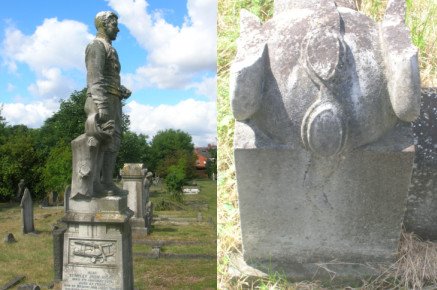
My latest thing (Tudor portrait memorial brasses) being recondite even by my standards - though I found a nice example in the University Church, St. Mary's in Oxford this last Sunday), I post instead about a more recent piece of memorialising. This marvellous monument is very local to me here in Reading, being in the far reaches of the Cemetery Junction burial ground.

It is 'To the proud and beautiful memory of Air Pilot Bernard Laurence, the beloved eldest son of R. L. & L. Hieatt, who was suddenly called away in his hour of victory on May 3rd 1930, after creating two world records in the two hundred miles motor cycle and sidecar race at Brooklands, aged 21 years'.

His grieving parents had their aviator and motorcyclist depicted in his flying jacket, with lace-up puttees. He nonchantly holds his flying helmet, and I suppose that only piety prevented the sculptor from carving in the cigarette which you have to feel that his left hand would inevitably have had poised. He grins, this youthful Icarus, who has for the moment harnessed all the technology of speed. In early May 1930, he died at Brooklands, that steeply banked Surrey circuit beloved of the record-breakers. The extensive Brooklands-related website http://www.brooklandsmuseum.com/ doesn't record any 200 mile motorbike and sidecar race records, but there is a photograph on the http://www.brooklands.org.uk/intro.htm site which maybe gives a glimpse of how insanely hairy that type of event might have been - for the sake of aerodynamics, the sidecar rider lies prone, facing backwards!: http://www.hartlana.co.uk/bsarchive/im139.htm

If this fine piece of 30's art has any signature by the sculptor, I missed it. At the corners of the plot, what were once winged helmets, with goggles draped over them, add another heroic touch. The biplane depicted on the side of the monument looks vaguely like a Hawker Hart. What we are seeing is W. H. Auden's airman, glamorous and doomed, ready to step into or out of the exactly contemporary The Orators.

As for myself, too many churches, and now cemeteries ... I suspect myself of admiring the dead too much, simply for having got through an ordeal to which I find myself peculiarly averse.

Update: John Pulford at Brooklands Museum fills me in on the details of Hieatt's death and career: "He was leading a 200miles motorcycle and side car race at Brooklands on a Rex Acme combination when he ran into a fence coming off the Byfleet Banking after complaining at his last pit-stop of very poor visibility caused by heavy rain. He took several world records and won races, achieving a coveted BMCRC ‘Gold Star’ in 1929 for lapping the track at over 100MPH"

Friday, August 18, 2006

Fine knacks for lecturers, cheap, choice, brave and new.


My latest toy is something called a USB turntable, by Ion. This spins your time-hallowed vinyl in the old way, but connects umbilically to your PC, and digitises the sound in one step - especially if (when you try to set this thing up) you just sit by the PC with the device ready to go, phone their help line, and get them to run through which processes detailed in the guide book which you neither can nor have to do, and which unmentioned changes to your sound settings you have to make. Then you are away. (The secret is to surrender to helplessness early: the kit is fine, the guide book to using it simply scandalous.)

At no time in my life have I ever possessed a crumhorn (opinions have varied over the years, perhaps), but back in the (my God!) late 70's and 80's, I was a Wigmore Hall regular, a fan of the still incomparable Emma Kirkby, and avid follower of the Consort of Musicke when the early music repertoire was first being extensively opened out and made available. My collection of LP's has followed me round since then. I was either too mean or too conservative to buy the music again on CD's; I'm not even sure that every disk reappeared in the other format. 'His golden locks time hath to silver turned', in the case of these LP's, their white slip cases time hath to yellow turned. But now their sound is released, and joins me again, in a new century.

A substantial Emma Kirkby fansite I used to know seems to have disappeared, while the official site http://www.emmakirkby.com/
seems to be just a place-holding site without content, as does http://www.musicke.net/
for the Consort of Musicke. Mysterious.

I wonder if I can post mp3's to Blogger? - To start with Dowland's 'Shall I sue?' would seem appropriate, I'd guess from this very cagey web-presence of the artiste. I recall that once, as I was fighting the wind along a motorway in a Citroen Dyane which I then owned, straining - against the rattle of the tiny engine - to listen to some lute music on a tape player I'd put on the passenger seat, I suddenly doubted my commitment to the late 20th century. But now I've got hold of some new (-ish) technology that puts me in touch with the past. Ace.

http://www.ion-audio.com/products/turntables/iTTUSB.html

Wednesday, August 16, 2006

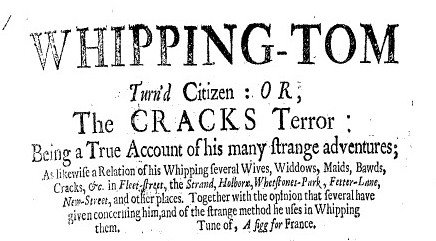
The Cracks Terror, 1681


‘Whipping Tom’, the subject of a news pamphlet and this street ballad, made his way to London in 1681. Contemporaries thought that he was either the same man as, or had been inspired by, an earlier, country-based ‘Whipping Tom’ (who gets a likely mention in John Phillips's Virgil Travesty, 1678). Dressed in black, he waited in dark city corners for solitary women, and then made his assault, a vigorous hand spanking.

During his period of activity, he seems to have frightened the women of London into staying at home (the contemporary reports evidently regard this as a good outcome), or, if they had to be out, arming themselves with ‘Penknives, sharp bodkins, Sizzars, and the like’. But the rumour was that Tom either wore a concealed suit of chain mail, or was simply a spirit, and invulnerable.

His activities, now, would of course instantly brand him as a pervert, making these attacks simply for his own sexual gratification. The late 17th century cannot see this: ‘Some says he does it in pure love, / To such whose wives are us’d to rove;/ And that since last he came about,/ Few City Dames dare not stir out:/ The which if true, will save much Coin, / Which otherwise they’d spend in vain’ (and I do like that ‘coin/vain’ rhyme!). As you see, ‘Whipping Tom’ was represented as an agent of social correction: not something that you’d wish to have happen to one of the women in your own family, perhaps, but, overall, a good thing, distributing only what was generally deserved. The attitude was not a very considered one, while the pamphlet, in the main, colludes with 'Whipping Tom', in describing his deeds with a bawdy relish – at least of language, for it seems to stop short of any acknowledgement that these were sexual encounters for ‘Tom’: ‘They durst not stir out after Candlelight … for fear of having an Alarum beaten upon their Tobies’ .. ‘and turning them up as nimble as an Eeel, makes their Butt ends cry Spanko’.

The ballad, in representing Tom as ‘the Crack’s Terror’, assigns to him a particular class of victim, and therefore misrepresents the indiscriminate attacks he made. Like everything else in the ballad, the term ‘crack’ comes from the news pamphlet: ‘Another time as we are informed, he meeting with a demure Crack or Miss of the Town (who came to accost him) he so swinged her tail, that tis thought, she will not be capable of her Trade for some considerable time.’ A ‘Crack’, a 17th century idiom I’d missed (though it will surely be in Gordon Williams’s Dictionary of Sexual Slang and Imagery in Shakespeare and Stuart Literature) was a prostitute. But you can tell that the anecdote is spurious, written for the sake of a poor joke: compare these convincing specifics: ‘Another time the Woman that cries hot Gray Pease about the Streets, coming up Ram Alley in Fleet Street … a cold hand was lay’d upon her, and up flew her heels, and down fell the Pease Tub, when (as she has farther related) her sences were so charmed, that she lost all power of Resistance, and left him to Tyranize over her Posteriors at pleasure, the which when he had done, he left her to scrape up her ware as well as she could, for the use of such longing Ladies as are affected with such Diet.’

Shakespeare knew about these proclivities – there’s Cleopatra, the dominatrix of the imagination:

The oars were silver,

Which to the tune of flutes kept stroke, and made

The water which they beat to follow faster,

As amorous of their strokes…

The stupefied grey pea seller ambushed in Ram Alley, unable to resist, her senses charmed, letting Tom take his strange pleasure, seems a world away from Cleopatra, but trembles on the edge of Cleopatra’s assertion that ‘The stroke of death is as a lover’s pinch, / Which hurts, and is desir’d’. Her trade, in what I take to be salt-preserved peas, ministers to one of the other unaccountable longings of women.

Men dressed as woman went out on vigilante patrol, but Tom was never lured into a misplaced attack leading to his arrest. Aphra Behn mentions him in her play of 1682, The City Heiress ('and at last defeated, turn Whipping Tom, to revenge yourself on the whole sex'), there are a couple of other allusions, and then he slips back into the shadows, pioneer of a gaudy mass-produced pornographic fantasy.

I do not think I will look for any illustrative links for this one...

Saturday, August 12, 2006

Another Literary Church


Back to the English landscape today, opting to go to a Church I'd been saving up, that at Ewelme in Oxfordshire (the odd name is Old English 'aewelm', 'place at the river source'). I was mainly thinking about Dame Alice, Chaucer's granddaughter, and Duchess of Suffolk until her death in 1475. I've made a composite picture of her two effigies on her 'transi-tomb': the in-life image of her in her ducal coronet, her pillow being puffed up for her by gilded angels, and, in the lower compartment, her as cadavre, pitilessly shrunken in flesh, only her flowing hair unchanged. In her life image, she is wearing the Order of the Garter round her left forearm, which is apparently what noblewomen and queens admitted to that noble order did - it was presumably far too raunchy a notion for them to wear the garter as just that. Queen Victoria, referred to just this tomb for precedent, wore her order of the garter-garter that way (and probably garters as well).

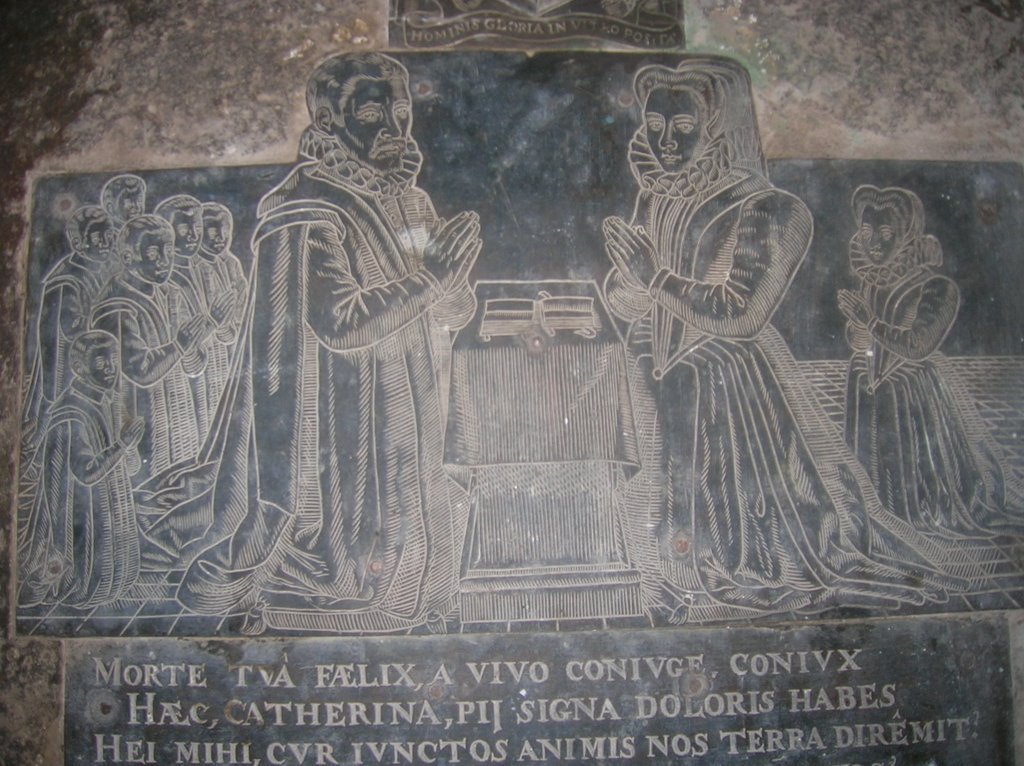
But the pious efforts of John, Duke of Suffolk (a crony of Richard III) on behalf of his mother seem to have created a critical mass that lifted the quality of other monuments. My other image is of a more bourgeois brass, that to Catherine Palmer, who died in childbed June 26th 1599, aged 34. They had had six sons and one daughter, who are all present in this superb portrait brass. A social historian would say, the classic 7 child reproductive career of the early modern woman, and its concomitant risk. The Latin verses speak for the husband of their always having being of one mind, but now separated. In another brass, the surviving verse reads:
Here lyeth my good amie, the wife of John Froste
Who lyvinge was thanne beloved of moste.
And as here her bodye lyeth close in cheste
So hope I her soule with Christe in much reste.
Obit 13 of June 1585.
Whether she was called 'Amy'. or 'amie' stands for 'friend', I do not know: it was probably a deliberate and rather tender pun.
I was busily transcribing another set of English verses before I spotted in the Latin inscription 'funebre carmen ab Inclyto Edmundo Waller'. Waller did this set of verses in 1658 to commemorate the precocious John Howard, son of Lord Andover; but it was interesting to find them in their designed context:

'Tis fit the English reader should be told,
In our own language, what this tomb does hold.
'Tis not a noble corpse alone does lie
Under this stone, but a whole family.
His parents' pious care, their name, their joy,
And all their hope, lies buried with this boy;
This lovely youth! for whom we all made moan,
That knew his worth, as he had been our own.

Had there been space and years enough allowed,
His courage, wit, and breeding to have showed,
We had not found, in all the numerous roll
Of his famed ancestors, a greater soul;
His early virtues to that ancient stock
Gave as much honour, as from thence he took.

Like buds appearing ere the frosts are passed,
To become man he made such fatal haste,
And to perfection laboured so to climb,
Preventing slow experience and time,
That 'tis no wonder Death our hopes beguiled;
He's seldom old that will not be a child.

Waller notoriously specialised in compliments, but this sounds plausible enough. I like the way in which the kind of adages Richard Duke of Gloucester mutters aside in Act 3 of Richard III ('So wise so young, they say, do never live long' and 'Short summers lightly have a forward spring' - York also reports his Uncle saying that 'Small herbs have grace: great weeds do grow apace') get redeployed for consolatory purposes in Waller's poem, which is secure enough in its tough-minded wisdom to make John Howard sound somewhat to blame for his premature demise.

I walked back to my car along a long lane across a field. Sun-bleached grass, the colour of dry sand, hissed like sand in the wind. Sometimes I feel my loneliness, and mortality. I tried to conjure into sight some archaeology: a hand-axe in the recently ploughed furrows, a bronze torque. Obviously, nothing appeared. I suppose this effort was my obscure way of getting back at recently captivating America, a 'what we lack in scale, we make up for in history' consolation.

Running to schedule in the land of the free.


I can't continue with matters early modern without some reaction to my first trip to America. So here's your blogger and, sliding into the distance, his son, near the top of the Tioga Pass, en route from Yosemite to Death Valley.

I had never done anything like the driving to a vanishing point on a long straight road through desert such a touring holiday in America dictates.

I approached the Grand Canyon with something like a geological version of 'Jerusalem fever'. We managed to be there on three separate days. My expectations had been that viewing would be uncomfortably vertiginous. But that wasn't the case, from its brim, the canyon seems benign, tranquil in its stupendousness. It was pleasant to be at Hopi Point at sunset, with people from all over the world, of all races, there for the same experience. Tim and I were lucky to hit on a cloudy morning for our main day there, and we descended down the Kaibab trail as far as Cedar Ridge. I was cajoling him along with the mischievous sentiment that he could repudiate going any further country walks with his mother, on the basis that he had done the ultimate walk. Even the one-fifth descent we did was a tough re-ascent: this is where the canyon feels a very dangerous place.

That evening, I was looking at fossils in the Permian Kaibab limestone at the edge near Trailview Overlook. Here there is also a non-denominational 'worship site', occupied by a few young Americans addressing themselves, under the rather pressing dictation of one of their number, to the matter of the blood of Christ. This combination of geological deep time and fundamentalist verities was piquant. I suppose that their feelings were intensified by being where they were, but it didn't seem like they were discussing anything they would not have said to one another anywhere. The much seen National Geographic 'Imax' Grand Canyon film resorts to a sub-Wordsworthian note in its commentary, which is safe enough, though rather absurdly it personifies the Canyon as a 'she'.

http://nps.gov/grca/

Thursday, July 20, 2006

Hoby monuments, Bisham Church


This will be my last post for a couple of weeks. I am off with my son Tim to America, a first visit for both of us. A fly-drive, with large scenic holes in the ground for me (Grand Canyon, Death Valley), and Las Vegas and Los Angeles for him.

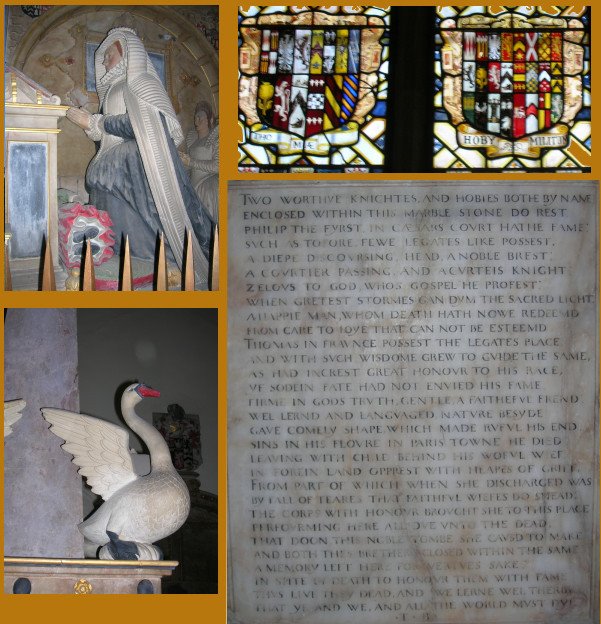
Yesterday, I visited the Church at Bisham Abbey near Marlow, to take a look at the Hoby monuments: Tudor humanism in stone. Elizabeth Cooke, along with her four sisters, was educated by her father Sir Anthony to the highest standards of the age. She married Sir Thomas Hoby, the translator of The Book of the Courtier. He died, as the tomb says, 'at Paris the 13 of May 1566 of the Age of 36 leaving his wife great with child in a strange country, who brought hym honourable home, built this chappell and laid him and his brother here in the tombe together'. Her English verses about him are heart-felt:
Firm in Gods Tryth, gentle and faitheful friend,
Wel lernd and languaged, Nature besyde
Gave comely shape which made ruful his end
Since in his floure in Paris towne he died.
And in her Latin verses, she says he was 'my soul's far dearer part, / Life of my life and solace of my heart ... How happy we then; our wishes, joys the same / one soul inspired our double frame / But ah, how short our pleasures here below'.
The DNB entry on her father describes her as 'formidable'. She became an habitual and angry litigant, while the churchwarden at Bisham repeated to me the local story that she caused the death of one of her children who had raised her ire by (literally) blotting his copy book. There's no record of a missing child, so one has to suspect that her reputation for learning and ill temper caused such posthumous local libels. In her own monument, her will having forsworn 'vain ostentation or pomp', she kneels in a coronet topping an almost Pharonic head-dress of pleated linen, with a full entourage of her children, both living and dead, her elder daughter kneeling before her in her robes as a Countess. A daughter-in-law had the marvellous enamelled glass windows created in 1609, they celebrate the lineage of the families, and were recently restored using a large grant of money from the Glaziers' Company, so precious are they. Margaret Hoby's own monument has the swans, the Hoby's used falcons (or otherwise the 'hobby' hawk) as their heraldic bird. Edward Hoby even named a bastard son he had 'Peregrine Hoby'.
But the main monument is that Elizabeth Hoby made for her husband and his older half brother. It is almost a surprise that the V&A hasn't long ago appropriated something so perfect. In full armour, the two men recline on rush mats, heads on their helms. Sir Thomas' armour is more decorative (if you click on the image to see it enlarged, you can pick up the 'hobby' motifs his suit features), but the modelling (in alabaster) of the faces and hands of both men is very sensitive. Placed together, their being represented at the age they died has obscured the 24 year gap between them, so they have become virtuous Renaissance friends, Protestant champions ('Zealous to God whos Gospel he profest, / When gretest stormes gan dym the sacred light', says Elizabeth's verses, refering to their Marian exile), Pyrocles and Musidorus: the type of male twinning in virtue Jonson praised in his Cary-Morison Ode. There's no sprezzatura here, no 'recklessness' or courtly nonchalance, but rather, a deep Protestant seriousness, and, not suppressed amid the solemnity, the love and bewildered grief of a woman who was clearly not easy to impress.

Monday, July 17, 2006

Early modern cryptozoology


Apart from the animals they knew well, much early modern zoology was suffused with folklore and traditional fantasies. I was reminded of this 'True and Wonderful' discourse of the Sussex dragon by the BBC's notice of the latest investigation of 'Ninki Nanka' in the Gambia - another of those sauropod- survival stories which hinges on tales told by people who knew someone, who knew someone, who definitely saw something one dark night (when he was a boy).


At least nobody is marching off up river in quest this time, the investigation seems to be more into the folklore of the story than conducted with any credulity regarding the creature's existence. See


http://news.bbc.co.uk/1/hi/world/africa/5180404.stm

The pamphlet about the Horsham beast of 1614 is not quite what it seems to be: I claim it as the first occurence of 'silly season' journalism in English. To elucidate, in my youth, when England was a more parochial country, in the high summer, serious news would run thin. Inveterate murderers would go to the seaside with surviving members of their family, bank managers were too busy out on the links to empty the branch safe and flee abroad, trials went into lengthy recess. There was no news, but news had to be found, and so we had 'silly season' stories. In these days of a global news reach, every day brings its bad news, and trivia to all tastes, then, the journalist made the silly season news.

If you read this pamphlet from the silly season of August 1614, you can sub-read the discussion between the hack ('A.R.') and his boss the publisher. There's nothing stirring. But a large snake has been seen on heathland near Horsham. A. R. is told to write it up, despite his protests that their last outrageous stretcher was exploded. The pamphlet shows some of his feelings. He starts off with a semi-apology, to the effect that some recent stories in print were perhaps a product of 'our forward credulity to but seeming true reports' or 'false copies translated from other languages'. But this one is true, he huffs, before signing off his introduction with an ambiguous protest, 'He that would send better news if he had it'.

A.R. then shows off for a few pages, with a gratuitous account of the matings of serpents, and of serpents in history: he is staking his claim to be a real writer and a learned man, far better than this subject allows him to be. Three or four pages of actually relevant material are sandwiched in the middle: it's a serpent ('some call it' a dragon - A.R. seems to mean, people like my get-penny boss here), about 9 feet long, which preys on a rabbit warren in Sussex. It is 'a quantity of thickness in the middest, and somewhat smaller at both ends' (so making it identifiable as a Monty Python). It might have feet, 'but the eye may be there deceived'. It apparently has lumps like footballs on its back, from which its dragon wings may one day grow. A. R. now fibs like the pro he is: it can project venom so far (with two human casualties and two dead dogs already) that no-one can really witness its horror properly and survive. A.R. opines that 'when it shall please God', the serpent will be destroyed, it is rather something to be afraid of in a metaphorical, not literal sense: it is 'to be feared as an eclipse or fearfull comet'.

And he is away again, happy to leave behind this doubtfully veracious subject, and onto the subject of 'serpentine sinnes that live amongst us'. The serpent is an allegory of the corruption of the legal profession, or of drunkards (as it leaves a nauseous mess in its wake). Finally A.R. 'applies' the serpent to 'the Serpentine sisterhood of Brotherly (sic), the diseased Strumpetrie of the Suburbs'. The serpent has a white band round its neck, while you get only 'a white tiffanie about the necke of one of those tugging Gally-slaves of damnation'. There has to be a significant connection there.

And having somehow covered ten pages, he takes his money and runs, while the printer gets a promising boy artist to do the unabashed woodcut that will really sell the pamphlet. It's so good that he puts it in twice.

Friday, July 14, 2006

Thomas Shipman requests a kiss


Thomas Shipman: 'The Kiss, To Mrs. C.'

Hold not your Lips so close; dispence

Treasures, Perfumes, and Life from thence.

Squeeze not those full-ripe Cherries; this

Becomes a Simper, not a Kiss.

There’s danger to lock up your Breath,

It Cousin-German is to Death.

None bags up wind, the Merchant swears,

Unless some wrinkled Laplanders.

What needs this Guard? It is small sence

Thus to hedge in a double Fence.

Clos’d Lips express but silent Blisses,

And at best are but dumb Kisses.

You are with Cupid little kind

To make him Dumb as well as Blind.

Such Smacks but shew a silent state;

Kisses should be articulate.

An open-mouted Kiss speaks sence,

It is the lover’s eloquence.

Let your speak out then! There’s no Bliss

To the Pronunciation of a Kiss.


~ a fairly standard 17th century lyric, but giving the impression of being personal and 'practical'. Some of Shipman's other poems have dedications after their titles to identifiable women ('Right choice at last, 1662' was his well-meant poem to his wife to be, though it does accidentally flaunt his track record with such as 'Mistress C', who perhaps had her own notions of osculatory decorum. Cavalier poetry featured lots of kiss poems, most graciously in the dialogue on a kiss Lawes set from Herrick. On the specific topic of what the 1930's began to call the 'French Kiss', this is a passage from Harington's translation of Orlando Furioso, with Rogero (Harington relishes his bawdy version of 'Ruggiero') getting it together with the sorceress Alcyna:

And look how close the Ivy doth embrace
The tree or branch about the which it grows,
So close the lovers couched in the place,
Each drawing in the breath the other blows:
But how great joys they found that little space,
We well may guess, but none for certain knows:
Their sport was such, so well they leere their couth,
That oft they had two tongues within one mouth.

(Book 7, canto 1, stanza 27).

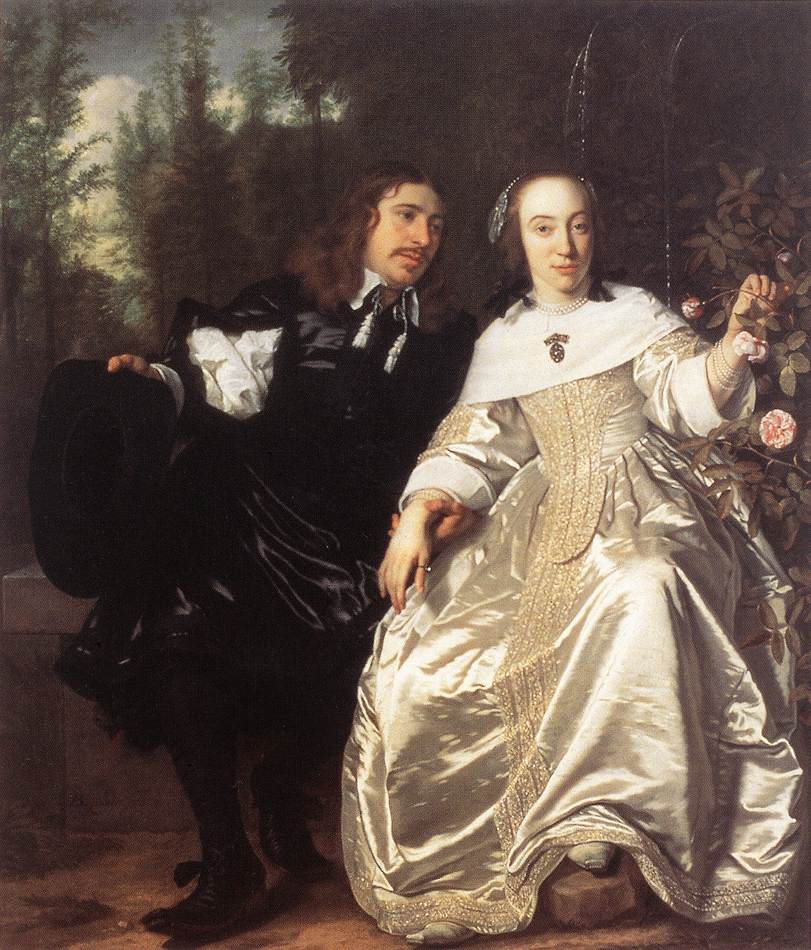
My image, from the Weg Gallery of Art, is Bartholomeus van der Helst, ' Abraham del Court and Maria de Keersegieter' of 1654: the gentleman courting, the lady in the role of a rose in bud, still attached to its native and thorny bush.

Sunday, July 09, 2006

Family Cycling, Burnham Beeches

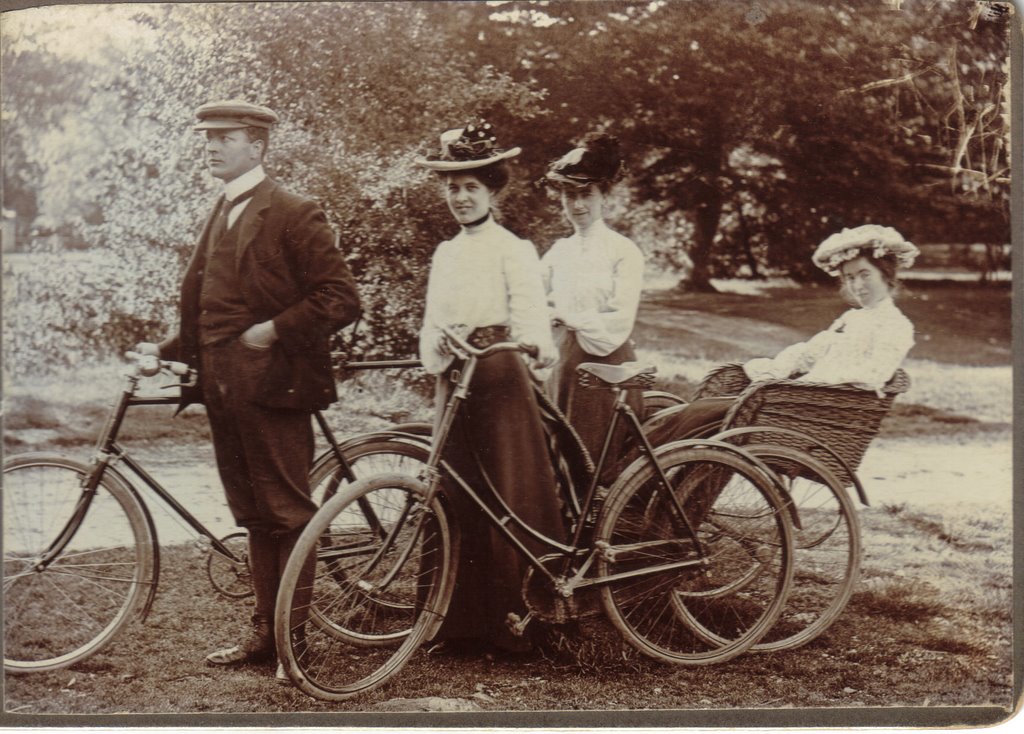
I bought this photographic print from one of my regular postcard dealers last weekend. There's no date or names, just the stamped 'Herb: Sharp and Sons, Burnham, Bucks' to locate the scene.
I surmise that they are a family group, the mother behind her children; it must be late Edwardian. I like the way that the three women look at the camera, while the young man adopts an 'I have got to here, next I will go to there' gaze, his stance resolute as an explorer's. He is towing his younger sister, a slight figure (perhaps she was considered 'delicate'), using a single speed bicycle with just a front rod brake. The tracks in Burnham Beeches roll up and down, and any kind of descent must have been potentially alarming as her weight started to push him along. His immaculate high collar makes no concession, but he must have to work hard on the flat, up any rise, and in using his fixed wheel to fight the rotation of the pedals on the down slopes.

Cycling in its days of high respectability; while the mixture of dark and white in their clothes, and the sun coming through the trees, makes them seem as if they could blur into an impressionist painting.

I must have a look for bicycles in such paintings.

http://www.cityoflondon.gov.uk/Corporation/living_environment/open_spaces/burnham.htm

Wednesday, July 05, 2006

An Oxford Don Curses his Cat


‘On lute strings cat-eaten’

Are these the strings that poets feign

Have clear’d the Ayre, and calm’d the main?

Charm’d wolves, and from the mountain crests

Made forests dance with all their beasts?

Could these neglected shreds you see

Inspire a Lute of Ivory

And make it speak? Oh! Think then what

Hath been committed by my cat,

Who, in the silence of this night

Hath gnawn these cords, and marr’d them quite; 10

Leaving such reliques as may be

For frets, not for my lute, but me.

Puss, I will curse thee: Mayst thou dwell

With some dry hermit in a cell

Where Rat ne’re peeped, where mouse ne’re fed

And flies go supperless to bed

Or with some close-pared Brother, where

Thou’lt fast each Sabbath in the year,

Or else, prophane, be hang’d on Monday

For butchering a mouse on Sunday 20

Or mays’t thou tumble from some tower

And miss to light upon all four

Taking a fall that may untie

Eight of nine lives, and let them fly.

Or may the midnight embers singe

Thy dainty coat, or Jane beswinge

Thy hide, when she shall take thee biting

Her cheese clouts, or her house beshiting.

What, was there ne’re a rat or mouse

Nor buttery ope? Nought in the house 30

But harmless lutestrings could suffice

Thy paunch, and draw thy glaring eyes?

Did not thy conscious stomach find

Nature prophaned, that kind with kind

Should stanch his hunger? Think on that

Thou cannibal, and Cyclops cat.

For know, thou wretch, that every string

Is a cat-gut, which art did spin

Into a thread; and now suppose

Dunstan, that snuff’d the divel’s nose 40

Should bid these strings revive, as once

He did the calf, from naked bones,

Or I, to plague thee for thy sin

Should draw a circle, and begin

To conjure, for I am, look to’t

An Oxford scholar, and can doo’t:

Then with three sets of mops and mows

Seven of odd words, and motley shows

A thousand tricks, that may be taken

From Faustus, Lamb, or Friar Bacon 50

I should begin to call my strings

(My catlings, and my minikins)

And they, recalled, straight should fall

To mew, to purr, to caterwaul

From Puss’s belly. Sure, as death

Puss should be an Engastranith;

Puss should be sent for to the King

For a strange bird, or some rare thing,

Puss should be sought to far and near

As she some Cunning Woman were, 60

Puss should be carried up and down

From shire to shire, from town to town

Like to the camel, lean as hag,

The elephant, or apish nag

For a strange sight, Puss should be sung

In lousy ballads, midst the throng

At markets, with as good a grace

As Agincourt, or Chevy Chase

The Troy-sprung Briton would forgo

His pedigree he chaunteth so 70

And sing that Merlin – long deceased

Returned is in a nine-liv’d beast.

Thus Puss, thou seest what might betide thee -

But I forbear to hurt or chide thee

For maybe Puss was melancholy

And so to make her blithe and jolly

Finding these strings, she’d have a fit

Of mirth, nay, Puss, if that were it

Thus I revenge me, that as thou

Hast played on them, I’ve played on you 80

And as thy touch was nothing fine

So I’ve but scratched these notes of mine.


Thomas Master or Masters (1603-43), an
Oxford scholar associated with the literary circle of William Cartwright.

British Museum, Harley Ms 6917.

~ This playful poem deploys the classical sub-genre of dirae, curses, which had to be wittily apt to the subject of the curse. Donne’s Elegy IV, ‘The Perfume’ is an example. His cat having eaten the lute strings, Masters finally arrives at the idea of using magic to reanimate the cut-gut strings, and so causing his “cannibal, and Cyclops cat” to turn “Engastranith” (56), which is in the OED in the form ‘Engastromith’, an early word for a ventriloquist. After his outburst, Masters charmingly forgives Puss for her misdemeanor.

The Puritan hanging his cat on a Monday (19ff) for having profaned the Sabbath by catching a mouse the day before was a common anti-puritan joke of the time. I can’t find the story about St. Dunstan (40ff) reviving a calf from bones. Prior to his conversion, the Saint was supposed to have been a practitioner of black magic. That he tweaked the devil’s nose with his metal-working pincers when the devil tried to tempt him in the form of a young woman is in the Golden Legend. The Devil Tavern in London was opposite St Dunstan's Church, and was properly 'The Devil and St Dunstan'; http://www.paintedchurch.org/bartduns.htm
gives fragment of a wall painting of this comic and popular legend.

There is a brief mention (61ff) of captive exotic animals then being shown around England: a scrawny camel and an elephant, while the ‘Apish nag’ may well be Banks’ performing horse. ‘Catlings’ and ‘minikins’ (52) are terms for the various thicknesses of lute strings.

(The image is a detail from Evaristo BASCHENIS, 'Still-life with Instruments', on the Web Gallery of Art)

Sunday, July 02, 2006

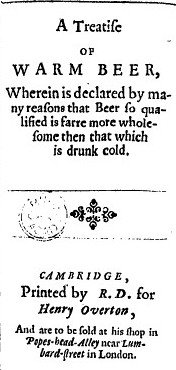
'Deoppilative virtue': A Treatise of Warm Beer


I am not at all a hot weather person. I cycled this morning, and returned so over-heated, thirsty and tired that I set about a large amount of Pepsi Max full of ice cubes, and spent the rest of the afternoon slumped in front of the Tour de France coverage (otherwise, 'Let's try and get excited about the also-rans of previous years') with a mild headache.

In committing this minor folly, I ignored the wisdom of the anonymous author of this unlikely treatise of 1641, which spends 143 pages recommending that you take your drink (taken as virtually synonymous with beer) warm rather than cold.

The medical grounds for doing this seem overwhelming to the author. One F.W., writing a preface, argues that you can see that cold beer hinders the digestion if you inspect what people who overdo it on the cold stuff throw up. The author himself energetically defends a series of major and minor propositions on warm beer preventing the stone, making women more fertile, slowing down the aging process (and many more benefits), and certainly being something we should partake of if we want to follow the ancients, who, in their wisdom, he proves by extensive quotation, took their drink hot.

The argument that swung it for me came on the penultimate page, where he notes "That it [hot drink] is used at this day among whole nations I will prove by Giovani Petro Massei the Jesuite, who in his 6. booke of histories writes that they of China do for the most part drink the strained liquor of a herb called Chia hot". I too felt restored after a cup of cha (in English from 1616, the OED indicates, with an advertisment in Mercurius Politicus, 30 Sept. 1658 throughly informed about "That excellent drink called by the Chineans Tcha, by other nations Tay alias Tee." I shall demand a deoppilative (ie., obstruction-clearing) warm beer in the pub later on this evening. At least I think so.

Thursday, June 29, 2006

In bed with Nicotiana


George Daniel, of Beswick (his dates were 1616–1657) vowed that he would never again take razor to his beard after the execution of Charles I. In this self-portrait, he is looking understandably surprised about the immensity of the consequence three years later: he is just 32, but has the beard of a patriarch, which he boldly complements with a balancingly vast furry hat. A friend confronted him with a mirror, and he wrote this poem about his new self:


How am I lost! though some are pleased to say
My mossy Chops estrange
All former Knowledge; and my Brother may,
At distance interchange
Discourse, as to a man he ne’re had known;
It cannot be, persuade
Your Selves; for when you made
Me take a Glass, I knew my Face my own.

The very Same I had three years agoe;
My Eye, my Lip, and nose,
Little, and great, as then; my high-slick't Brow,
Not bald, as you suppose;
For though I have made riddance of that Hair,
Which full enough did grow,
Cropped in a Zealous bow,
Above each Ear; these but small changes are.

For wer't my work, I need not far go seek
The Face I had last year;
The growing Fringe but swept from either Cheek,
And I as fresh appear,
As at nineteen; my Perruke is as neat
An Equipage as might
Become a wooer, light
In thoughts as in his Dress; but I forget;

Or rather I neglect this Trim of Art;
And have a Care so small
To what I am in any outward part,
I scarce know one of All;
'Tis not that Form I look at. Could I find
My inward Man, complete
In his Dimensions! let
Me glory Truth, the better part's behind.

It’s one of Daniel’s better performances. He likes to write about himself, though rather too often about himself as a poet, which he very self-consciously was: I don't know that he is ever really interesting on the topic. He admired George Herbert, but his own verse tends to be chopped-up prose with rhymes. He apparently lost many of his poems in a fire, and probably comforted himself with the assertion that those lost poems were his best ones.

My favourite Daniel piece, though, is his erotic poem about the pleasures of tobacco, which starts:

Come, my Nicotiana; we’ll renew
Our free delights, and Appetite pursue;
Wee fearless will Enjoy those real joys
Lovers would paint, in their fantastic toys…

Normally quite passionless in the relatively few amatory poems he does permit himself, which do conventional 'Platonic'/'Anti-Platonic' topics, in describing his passionate intercourse with the nymph Nicotiana, he really releases the sensualist. Suddenly, our bushy Yorkshire squire sounds like Carew at his fruitiest:

my free hand
No bashful blush shall ever Countermand,
But in a Thousand forms, thy Tresses part
And slide along, with uncontrollèd Art,
Thy dainty Body; not to fear a frown,
For soiling of thy new white Satin Gown;
My willing Lips shall part, to catch thy Breath,
Sweet, as the Honey-dew, which Hybla hath.
There will I hang; and all my veins inspire
With Ardent Wishes, taken from thy fire;
Hard on my Lips, thy wanton tongue shall press,
And by new Chimistrie in Wantonness,
Send the rich Quintessence of all I seek,
In Dalliance through that faire Alimbecke:
There will I suck, with Cunning Industrie,
Thy Spirits Extracted by Love's Alchimie.
When we 'are be-qualm'd, that long embraces has
Made dull Desire, and wee shall only pass
Faint breathings, I will summon a fresh Store
Of Vigour, far more Active, then before;
And with neat Titillations, new provoke
Decayed fire in thee, to the full Stock;
Invent new postures, & out-doe the old
Fictions, to make 'em Story; when with bold
Uncurbèd flames, we grapple; and not part,
But to renew our Action, and our Art.

I find it hard to think that Mrs. Elizabeth Daniel would not have approved: the oral and semi-tactile pleasures George describes all sound a bit unusual. I imagine that Charles I was a convenient pretext for the vast beard: Daniel clearly liked to be in a nimbus, of hair or smoke: the Creator, whose words issue from a bright cloud or burning bush.

Monday, June 26, 2006

Coming on strong, early modern style


I spent an almost spookily quiet Sunday (the England match was on TV) cycling in rural Hampshire.

After two visits to churches, one of which, on the redundant churches list, had cobwebs between the pews, and then traversing the site of the Battle of Cheriton Down (March, 1644) -

- http://www.appledowncentre.co.uk/battle.html gives a reasonable summary based on William Seymour's analysis - I decided that I was communing with the 17th century dead rather too keenly.

So here's a bit of 17th century life, as rendered by Thomas Deloney in Part 2 of The Gentle Craft (1639). Harry Nevell is trying (this is Chapter 9) to woo Mistress Farmer, a London widow just 2o years old:

Faire Mistris quoth Harry, I know it is the custome of women to make their denials unto their louers, & strictly to stand on nice points, because they will not be accounted easily won, or soone entreated: alack deere Dame consider nature did not adorne your face with such incomparable beauty, & framed every other part so full of excellency, to wound men with woe, but to worke their content.

Wherefore now in the Aprill of your yeares, & the sweet summer of your dayes, banish not the pleasures incident to bright beauty, but honour London streets with the faire fruite of your womb & make me blessed by being father to the issue of your delicate body; & though your beauty as the spring doth yet yearely grow, yet in the black winter of old age it will not be so, & we see by daily experience, that flowers not gathered in time rot & consume themselves: wherfore in my opinion you should doe the world intollerable wrong to live like a fruitlesse figtree.

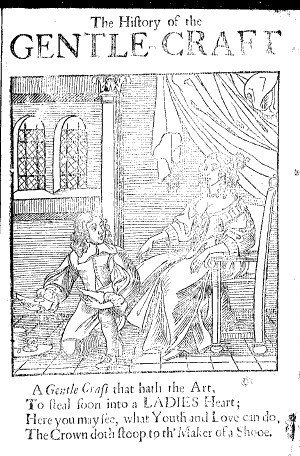
"Honour London streets with the fair fruit of your womb, and make me blessed by being father to the issue of your delicate body." Deloney is praised for the vividity of his dialogue, on which his fiction is highly dependent. He's fond of his shoemakers, who are always depicted as rather lucky fellows, who have a professional access to women's (lower) bodies. My illustration, from a 1678 edition of the first part of the book, captures those erotics. Earlier in the fiction, Long Meg of Westminster is involved in a piece of intense flirtation, and recites as she lifts her clothes (and is encouraged to lift them higher still):
Euery Carter may reach to the garter,
A Shoemaker he may reach to the knee,
But he that creepes higher shall aske leaue of me.

Harry's undeniably forthright pitch fails, for Mistress Farmer turns him down. But I do not think he is represented as foolish, rather that his carpe diem arguments (echoic of Venus and Adonis) are meant to sound eloquent, and his allusion to getting her pregnant - with its odd insinuation of a metropolitan version of patriotism, in which she first honours London, and secondly blesses him - was meant as well said. He rather goes off the rails after her refusal, largely because he is so winning in his ways with his later mistresses and their maids. Mistress Farmer accepts the offer of one of her shop's senior apprentices, after a series of trials of his patience, and his point blank advances on her. She tells him to join the army, he replies that: I had rather have my manhood tried in another place. Yfaith where quoth shee? by my troth said he, in your soft bed, which is far better then the hard field: why thou bold knave quoth she...

Till reading this part of The Gentle Craft, I don't think I'd noticed that it seems to have been customary for the mistress of a middle class house and premises to summon her servants using a whistle. There's an early allusion in the book, as two maids are fantasising about the pleasures of married life and being in charge of a household: 'she sets her siluer whistle to her mouth, and calles her maid to cleare the boord'. Mistress Farmer uses her whistle later in the book.

Tuesday, June 20, 2006

Surviving 105


On Sunday, as I was coming back from completing the 105 mile 'Circuit of the Cotswolds' Ride (I was rider 396) http://www.circuitofthecotswolds.org/2006/results.php
I called in at Brightwell Baldwin church in Oxfordshire to pay my respects to 105 year old Stephen Rumbold. If you heave aside a vast doormat in the Church porch, and dust a bit, there's his grave slab, with its splendidly confrontational quatrain:

"He liv'd one hundred and five
Sanguine and strong
An hundred to five
You do not live so long."

He lived from February 1582 to March 4th 1687: from before the Armada, almost to the Glorious Revolution, through the reigns of the later Elizabeth, James I, Charles I, the Commonwealth, Charles II, and on into the reign of James II.

There is apparently a Rumbold's Lane and a Rumbold's Copse locally. We are currently living through the last years of those exceptionally long-lived people who fought in World War One. These occasional centenarians really do seem to last into an eighth age of man, and were (and are) made much of, and rightly. Of course, early tombstones, with their regular 'hodie mihi, cras tibi' and 'such as I am, so will you be' mottoes did confront the reader uncompromisingly with mortality. But I have never seen was as cheerfully challenging as this, with old Stephen laying the odds just outside the church door. I do not know, but I'd guess that the gravestone which uses its inscription to remind the reader that he or she must die was a type which disappeared after World War One. Utterly unthinkable now, where prompting such thoughts has become bad taste. I like to think that the unknown verse-writer captured Stephen Rumbold's 'sanguine' character, maybe even one of his own jokes.

Brightwell Baldwin does well for inscriptions. Inside, now safe on the wall, is what might be the earliest recorded memorial brass in English: 1371, for John the Smith:
'Man com & se how schel alle ded li; wen yolk comes bad & bare
Noth have wen we away fare; All ye wermes yt ve for care;
Bot yt we do for god yr luf haue nothyng yare; hundyr
yis grave lys John ye Smith god yif his soule hewn grit.'

('Man come and see how shall all dead lie, when [youth? folk?] comes bad and bare
We have nothing when we go away, only the worms care for us.
Except what we [have done] for God's love, we have nothing ready [provided]; Under
this grave lies John the Smith God give his soul great heaven').

The idea here is that John Smith survived the Black Death, and bought up ownerless lands, became prosperous, and finally wanted a vernacular inscription - Latin had probably died in the parish with the priest. Blogger has put my blurry picture at the top of this post, my camera could not cope any better than that. As a final monument, in you lift the carpet in the aisle, there's one of the Cottesmore brasses, commemorating Chief Justice John Cottesmore, Amice his wife, and their eighteen children, five boys and thirteen girls.

History, human history accumulating in yet another 'accoutred frowsty barn'! (http://www.artofeurope.com/larkin/lar5.htm)

Saturday, June 17, 2006

Early Modern Nakedness


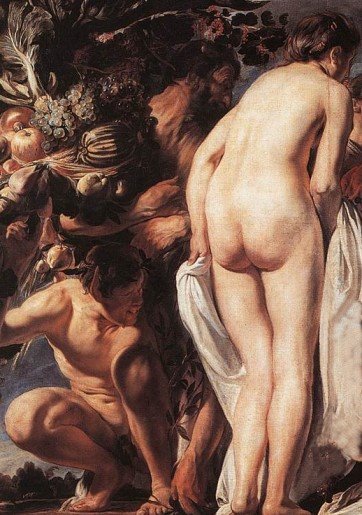
I’ve been unable to get on-line, my ISP having problems. I’ve anyway been reasonably busy with the effort to get degree results out after the lifting of the industrial action. My image is taken from a painting by Jordaens, because in this hot weather, I am offering you two passages concerning early modern nakedness.

“The same day sevennight he [Prince Henry] died, there fell out a very ridiculous accident. A very handsome young fellow, much about his age and not altogether unlike him, came stark naked to St. James’s whiles they were at supper, saying he was the Prince’s ghost come from heaven with a message to the King. But by no manner of examination or threatening could they get any more out of him, or who set him to work. Some say he is simple, others mad. He belongs to one of the Chancery. All the penance they gave him was two or three lashes, which he endured as it seemed without sense, and keeping him naked as he was all night and the next day in the Porter’s lodge, where thousands came to see him. The King sent to have him dismissed without more ado or enquiry.”

Diary of John Chamberlain, 19th November, 1612

“And in the mean while went the Lord Frederick secretly away, and came into the chamber, where she did unclothe her all naked saving a cloth before her members, and then came into the hall before the king and all his lords, and before all the other persons there being present, all naked, save that she had a kercher of silk before her members. And when she was come in, she went to the king and did him reverence. And when the king and his lords saw her, they marvelled greatly, wherefore that that fair woman came in naked before them… and therefore said the king to her, ‘Show you us what ye be and wherefore that ye come in here before us all naked in this manner.’ Then answered the woman to the king and said ‘I am the same person Lord Frederick that you spake on…’ ”

This second passage is from the narrative called Frederyke of Jennen (1518, 1520, 1560). It is the source narrative that you will find in the back of any decent edition of Cymbeline – the tale of the good wife whose partner has wagered on her virtue, who over-trustingly takes a trunk into her bedroom, from which a villain emerges to gather evidence that will win his bet that she can be proved lacking in virtue, the wife who then disguises as a man until the time comes for her dramatic way of revealing her true gender. A pity Shakespeare’s theatre prevented him from having Imogen cease to be ‘Fidele’ in this way (it would have done something for the popularity of the play). The theatrical conventions of the self-regendering moment are interesting – Luce in Thomas Heywood’s The Wise Woman of Hogsden stops being Jack the lad with this concise action and question to the bewildered man she is claiming as her husband: ‘She scatters her hair. What say you now?’

The first passage is an incident at the Jacobean court, rather well handled by King James, considering the offence he could have taken at this impersonation of his dead son. I suppose that at an early modern court, you had to do something to fix royal attention on you, and get them to listen to your petition. I like the way word gets out, and thousands go to take a look at the offender, though that he felt punished by this is perhaps open to doubt.

Sunday, June 11, 2006

A Recollection of Dame Helen


Posting on the number of the beast reminded me of Dame Helen Gardner - not that the late Merton Professor of English was in any way satanic herself: far from it, in fact. I knew her via an early form of staff-student committee in the Oxford English faculty, which she invited me to join, probably assessing me shrewdly enough as suitably ordinary and from nowhere special (and so credible to the role), but (when it came to any dispute about the degree) deeply compliant. Stories about her were rife in the student body, and we massed in her otherwise not particularly remarkable lectures, hoping to hear one of her fabled candid asides.
She once quenched a potential postgraduate pitching a research project on a Renaissance numerologist called (apparently) Pietro Bongo with the regal and disdainful query: 'And who is Bongo?' (tonally very much in the line of the earlier Oxford joke, 'What I don't know ain't knowledge'). Another Unlucky Jim in a similar position unluckily ad libbed at some point about 'God-botherers', to be told acidly: 'I consider myself something of a God-botherer'.

In 1972 this devout and learned lady edited the New Oxford Book of English Verse, all 884 poems of it, and so had to choose a poem to be number 666. Somehow she slipped into place, without apparent disruption of the chronological run of the book, this sonnet, Lucifer in Starlight, by George Meredith:

ON a starred night Prince Lucifer uprose.

Tired of his dark dominion swung the fiend

Above the rolling ball in cloud part screened,

Where sinners hugged their spectre of repose.

Poor prey to his hot fit of pride were those.

And now upon his western wing he leaned,

Now his huge bulk o'er Afric's sands careened,

Now the black planet shadowed Arctic snows.

Soaring through wider zones that pricked his scars

With memory of the old revolt from Awe,

He reached a middle height, and at the stars,

Which are the brain of heaven, he looked, and sank.

Around the ancient track marched, rank on rank,

The army of unalterable law.


And so, having put the devil in his place, she passed serenely on - if you wanted to carp about her victory, well, Meredith was born in February 1828, and Dante Gabriel Rossetti (the immediately prior poet in the anthology) not until the May of that year, and so technically he ought to appear in the book after Meredith. So she did cheat a bit. I doubt that anyone would have said as much to her when she was alive.


Thursday, June 08, 2006

The Wrong Number of the Beast


The world seems to have survived 6.6.06, despite those ominous words, ‘Here is wisdom. Let him that hath understanding count the number of the beast: for it is the number of a man; and his number is six hundred three-score and six’: Revelation, 13; 18).

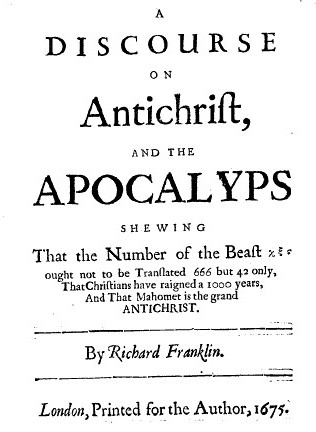
With the abrupt ending of the marking boycott, life is full of the business of moderating numbers, so here’s just a brief post based on Richard Franklin’s argument (from 1675) that the number of the beast had always been misunderstood, and should be construed as 42.


Yes, 42, one of the favourite numbers on the internet, with a whole website devoted to sightings of it at http://www.digitalthoughtsw.com/DTS/42/

That site is, of course, created in homage to Douglas Adams’ Hitchhiker’s Guide to the Galaxy, where the computer Deep Thought calculates ‘the Ultimate Answer to Life, the Universe, and Everything’. After seven and a half million years of computation, '42' is the answer Deep Thought comes up with. To the delight of Adams’ fans, 42 was subsequently strongly backed (at least for a spell) as the figure for the ‘Hubble Constant’ (which determines whether the universe expands, or is static, and so whether it will end entropically, or in a ‘Big Crunch’) For which see http://en.wikipedia.org/wiki/Hubble_constant

Richard Franklin based his argument about a different kind of end-of-the-world on reading the Greek 'chi xi sigma' not as denoting numbers, but as letters that are then to be decoded as numbers (on a simple scheme with alpha as one, and then onwards through the 24 letter alphabet of Greek to omega, so giving him signs in these three cases equivalent to 22, 14, and 6: the product of those numbers being 42). This he can then prove, at least to his own satisfaction, to be the number of Roman emperors prior to Constantine, the first Christian emperor. He goes on to argue that the Antichrist cannot be identified with the Pope, but has (in the 17th century way of these things) to be Mohammed.

What really is interesting here is that sense (again) that the press in the mid 17th century was very much their internet, their way of posting their crazy ideas. Once censorship had lapsed post-1642, and after the burst of urgent controversy in the mid 17thcentury, it looks as though lots of printing presses were chasing work. It clearly didn’t cost very much to publish a pamphlet, so all sorts of ill-advised stuff appeared, 'Printed for the Author'. Franklin apparently projected a life of Cranmer, but this little work seems to be all that's left from him. Among the class of writings that rave about Gog and Magog, it is relatively lucid, but 42 just didn't catch on - after all, compared to 666, it is such a banal number. How could anyone get excited about 42? Oh, yes, I've already answered the question. I think he must be right.