Saturday, September 30, 2006

Comenius in English


I have been clearing from my son’s room the books he has now outgrown – down to the Amnesty International bookshop with them all. Children (I was reminded while doing this) are still given encyclopedias when young, books that offer to tell them everything about the world before them.

Thinking about such books led me to Jan Amos Komensky, ‘Comenius’, the Czech pansophist and ‘Father of Education’. Between 1650 and 1654, working in Transylvania, he produced his enormously successful Orbus Sensualium Pictus, which appeared in English editions in 1659, 1664, 1685, 1689 and 1700 as: Joh. Amos Commenius's Visible world. Or, a picture and nomenclature of all the chief things that are in the world; and of mens employments therein. A work newly written by the author in Latine, and High-Dutch (being one of his last essays, and the most suitable to childrens capacities of any that he hath hitherto made) and translated into English, by Charles Hoole, M.A. for the use of young Latine scholars.

It is the first illustrated encyclopedia for children, simultaneously giving a huge push to their Latin vocabulary. It sets off with a bizarre alphabet, in which every letter is alleged to be pronounced by a suitable animal. Thus fired to surpass the mere animal kingdom, the child is led into the word clusters and basic concepts associated with God, The World, Heaven, Fire, Air, Water, and onwards to the things in the earth: its fruits, metals, gems, flowers, animals, and then into the human world, with its life stages, trades, activities, amusements. It is strictly Eurocentric, with one brisk account of Mohammadism. The ‘visible world’ notion does not stop the book from discussing moral concepts.

And every page is illustrated, with a woodcut, many of them highly engaging. I imagine that the text was tinkered with in transmission. Comenius advocated such advanced notions as universal education (both sexes equally, and for all abilities), minimal rote learning, and regarded corporal punishment in schools as inevitably counter-productive. When the Orbuscomes to describing all aspects of a school, it is in a section which must have been adapted to local and normal conditions during the book’s progression across Europe: “Some talk together, and behave themselves wantonly, and carelessly; these are chastised with a Ferrula and a Rod’ (concludes section XCVII).

This link below is to an essay on Comenius which I recommend: it is rather moving to hear of such amazingly advanced notions being put forward by a man whose life was one of harrowing sequential exile and loss. No wonder the Czechs are proud of him:

http://www.ibe.unesco.org/publications/ThinkersPdf/comeniuse.PDF

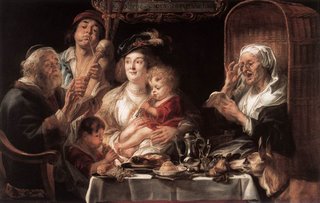
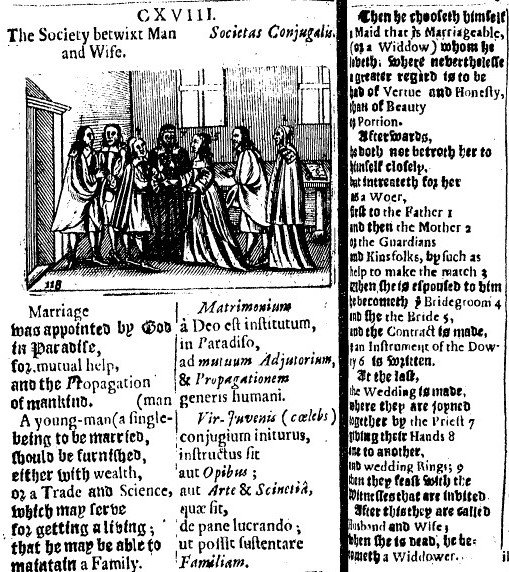
I have put together in a single image the intriguing way the woodcut artist chose to depict the soul; the seven ages of man (and woman); the picture of domestic pets (“The Dormouse and other greater Mice, as the Weesel, The Martin and the Ferret, trouble the house” explains the text); and a depiction of a domestic amenity I did not know early modern Europe had, the ‘Stove’ room, designed to be warm and cosy. It is depicted adjacent to a bedroom, complete with chamber pot. I doubt many 17th century children needed to be told its function (“A chamber pot is for making water in”), but the Latin word ‘Matula’ can’t have cropped up that often.

Alongside, I’ve put most of the double page about marriage, as a specimen, and because it appealed to me (“After this they are called Husband and Wife; when she is dead, he becometh a widower”).

Supposing Comenius’s project had triumphed… He was a Bishop in the Moravian Brethren, a Christian Church that did NOT teach that only its adherents were the saved. Suppose Comenius had managed to teach such tolerance, alongside the vital importance of a universal education based always on practice and encouragement. Suppose his vision of Europe as a Utopia had somehow taken hold...


Wednesday, September 27, 2006

Two lost daughters, Sonning Church


"Here lyeth Elizabeth Chute, Daughter of George Chute Knight and Dame Anne his wife, whoe lived 3 yeares and 6 monthes and dyed the 18th of May Anno 1627.

What Beauty wold have lovely stild
What manners sweet what nature mild
What wonder perfect All were fild
Upon record, in this one child
And, till the coming of the Soule
To call the flesh, wee keep ye Roule."

This miniature version, amateur and heartfelt, of Donne's Anniversaries on Elizabeth Drury, is complemented by the memorial brass, showing a very adult-looking Elizabeth Chute.

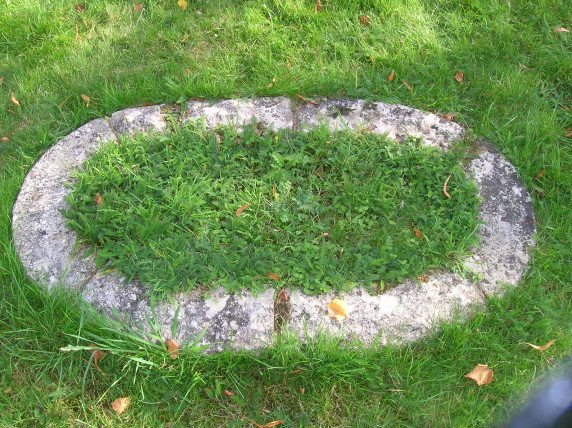
Outside, another set of parents, in 1940, somehow mastered their grief to create a very moving grave for their daughter. The inscription, on the top face of the end stones, is almost effaced, as the stones were laid flat. It is worth recording:

'With sweet memories of our darling daughter Emerald Green, [ ]- 1940',
and at the foot of the grave, the text (a version of Matthew 10, 16), 'And he took little children into his arms and blessed them'.

The diminutive grave employs a 17th century 'conceit': for their brilliantly named daughter, a visual pun, in which the stones define a gem in the grass. The parents must have been remarkable people; it is not often that the product of mourning is a work of art.

Saturday, September 23, 2006

Miraculous swarms of flies, 1675


I missed my favourite, large-size teacup this morning, and eventually found it upside down on my son's desk, imprisoning a wretched crane fly that had been blundering around in his room in the night.

They are currently swarming, not to any Biblical extent, but enough to keep popping up in the news: http://www.guardian.co.uk/uk_news/story/0,,1876307,00.html

This took my thoughts to this, well, 'flyer' would be the appropriate term, of 1675, when London was hit by a genuinely prodigious swarm of insects: 'they seemed to be descending like Showers of Rain, to the great Wonder and Admiration of several Spectators, who for some considerable time stood to behold them as a great Prodigy'.

The main body seems to have drifted around London: 'this wonderful sight continued up and down from one Place to another till Night' ... 'These Insects fell down in such great Numbers in Southwark that in the Borough the Market people swept them off their Fruits, Meat, and other Commodities, by whole handfuls ... in the Gardens, at Sir John Oldcastle's near Islington, and the Long-Field, near Blooms-bury, the Flies fell down there in such swarms, that they swept them up by Pecks'.

The sheet unfortunately gives very little entomological detail: the flies, or their wings, were white, they made 'a great sort of Buzzing', the insects' wings were 'very long'. Perhaps the mention of the 'strange appearance' of the flies might refer to both their individual unfamiliarity as well as their numbers: 'the General Consternation they have put the Town in, has made the Prodigy the only Talk and Discourse of all People both in City, Town and Country.'

It doesn't sound much like a stray swarm of locusts, swept by some freak of the weather across Europe. The news sheet has no room for speculation, and is almost surprisingly un-apocalyptic, no obvious Biblical identification is made. Locusts would surely have prompted some remark about the size of the insect; these suggested rain and snow, and were swept up in handfuls. A 'Prodigy', but, by this date, nothing to suggest that heaven is sending a message, it is just one of those odd things that happen. These days, we would be in a pother about it as a sign of global warming, 'apocalypse-nouveau'.

Thursday, September 21, 2006

Possess yourself with an amorous humour, Phillis!


There's lots of effort being made at approaching the erotics of early modern culture, with literary texts being picked over, and the small corpus of Elizabethan pornography given much attention. I am as amused as anyone by Nashe's 'Choice of Valentines' - who could fail to respond to a poem which starts by invoking, pricelessly, 'the merry month of February'?

But the culture was one that generally hid it all well. If we don't look for it in music, we are not looking in the right place. This is John Ward, in 1613, a madrigal setting of a quatrain. 'Phillis' is always a dubious character, and 'frankly' is a code word for 'the opposite of chaste':

Phyllis the bright, when frankly she desired
Thyrsis her sweet heart to have expired,
'Sweet', thus fell she a-crying,
'Die for I am a-dying.'

http://personal.rhul.ac.uk/uhle/001/Phillisthebright.mp3


'That strain again! It had a dying fall!' ~ Phillis asks Thyrsis to join her in her approaching climax, and Ward's madrigal shudders sweetly at its close. I have posted, outside 'Blogger', the Consort of Musicke's 1981 performance, for purposes of comment etc (I cannot see that this music is still available anyway).

Here goes Phillis again, surrendering to pleasure after a bit of persuasion:

He:
Phillis, I fain would die now,
I fain would die now.
She:
O to die what should move thee?
He:
For that you do not love me.
She:
I love thee, but plain to make it,
Ask what thou wilt and take it.
He:
O sweet, then this I crave thee,
Since you to love will have me,
Give me in my tormenting,
One kiss for my contenting.
She:
This unawares doth daunt me,
Else what thou wilt I grant thee.
He:
Ah, Phillis, well I see then,
My death thy joy will be then.
She:
O, no, no, no, I request thee
To tarry but some fitter time and leisure.
He:
Alas, death will arrest me,
You know, before I shall possess this treasure.
She:
No, no, no, dear
He:
No, no, no, no, dear
Both:
No, no, no, no, dear, do not languish,
Temper this sadness,
For time and love with gladness,
Once ere long will provide for this our anguish.

Once again, a link to where I have posted a 1983 performance by the Consort of Musicke, and once again, for purposes of comment, and music that does not seem to be available commercially any more:

http://personal.rhul.ac.uk/UHLE/001/PhyllisIfain.mp3


What Thomas Morley audaciously did here was score for three women to sing 'She' (aka 'Phyllis'), four men as unnamed 'He'. Amateur performance of this song must have been as intimate as a session of 'dauncing signifying matrimony', especially in that responsive interlacing of the voices on 'no, no, no, no, dear'.

Morley himself (well he would, wouldn't he?) represents being able to take your part more or less impromptu as a necessary social grace. Morley's A plaine and easie introduction to practicall musicke, 1597, is dialogue form, and it opens with one of the dialogists scurrying off to put right his own ignorance after experiencing social disgrace:
"But supper being ended, and Musick books, according to the custom, being brought to the table, the mistress of the house presented me with a part, earnestly requesting me to sing. But when after many excuses, I protested unfainedly that I could not, every one began to wonder. Yea, some whispered to others, demanding how I was brought up: so that upon shame of mine ignorance I go now to seek out mine old friend master Gnorimus, to make myself his scholar..."

When you consider just how amorous this otherwise sexually restrained culture seemed prepared to allow its private music to be, you can see the social advantages in being able to perform. Yet, speaking officially, Morley toes the moral line. This is what he says about naughty music (like some madrigals): first he lays the blame on the poets who have written the words, but then insists that once it comes to the musical setting, you have to write as expressively as possible:

"This kind of musicke were not so much disallowable if the Poets who compose the ditties would abstain from some obscenities, which all honest ears abhor ... If therefore you will compose in this kind you must possess your self with an amorous humor (for in no composition shall you prove admirable except you put on, and possess your self wholly with that vein wherein you compose) so that you must in your musicke be wavering like the wind, sometime wanton, sometime drooping, sometime grave and staid, otherwhile effeminate..."

And so he is free to score something as erotically descriptive as he can make it be.
Monday, September 18, 2006

Fruyte and ofspring, 1567


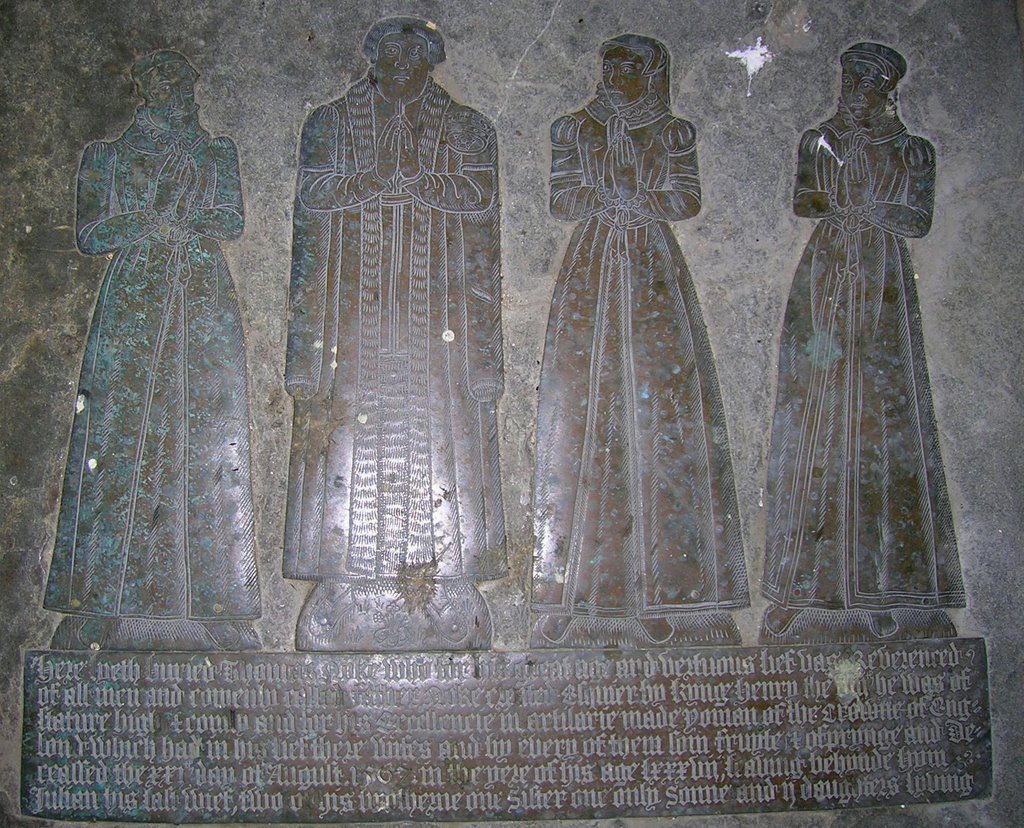
I went out cycling late on Friday afternoon, and was across to Shottesbrooke, a few miles east of Reading, in time to pick up the key to Shottesbrooke Church from the Landmark Trust office on the estate. It is a notable example of a 'Decorated' style Church, still consecrated, but with most of the pews removed. Among the brasses this left completely clear of the usual lengths of carpet, was this one, to Thomas Noke.

"Here lyeth buried Thomas Noke who for his great age and vertuous lief was reverenced of all men and com(m)enly called Father Noke created Esquier by King Henry VIII he was of stature high + comely and for his Excellencie in artilarie made y(e)omen of the crowne of England which had in his lief there (three) wifes and by every of them com fruyte + of(f)spring and deceased the 21st day of August 1567 in the year of his age 88, leaving behynde hym Julian his last wief, two of his brotherne one sister one only sonne and ii daughters living"

I suppose that the surviving wife, Julian, had herself depicted alone on her late husband's right, her two predecessors on his left. Nothing distinguishes their ages or costumes. Thomas Noke himself has a crown with a Tudor rose on his left shoulder, as a mark of his Royal service, and is well dressed, with fur linings to his robes and ornamental sleeves. There's a stylised flower between his feet. Facing us full-frontally, with his wives orientated to three-quarter face around him, he is made central to the otherwise inevitably assymetrical design.

The hieratic image, static and pious, makes the hazardous career Nokes somehow survived come as a surprise. I suppose that the memorial means 'artilarie' as in guns (the 'great artillery', properly), and so we have to imagine the old blue powder burns on his praying hands, and the ringing in his ears he'd probably have lived with for many years.

It is a dignified memorial, though perhaps faintly conveying (by that redundancy, in an otherwise breathlessly terse summary, about "fruyte and ofspring") the last Mistress Nokes' appreciation of her late husband as a potent man, whose various talents satisfied a King and three wives.

http://www.landmarktrust.org.uk/
http://www.hac.uk.com/history_hac.htm

Friday, September 15, 2006

Contaminations


I have more or less given up on the National Trust: a visit to one of their historical properties feels to me increasingly like a visit to a Departmental store. Everything is tasteful, quite beautifully presented, and an attentive staff will keep you from straying, and tell you everything you want to know. So I'm increasingly getting my jolts of less mediated history from local churches. You may not be able to get in, there's often no way of knowing what you will see there, and you never quite know whether to believe what the (quite frequently admirably learned) church guide says.

The font above is in Bramley Church: Norman, in that Purbeck marble that is full of fossils of the snail Viviparus. The wooden lid is very old, and seems to be a rare survival of a 12th century edict that fonts, with their contents of Holy Water, should be locked. Here, the hasp for the padlock survives, to retro-fit this, the Norman font was crudely hacked down to shape.

This was to prevent the theft of Holy Water. Obviously, the Holy Water was invested with a lot of mana. Prior to baptism, the child might go to hell, after it, the child could be among the blessed. So one can readily imagine that people would think that something that can deliver you from eternal death might be quite curative: 'I'll get some and pour it on my gammy leg...'

Magical medicine is one step to what could be construed as witchcraft. The church guide at Bramley alleges that the 12th century edict was to prevent witches stealing Holy Water to use in their spells. In terms of chronology, this looks to me like a later development, when a slippage from semi-religious healing to deliberate desecration could be imagined. Even so, the Medieval mind was determined to keep Holy Water where it should be.

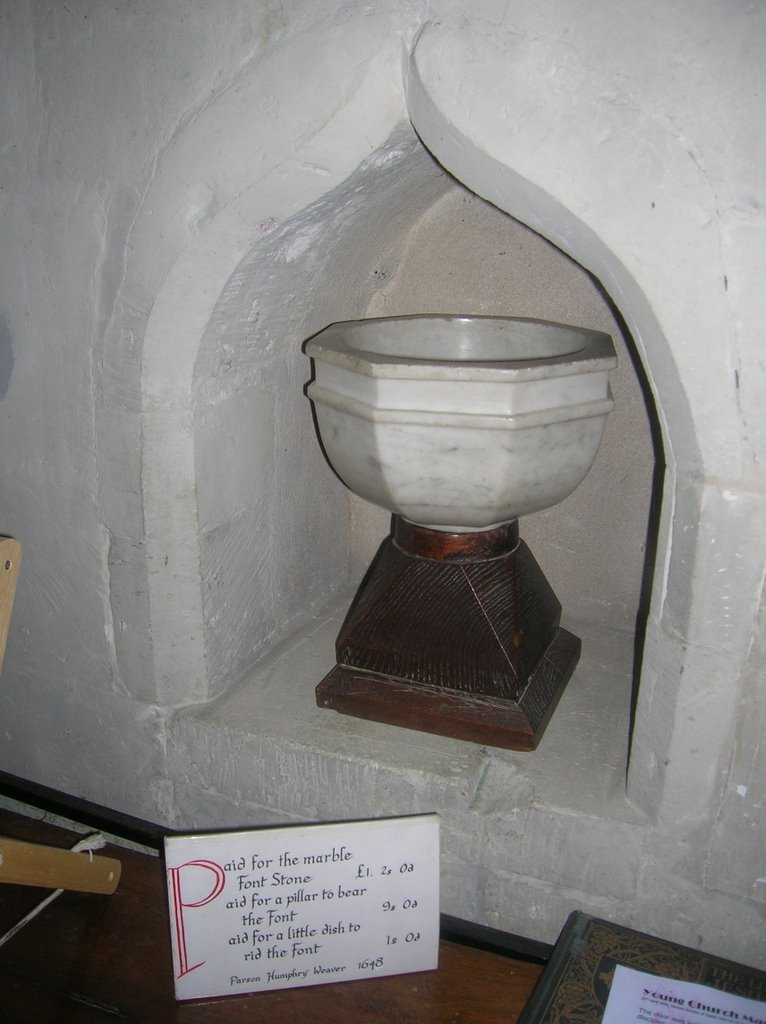
The other, chalice-like object is at Crondall church. Again, something that I'd never heard of nor seen before: it is 1648, and the pendulum has swung to the other extreme. The object does not express fear that the Holy Water in the font might be contaminated, but rather fear of contamination by that Holy Water: this is a font to fit inside the font, a new Puritan font untainted by any residues left by Catholic ceremony: who knows, there might be specks of chrism blessed by a Catholic Bishop floating around in there!

The wikipedia entry on baptism looks good (and if you can find a citation on a baptism using antifreeze being accepted as valid, the author would clearly be pleased to have it)

http://en.wikipedia.org/wiki/Baptism

As usual, the 1912 Catholic Encyclopaedia has the authoritative word on the minutiae on what is vaid and what is not: beer will just not do, it seems.

http://www.newadvent.org/cathen/02258b.htm

Saturday, September 09, 2006

To his Coy Wife...?


I have been off-line, waiting fairly patiently for BT's server to go back up, unaware that Lupin the rabbit had wandered in out of the garden, found the door she always wants to get through open, and had abstractedly bitten through the cable running from the wall socket to the wireless router.

While Lupin was disconnecting, I was unearthing the career of Thomas Jordan. His name pops up when the first woman actress, in the 1660 Othello, gets mentioned, as he wrote a genial Prologue and Epilogue to the production, which asks the audience to agree that she was far more authentically female than anything they have been used to seeing, but firmly points out that just because she has appeared on stage, it does not mean that they can have her (just what kind of women on-stage shows had these 17th century gentlemen been frequenting?). It's all rather graceful of Jordan, for he too had played female roles during his stage career.

Jordan does seem to have been everything an actor ought to be. These days, every shouty old hack seems to become a knight, but back in the days of burial at the crossroads (and quite right too), Jordan was a grade one scamp. I've read his poems, which are amateur, and very enthusiastic about women and sex. His various lady friends get their dedications, but would have found themselves (perhaps disconcertingly) not alone in being honoured by their poet - there's quite a room-full, including an Avisa Booth, and Susannah Blunt, who would be his wife. I surmise that Jordan was both pretty (playing all those girls), and a convincing performer. Thomas Randolph, in his 'Ad Lesbiam, et histrionem' makes a spicy allegation about why 'Lesbia' pays for her actor toy-boy's gambling:

you'd know the reason why
Lesbia does this, guesse you as well as I;
Then this I can no better reason tell,
'Tis 'cause he playes the womans part so well.

A performer like Jordan could deliver a best-of-both-worlds experience, it seems. Scrupulous behaviour does not appear in Jordan's history of publication. He pulled every trick: blank spaces in dedications, old volumes reprinted entire with new titles ... and how can the author of such highly sexed poetry claim this?

You wanton Lads, that spend your winged time,
And chant your eares, in reading lustfull rime,
Who like transform'd Acteon range about,
And beate the woods to finde Diana out,
I'st this you'ld have? then hence: here's no content
For you, my Muse ne're knew what Venus meant...

This is the first authorial poem in his Divine Raptures of 1646 (the same year that he had his Poeticall varieties of 1637 reprinted with the new title Loves Dialect). Well, it was easy enough for him to make that claim, for the whole of Divine Raptures is a plagiary of the obscure James Day's sole publication, A New Spring of Divine Poetry (also 1637). There's chutzpah for you! (Someone Else's Divine Raptures just wouldn't have sold, would it?).

Anyway, this appealingly lairy boy had the excruciating lack of taste to publish the poem below. It is, essentially, 'To his coy wife'. The scenario he imagines with such undisguised salaciousness may be imaginary, but the impression from the rest of the volume is that Jordan, barely past 20 when he married, had form with the ladies. I am pretty much convinced that Jordan has Donne's Elegy XIX in his mind as he perpetrates this set of rhymes, and this reminds me of Germaine Greer's unforgettable and somehow convincing argument that Donne's Elegy XIX should be read as a matrimonial poem (in Michael Hattaway's Blackwell Companion to English Renaissance Literature and Culture, 2001).

But enough chat, here it is, 'To Leda his Coy Bride, on the Bridal Night'

Why art thou coy (my Leda) ar’t not mine?
Hath not the holy Hymeneal twine
Power to contract our Natures? must I be
Still interpos’d with needless Modesty?
What though my former passions made me vow
You were an Angel; be a Mortal now.
The bride-maids all are vanish’d, and the crew
Of Virgin Ladies that did wait on you,
Have left us to our selves; as loath to be
Injurious to our loves wish’d privacie.
Come then undress; why blush you, prithee smile;
Faith I’le disrobe ye, nay I will not spoil
Your Necklace, or your Gorget; Here’s a Pin
Pricks you (faire Leda) twere a cruel sin
Not to remove it; Oh how many gates
Are to Elizium? (yet the sweetest Straits
That e’re made voyage happy) here’s a Lace
Me thinks should stifle you; it doth embrace
Your body too severely, take a knife,
Tis tedious to undo it; By my life,
It shall be cut. Let your Carnation gown
Be pull’d off (too) and next let me pull down
This Rosy Petticoat; What is this cloud
That keeps the day light from us, and’s allow’d
More privilege then I? (Though it be white)
Tis not the white I aim at (by this light)
It shall go off (too) No? then let’t alone,
Come, let’s to bed, why look you so? Here’s none
Sees you, but I; be quick or (by this hand)
I’le lay you down my self; you make me stand
Too long I’th cold; Why doe you lie so far?
I’le follow you, this distance shall not bar
Your body from me; Oh, tis well, and now
I’le let thy Virgin innocence know how
Kings propagate young Princes, marriage beds
Never destroy, but erect maiden-heads:
Faire Virgins, fairly wedded, but repair
Declining beauty in a prosperous heir.
Come then, let’s kiss, let us embrace each other,
Till we have found a babe, faire (like the mother.)
Such face, breasts, waste, soft belly, such a---why
Doe you thrust back my hand so scornfully?
You’le make me strive (I think) Leda, you know,
I have a warrant for what ere I doe,
And can commit no trespass; therefore come
Make me believe theirs no Elizium
Sweeter then these embraces---Now ye are kind,
(My gentle Leda) since you have resign’d,
I’le leave my talking (too) lovers grow mutes
When Amorous Ladies grant such pretty sutes.

I think that I may have, at last, found something to rescue Donne's poem from its critical obloquy ('You found that offensive?! Let me show you offensive...'). But maybe Jordan's poem is just so funny and recognisable - that male impatience with female garments so well captured in this very 'hands-on' account - that the pasha-like dictating in the Donne poem ('off with' this and that) just looks worse.

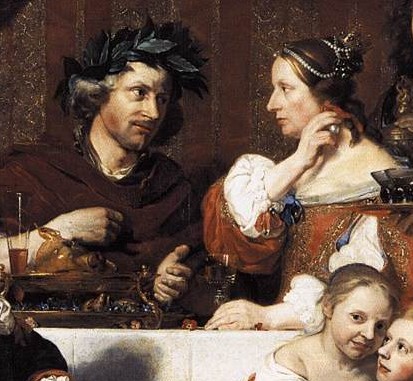
The picture is a detail from a painting by Jan de Bray, who seems, oddly, to have painted his Mum and Dad as Antony and Cleopatra. We won't go into that now, I just like the old-fashioned look she gives her partner as he plays the voluptuary.

Sunday, September 03, 2006

Actually, I'll gather the roses later on, thanks.

I have to write a first year lecture on 'To His Coy Mistress', and this made me start thinking about 'carpe diem' and 'carpere flores' poems. This (of course) is the quintessential version of the theme:

Robert Herrick, ‘To the Virgins, to make much of Time.

Gather ye Rose-buds while ye may,
Old Time is still a flying:
And this same flower that smiles to day,
To morrow will be dying.

The glorious Lamp of Heaven, the Sun,
The higher he's a getting;
The sooner will his Race be run,
And nearer he's to Setting.

That Age is best, which is the first,
When Youth and Blood are warmer;
But being spent, the worse, and worst
Times, still succeed the former.

My doctoral dissertation was about misogamistic sentiment in the literature of early modern England - all those versions of Beatrice and Benedick, expressing their morbid aversion from marriage. This was fun (and therapeutic) to write, and from that accumulated expertise, I post this (I think little known) answer poem to Herrick's classic lyric:

'The contented Batchelor'

Rose-buds that's gather'd in the Spring,
Can't be preserv'd from dying,
And though you'enjoy the wisht for thing,
The pleasure will be flying;

The glorious Lamp that mounteth high,
And to his Noon arriving,
Must not stay there continually,
But downwards must be driving.

The last is best, for though that time
With Age and Sickness seise us;
Yet on our Crutches do we climbe
Until a light shall ease us:

Then though I may, yet will I not
Possess me of't, but tarry;
He lives the best that hath forgot,
What means the word ‘Go Marry’.

It appeared in John Gamble's Ayres and dialogues (1659), and was obviously intended to be sung to the same simple strophic setting that had served for Herrick's poem. Songs and answer songs were popular at the time, though this is male voice answering male voice. Gamble's books of music are full throughout with 'seize the day' sentiments, but his circumambient culture readily supplied corresponding 'I don't want to pluck the roses' sentiments to his unknown lyricist. The basic Epicurean sentiment gets countered by a re-emerging Christian consolatio.

The painting - thanks again to the Web Gallery of Art - is by Bernardo Strozzi, from about 1615. She's meant to be an example of growing old disgracefully, but can be imagined - if you focus on the rose which she still holds - as a Beatrice who held on to her first principles. 'Contented spinsters' are inevitably a little harder to document. For all the feathers, mirror, and suggestions of (horror!) cosmetics, the picture isn't totally fierce: at least the lady is being dressed by young women rather than demons. The kind of scene you can get ground floor in any branch of John Lewis, in fact. Go it, girl.

Wednesday, August 30, 2006

Semper Dowland, semper ludens


1st voice
Humour, say, what makest thou here

In the presence of a queen?

2nd voice Princes hold conceit most dear,

All conceit in humour seen.

1st voice Thou art a heavy, leaden mood –

2nd voice Humour is Invention’s food.

Both But never Humour yet was true,

But that which only pleaseth you.

1st voice O, I am as heavy as lead,

Say then who is Humour now?

2nd voice I am now inclined to mirth,

Humour I as well as thou.

1st voice Why then 'tis I am drowned in woe.

2nd voice No no Wit is cherished so.

Both But never Humour yet was true,

But that which only pleaseth you.

1st voice Mirth then is drown’d in Sorrow’s brim,

O, in sorrow all things sleep.

2nd voice No, no Fool, the light’st things swim

Heavy things sink to the deep.

1st voice In her presence all things smile,

2nd voice Humour frolic then awhile.

Both But never Humour yet was true,

But that which only pleaseth you.

The closing sung dialogue in John Dowland’s Second Booke of Songs (1600). I have ventured to post an mp3 of this delightful piece on my academic web space, for purposes of comment only. I will take down this posting should objection be made:

http://personal.rhul.ac.uk/uhle/001/Humour%20%20say.mp3

“There can be little doubt that the song was written for a masque”, says Diana Poulton, in her study, John Dowland (1972). The musicologist’s curt comment may be right. The dialogue is complete, its little drama resolved within its three stanzas, but a masque ‘entry’ could be short and complete in itself. But I would rather see it as more properly a moment of courtly entertainment, to be staged as if impromptu. The Queen is going to take her exercise in a long gallery. She comes across a man in black, absorbed in thought (I’ve supplied a detail of Jan de Heem’s ‘A Student in his Study’ 1628, which, appropriately, is in the Ashmolean Museum, Oxford). Immediately, the first voice reproaches the Melancholic, who counter-argues that Princes approve of productive artistic melancholy. After the wonderful complimentary chorus, the speakers swap humours, with a continued defence of melancholy, and the little drama ends when both resolve to be glad in the Queen’s presence.

The Queen, whose purse was just as impenetrable as a more famous part of her person, no doubt expressed some general pleasure, and passed on in maiden meditation, fancy free, leaving her nation’s greatest melancholy artist (‘Semper Dowland, semper dolans’) unrewarded. That she had just heard something that sounds like a stray part of Cosi fan Tutti miraculously wafted into the wrong century would have been neither here nor there.

The text set might have been Dowland’s own, as he clearly wrote words for his own music. Published in 1600, the ayre must have been written during the vogue for ‘Humour’ pushed by Jonson and Chapman from 1597. Jonson himself might have written the words, as he was proprietorial about 'Humour'. The Entertainment he wrote for King James and Queen Anne at Althorpe in 1603 is another carefully staged and very flattering courtly impromptu (‘The invention was, to have a Satyre lodged in a little Spinney, by which her Majestie, and the Prince were to come, who (at the report of certayne Cornets that were divided in severall places of the Parke, to signifie her approach) advanced his head above the top of the wood, wondring, and (with his pipe in his hand) began as followeth. Satyre:Here? there? and every where? / Some solemnities are neere…’) with elaborate music: “whilst to the sound of excellent soft Musique, that was there concealed in the thicket…”

Sir John Davies’s A Lottery Presented before the late Queene's Majesty at the Lord Chancelor's House, 1601 gets us even closer to the kind of pleasant surprise poets and musicians tried to contrive to please their ageing Queen:
A Mariner with a box under his arm, containing all the several things following, supposed to come from the Carrick came into the Presence, singing this Song:
Cynthia Queene of Seas and Lands,
That Fortune euery where commands,
Sent forth Fortune to the Sea,
To try her fortune every way…

I haven’t been able to find other personifications of ‘Humour’. There’s something close in a poem by Samuel Rowlands, but the LION database produces no dramatic character simply named ‘Humour’ or ‘Melancholy’. The Consort of Musick's peerless performance is still available if you buy their complete Dowland on CD, there seems to be no separate recording of their Second Booke on the market. I'd include the precise link, but it will be too long to fit this column; easily found anyway on a site like Amazon.


Monday, August 28, 2006

Oh, come on, cheer up...


"Foole that I was, who had so faire a state
Fower or five thousant by the year at least
And waste it so as I have done of late
On Whores and Bawdes, and like a filthie beast
Caught foule diseases, which consume me sore.
And all proceedes from loving everie whore
As manie as I ere have laine withall
See here their faces how they face my gowne
Of all sortes: little, middle-sized and tall
Some Lovelie faire, some black, and some are browne
Some Wives, some Maidens, some rich and others poore
Some old, some young, yet everie one a whore
With all these sometime I have been acquainted
Which were they in their lively cullors limnd
Some should you see how they themselves have painted
How others with their borrowed hair are trimmd
How like this monkey sick themselves they faine
When in their bones, indeed, lies all the paine.
But since these daies are done, all warning take
How with their wealth they do their bodies wast
And then themselves to Hospitalls betake
Or Scorned Beggars do become at last.
Vice, by my example, then learn to flie
But most of all (the basest) LETCHERIE."

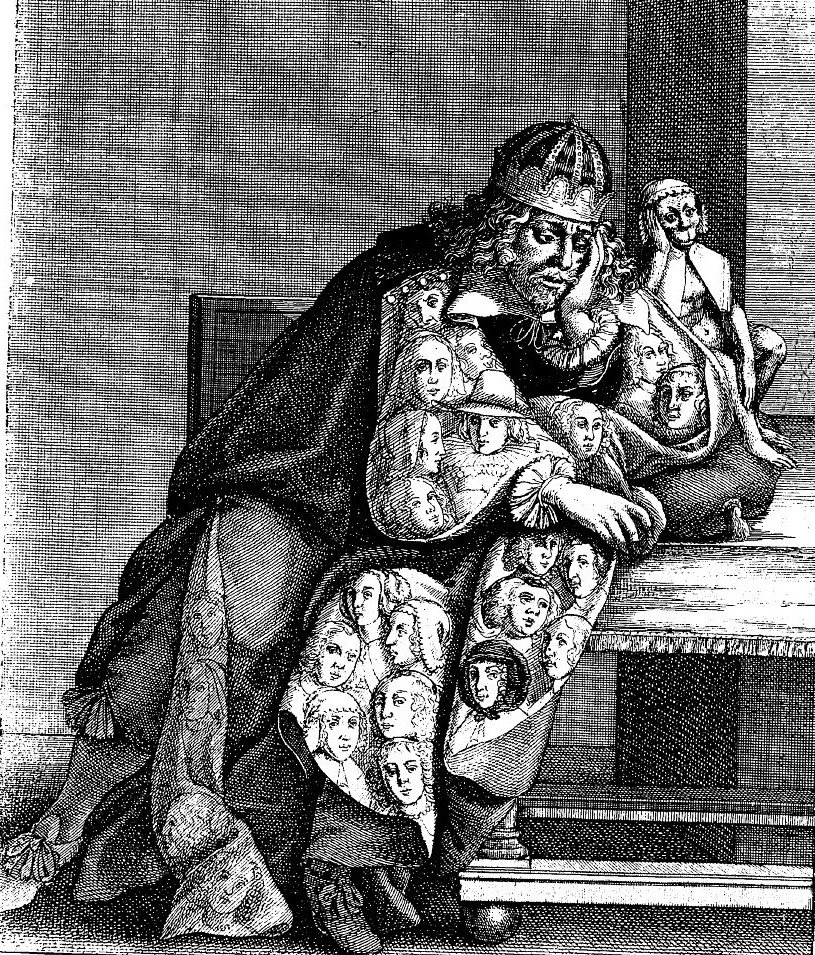
1642, and apparently a collaboration between Wencelaus Hollar and Thomas Killigrew. I've added some punctuation. A failed satire, blunted by the banality of Killigrew's text, and the benignity of Hollar's engraving. The repentent philanderer shows no sores or lesions, his nose hasn't collapsed with syphilis, he still looks wealthy, and he remains crowned (politically quite odd that he should be) in his masculinity, while the ape, which ought to signify his lechery, is in a woman's lace cap and falling band. Hollar had a special sensibility (which Gerald Hammond has identified as particularly akin to Cavalier poetry) for tertiary sexual characteristics in women, their clothes and accoutrements, as in his strange and wordless catalogues of the varieties of women's dress. Instead of pornographic parts of bodies, the artist has drawn rather uniformally attractive faces, and headdresses, and on the buttoned-on facings of the man's gown, as though he could slough off these memories in a moment: they are not inscribed on him. 'Everie one a whore', he mournfully announces - that slippiest of words in 17th century discourse about women, linking any unmarried partner, however faithful and long-term, to the sex professional. That the women all seem to be partners any man would be happy to be intimately involved with perhaps makes an unintended point about the effects of those Judeo-Christian inculcations of sexual guilt.

Hollar is not well served by the internet. His large output, too vast for book publication, would be ideally served by an Art History version of something like literature's commercial databases. In an ideal world... This single sheet print was presumably created (Hollar's engraving above his lettered version of Killigrew's text) as an up-market version of the illustrated ballad, for framing or simply pasting up as a wall decoration.

Thursday, August 24, 2006

Legislation on the Detestable Sins, 1650


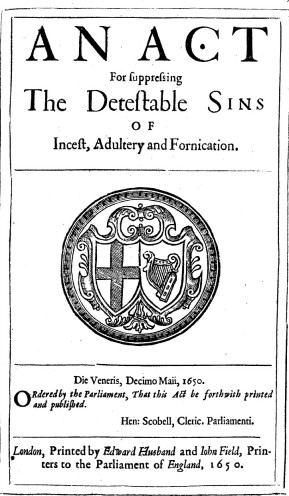
I had seen various references by social historians to the 1650 Act of Parliament by which the Puritan House of Commons sought to make fornication a felony punishable by death, but I’d never actually read the official publication, a brief and solemn black letter pamphlet, An Act For suppressing The Detestable Sins of Incest, Adultery and Fornication. The Act legislates first to make incest (both by blood and by marriage) a capital felony, and declares any children produced by an incestuous partnership (even if that marriage of relatives had previously been declared valid) illegitimate, and unable to inherit. The Act then continues, ‘That in case any married woman shall from and after the four and twentieth day of June aforesaid (ie., 1650), be carnally known by any man (other then her husband) (except in Case of Ravishment) and of such offence or offences shall be convicted as aforesaid by confession or otherwise, every such Offence and Offences shall be and is hereby adjudged felony; and every person, as well the man as the woman offending therein, and confessing the same, or being thereof convicted by verdict upon Indictment or Presentment as aforesaid, shall suffer death as in case of felony, without benefit of Clergy’.

After this drastic and momentous decree – legislating for both sexes - some anxious (and interestingly asymmetrical) clauses obviously inserted in debate appear – adultery must be a capital felony for the man committing the offence unless he didn’t know that the woman was married, a capital felony for the woman unless her husband had been abroad or absent for three years, or was believed dead (even a Puritan Parliament seems to acknowledge that women have their needs). Having thus resoundingly discouraged adultery, the act considered fornication, with virgin, widow or unmarried woman (those convicted get three months in prison, and release only after finding someone to stand security to their good behaviour for a further year), and finally the case of the common bawd and prostitute: ‘That all and every person and persons who shall from and after the four and twentieth day of June aforesaid, be convicted as aforesaid, by Confession or otherwise, for being a common Bawd, be it man or woman, or wittingly keeping a common Brothel or Bawdy-house, shall for his or her first offence be openly whipped and set in the Pillory, and there marked with a hot Iron in the forehead with the Letter B’ – then after this, three years in prison: with death for a second offence.

The Act ended with an attempt to prevent anyone accused and in mortal danger from this law using confession to retaliate in kind: ‘Provided, That no parties confession shall be taken as Evidence within this Act against any other, but onely against such party so confessing’, and an attempt to prevent domestic murder by judicial means: ‘nor the husband shall be taken as witness against his wife, nor the wife against her husband, for any offence punishable by this Act.’ This final clause apparently removes the operation of the act from the aggrieved parties most likely to call upon its provisions. It either served to make this a piece of dead letter legislation as far as adultery was concerned, or witnesses the confidence of the legislators that third parties would be self-righteous enough to come forward with their sworn accusations.

Shortly after the act passed into law, some interested party, remembering many a bawdy theatre scene, thought to express the likely reactions within the early modern sex industry. This was in A Dialogue between Mistris Macquerella, a Suburb Bawd, Ms Scolopendra, a noted Curtezan, and Mr Pimpinello an Usher, etc, Pittifully bemoaning the tenour of the Act (now in force) against Adultery and Fornication. (It was published in early July 1650). The names are traditional: the bawd’s name is as in John Marston’s The Malcontent (“Maquerelle, An olde Pandresse”), while ‘Scolopendra’ stems from a piece of lore as retailed in Deloney’s Jack of Newbury: “like the Fish Scolopendra, that cannot be toucht without danger”, and had been used for the monster lady in James Shirley’s play The Duke’s Mistress (1638).


It was a small act of resistance, but quite sprightly. The characters are differentiated - the older woman is given a piquantly Biblical phraseology (‘we the citizens of Sodome’), while the courtesan Scolopendra is throughout insistent in her view that her body is hers, to do with as she likes: ‘Alas, poor women, who are suspended from that priviledge the very Cats enjoy, who play and sport with their Tails, and yet fear no censure for so doing.’


Mistress Scolopendra complains of not having had a customer for ten days (‘we may een hang up our Harpes’), while Macquerella the bawd grumbles throughout in her characteristic quasi-moral way: ‘Ah wicked world, that I should live to see this day; a fine Age yfaith, when procreation must doe penance in an halter … The Act, the late Act against Fornication, and other Veniall sinnes, 'tis that hath undone us all … Oh! I hate the thought of being branded with the letter B. 'tis ten times worse then the Mark of the Beast I’le maintain it.’


Stanzas from what purports to be (and probably was) a ballad by Martin Parker about the act are read out, to initial disgust ‘Out upon thee (Pimpinello) this Song is made in disgrace of us, and our profession, prithee wipe thy posteriors with’t’, though they like more a stanza in which Parker (if it was him) recommends extra security against prying eyes in brothels.


Just as Shakespeare made Pompey resilient in his ignominy (‘the valiant heart’s not whipped out of his trade”), the dialogist has the three take some comfort from the thought that the effect of the act may not last long (‘This is but a paper pellet, a nine dayes wonder at the most’), and that it will in the meantime serve as a pretext to put up their prices: ‘this mutation we may well justifie, alledging the hazard we run’. Scolopendra, however, resolves to take to flight to
Venice ‘where I may use mine own, cum privilegio’.


I had half-expected some more explicit echoes of Measure for Measure, which would seem to be the text to have quoted (‘here’s a change indeed in the commonwealth!’), but the dialogist operates via a general reminiscence of whore, bawd and pimp scenes. It might have been a retired dramatist, speaking for the abolished theatre’s long-time partner. But the derision is muted, and perhaps Measure for Measure was just too loaded a text to allude to (with the Puritan Angelo’s hypocrisy, and Pompey’s devastating common sense), and so it was more a matter of voluntary suppression than a failure to bring to mind Shakespeare’s great play about the relative wisdoms of 'Justice' and 'Iniquity'.

Monday, August 21, 2006

Bernard Laurence Hieatt, 1909-1930


My latest thing (Tudor portrait memorial brasses) being recondite even by my standards - though I found a nice example in the University Church, St. Mary's in Oxford this last Sunday), I post instead about a more recent piece of memorialising. This marvellous monument is very local to me here in Reading, being in the far reaches of the Cemetery Junction burial ground.

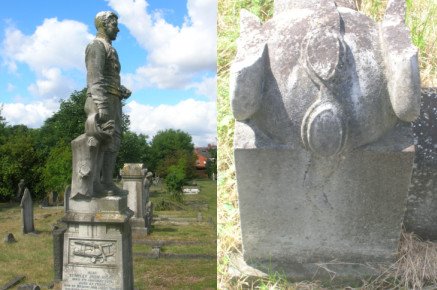
It is 'To the proud and beautiful memory of Air Pilot Bernard Laurence, the beloved eldest son of R. L. & L. Hieatt, who was suddenly called away in his hour of victory on May 3rd 1930, after creating two world records in the two hundred miles motor cycle and sidecar race at Brooklands, aged 21 years'.

His grieving parents had their aviator and motorcyclist depicted in his flying jacket, with lace-up puttees. He nonchantly holds his flying helmet, and I suppose that only piety prevented the sculptor from carving in the cigarette which you have to feel that his left hand would inevitably have had poised. He grins, this youthful Icarus, who has for the moment harnessed all the technology of speed. In early May 1930, he died at Brooklands, that steeply banked Surrey circuit beloved of the record-breakers. The extensive Brooklands-related website http://www.brooklandsmuseum.com/ doesn't record any 200 mile motorbike and sidecar race records, but there is a photograph on the http://www.brooklands.org.uk/intro.htm site which maybe gives a glimpse of how insanely hairy that type of event might have been - for the sake of aerodynamics, the sidecar rider lies prone, facing backwards!: http://www.hartlana.co.uk/bsarchive/im139.htm

If this fine piece of 30's art has any signature by the sculptor, I missed it. At the corners of the plot, what were once winged helmets, with goggles draped over them, add another heroic touch. The biplane depicted on the side of the monument looks vaguely like a Hawker Hart. What we are seeing is W. H. Auden's airman, glamorous and doomed, ready to step into or out of the exactly contemporary The Orators.

As for myself, too many churches, and now cemeteries ... I suspect myself of admiring the dead too much, simply for having got through an ordeal to which I find myself peculiarly averse.

Update: John Pulford at Brooklands Museum fills me in on the details of Hieatt's death and career: "He was leading a 200miles motorcycle and side car race at Brooklands on a Rex Acme combination when he ran into a fence coming off the Byfleet Banking after complaining at his last pit-stop of very poor visibility caused by heavy rain. He took several world records and won races, achieving a coveted BMCRC ‘Gold Star’ in 1929 for lapping the track at over 100MPH"

Friday, August 18, 2006

Fine knacks for lecturers, cheap, choice, brave and new.


My latest toy is something called a USB turntable, by Ion. This spins your time-hallowed vinyl in the old way, but connects umbilically to your PC, and digitises the sound in one step - especially if (when you try to set this thing up) you just sit by the PC with the device ready to go, phone their help line, and get them to run through which processes detailed in the guide book which you neither can nor have to do, and which unmentioned changes to your sound settings you have to make. Then you are away. (The secret is to surrender to helplessness early: the kit is fine, the guide book to using it simply scandalous.)

At no time in my life have I ever possessed a crumhorn (opinions have varied over the years, perhaps), but back in the (my God!) late 70's and 80's, I was a Wigmore Hall regular, a fan of the still incomparable Emma Kirkby, and avid follower of the Consort of Musicke when the early music repertoire was first being extensively opened out and made available. My collection of LP's has followed me round since then. I was either too mean or too conservative to buy the music again on CD's; I'm not even sure that every disk reappeared in the other format. 'His golden locks time hath to silver turned', in the case of these LP's, their white slip cases time hath to yellow turned. But now their sound is released, and joins me again, in a new century.

A substantial Emma Kirkby fansite I used to know seems to have disappeared, while the official site http://www.emmakirkby.com/
seems to be just a place-holding site without content, as does http://www.musicke.net/
for the Consort of Musicke. Mysterious.

I wonder if I can post mp3's to Blogger? - To start with Dowland's 'Shall I sue?' would seem appropriate, I'd guess from this very cagey web-presence of the artiste. I recall that once, as I was fighting the wind along a motorway in a Citroen Dyane which I then owned, straining - against the rattle of the tiny engine - to listen to some lute music on a tape player I'd put on the passenger seat, I suddenly doubted my commitment to the late 20th century. But now I've got hold of some new (-ish) technology that puts me in touch with the past. Ace.

http://www.ion-audio.com/products/turntables/iTTUSB.html

Wednesday, August 16, 2006

The Cracks Terror, 1681


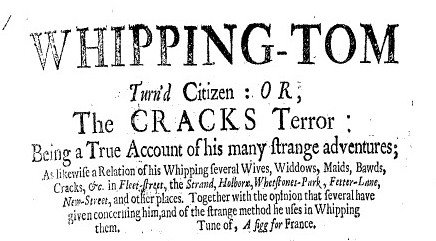
‘Whipping Tom’, the subject of a news pamphlet and this street ballad, made his way to London in 1681. Contemporaries thought that he was either the same man as, or had been inspired by, an earlier, country-based ‘Whipping Tom’ (who gets a likely mention in John Phillips's Virgil Travesty, 1678). Dressed in black, he waited in dark city corners for solitary women, and then made his assault, a vigorous hand spanking.

During his period of activity, he seems to have frightened the women of London into staying at home (the contemporary reports evidently regard this as a good outcome), or, if they had to be out, arming themselves with ‘Penknives, sharp bodkins, Sizzars, and the like’. But the rumour was that Tom either wore a concealed suit of chain mail, or was simply a spirit, and invulnerable.

His activities, now, would of course instantly brand him as a pervert, making these attacks simply for his own sexual gratification. The late 17th century cannot see this: ‘Some says he does it in pure love, / To such whose wives are us’d to rove;/ And that since last he came about,/ Few City Dames dare not stir out:/ The which if true, will save much Coin, / Which otherwise they’d spend in vain’ (and I do like that ‘coin/vain’ rhyme!). As you see, ‘Whipping Tom’ was represented as an agent of social correction: not something that you’d wish to have happen to one of the women in your own family, perhaps, but, overall, a good thing, distributing only what was generally deserved. The attitude was not a very considered one, while the pamphlet, in the main, colludes with 'Whipping Tom', in describing his deeds with a bawdy relish – at least of language, for it seems to stop short of any acknowledgement that these were sexual encounters for ‘Tom’: ‘They durst not stir out after Candlelight … for fear of having an Alarum beaten upon their Tobies’ .. ‘and turning them up as nimble as an Eeel, makes their Butt ends cry Spanko’.

The ballad, in representing Tom as ‘the Crack’s Terror’, assigns to him a particular class of victim, and therefore misrepresents the indiscriminate attacks he made. Like everything else in the ballad, the term ‘crack’ comes from the news pamphlet: ‘Another time as we are informed, he meeting with a demure Crack or Miss of the Town (who came to accost him) he so swinged her tail, that tis thought, she will not be capable of her Trade for some considerable time.’ A ‘Crack’, a 17th century idiom I’d missed (though it will surely be in Gordon Williams’s Dictionary of Sexual Slang and Imagery in Shakespeare and Stuart Literature) was a prostitute. But you can tell that the anecdote is spurious, written for the sake of a poor joke: compare these convincing specifics: ‘Another time the Woman that cries hot Gray Pease about the Streets, coming up Ram Alley in Fleet Street … a cold hand was lay’d upon her, and up flew her heels, and down fell the Pease Tub, when (as she has farther related) her sences were so charmed, that she lost all power of Resistance, and left him to Tyranize over her Posteriors at pleasure, the which when he had done, he left her to scrape up her ware as well as she could, for the use of such longing Ladies as are affected with such Diet.’

Shakespeare knew about these proclivities – there’s Cleopatra, the dominatrix of the imagination:

The oars were silver,

Which to the tune of flutes kept stroke, and made

The water which they beat to follow faster,

As amorous of their strokes…

The stupefied grey pea seller ambushed in Ram Alley, unable to resist, her senses charmed, letting Tom take his strange pleasure, seems a world away from Cleopatra, but trembles on the edge of Cleopatra’s assertion that ‘The stroke of death is as a lover’s pinch, / Which hurts, and is desir’d’. Her trade, in what I take to be salt-preserved peas, ministers to one of the other unaccountable longings of women.

Men dressed as woman went out on vigilante patrol, but Tom was never lured into a misplaced attack leading to his arrest. Aphra Behn mentions him in her play of 1682, The City Heiress ('and at last defeated, turn Whipping Tom, to revenge yourself on the whole sex'), there are a couple of other allusions, and then he slips back into the shadows, pioneer of a gaudy mass-produced pornographic fantasy.

I do not think I will look for any illustrative links for this one...

Saturday, August 12, 2006

Another Literary Church


Back to the English landscape today, opting to go to a Church I'd been saving up, that at Ewelme in Oxfordshire (the odd name is Old English 'aewelm', 'place at the river source'). I was mainly thinking about Dame Alice, Chaucer's granddaughter, and Duchess of Suffolk until her death in 1475. I've made a composite picture of her two effigies on her 'transi-tomb': the in-life image of her in her ducal coronet, her pillow being puffed up for her by gilded angels, and, in the lower compartment, her as cadavre, pitilessly shrunken in flesh, only her flowing hair unchanged. In her life image, she is wearing the Order of the Garter round her left forearm, which is apparently what noblewomen and queens admitted to that noble order did - it was presumably far too raunchy a notion for them to wear the garter as just that. Queen Victoria, referred to just this tomb for precedent, wore her order of the garter-garter that way (and probably garters as well).

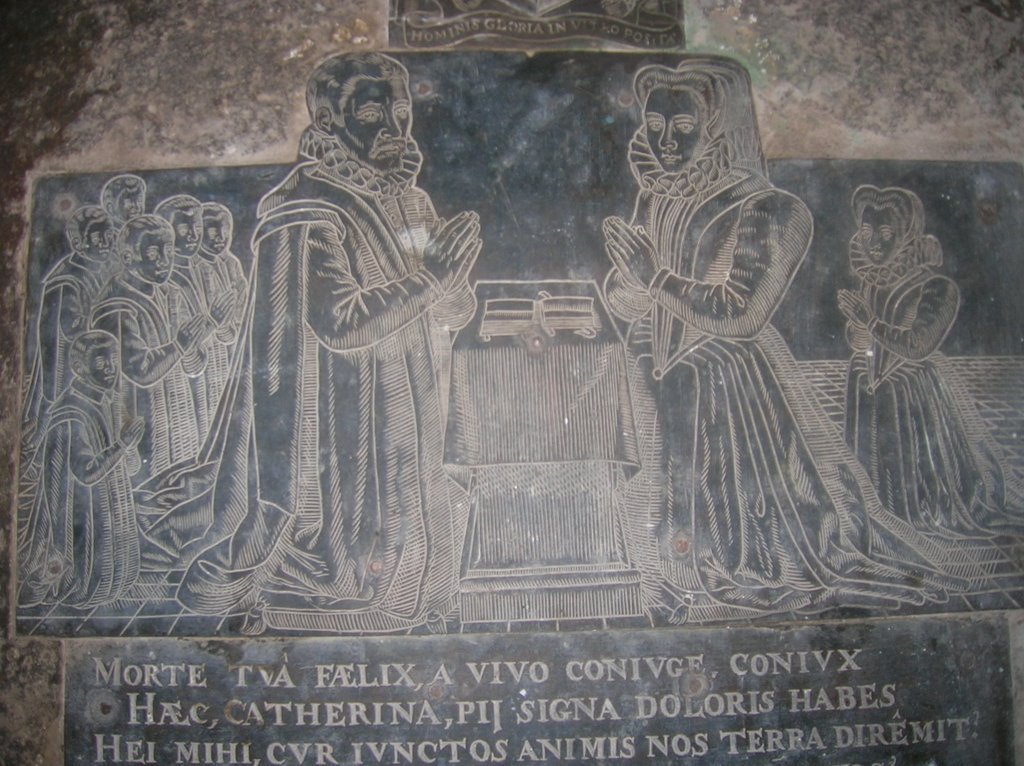
But the pious efforts of John, Duke of Suffolk (a crony of Richard III) on behalf of his mother seem to have created a critical mass that lifted the quality of other monuments. My other image is of a more bourgeois brass, that to Catherine Palmer, who died in childbed June 26th 1599, aged 34. They had had six sons and one daughter, who are all present in this superb portrait brass. A social historian would say, the classic 7 child reproductive career of the early modern woman, and its concomitant risk. The Latin verses speak for the husband of their always having being of one mind, but now separated. In another brass, the surviving verse reads:
Here lyeth my good amie, the wife of John Froste
Who lyvinge was thanne beloved of moste.
And as here her bodye lyeth close in cheste
So hope I her soule with Christe in much reste.
Obit 13 of June 1585.
Whether she was called 'Amy'. or 'amie' stands for 'friend', I do not know: it was probably a deliberate and rather tender pun.
I was busily transcribing another set of English verses before I spotted in the Latin inscription 'funebre carmen ab Inclyto Edmundo Waller'. Waller did this set of verses in 1658 to commemorate the precocious John Howard, son of Lord Andover; but it was interesting to find them in their designed context:

'Tis fit the English reader should be told,
In our own language, what this tomb does hold.
'Tis not a noble corpse alone does lie
Under this stone, but a whole family.
His parents' pious care, their name, their joy,
And all their hope, lies buried with this boy;
This lovely youth! for whom we all made moan,
That knew his worth, as he had been our own.

Had there been space and years enough allowed,
His courage, wit, and breeding to have showed,
We had not found, in all the numerous roll
Of his famed ancestors, a greater soul;
His early virtues to that ancient stock
Gave as much honour, as from thence he took.

Like buds appearing ere the frosts are passed,
To become man he made such fatal haste,
And to perfection laboured so to climb,
Preventing slow experience and time,
That 'tis no wonder Death our hopes beguiled;
He's seldom old that will not be a child.

Waller notoriously specialised in compliments, but this sounds plausible enough. I like the way in which the kind of adages Richard Duke of Gloucester mutters aside in Act 3 of Richard III ('So wise so young, they say, do never live long' and 'Short summers lightly have a forward spring' - York also reports his Uncle saying that 'Small herbs have grace: great weeds do grow apace') get redeployed for consolatory purposes in Waller's poem, which is secure enough in its tough-minded wisdom to make John Howard sound somewhat to blame for his premature demise.

I walked back to my car along a long lane across a field. Sun-bleached grass, the colour of dry sand, hissed like sand in the wind. Sometimes I feel my loneliness, and mortality. I tried to conjure into sight some archaeology: a hand-axe in the recently ploughed furrows, a bronze torque. Obviously, nothing appeared. I suppose this effort was my obscure way of getting back at recently captivating America, a 'what we lack in scale, we make up for in history' consolation.

Running to schedule in the land of the free.


I can't continue with matters early modern without some reaction to my first trip to America. So here's your blogger and, sliding into the distance, his son, near the top of the Tioga Pass, en route from Yosemite to Death Valley.

I had never done anything like the driving to a vanishing point on a long straight road through desert such a touring holiday in America dictates.

I approached the Grand Canyon with something like a geological version of 'Jerusalem fever'. We managed to be there on three separate days. My expectations had been that viewing would be uncomfortably vertiginous. But that wasn't the case, from its brim, the canyon seems benign, tranquil in its stupendousness. It was pleasant to be at Hopi Point at sunset, with people from all over the world, of all races, there for the same experience. Tim and I were lucky to hit on a cloudy morning for our main day there, and we descended down the Kaibab trail as far as Cedar Ridge. I was cajoling him along with the mischievous sentiment that he could repudiate going any further country walks with his mother, on the basis that he had done the ultimate walk. Even the one-fifth descent we did was a tough re-ascent: this is where the canyon feels a very dangerous place.

That evening, I was looking at fossils in the Permian Kaibab limestone at the edge near Trailview Overlook. Here there is also a non-denominational 'worship site', occupied by a few young Americans addressing themselves, under the rather pressing dictation of one of their number, to the matter of the blood of Christ. This combination of geological deep time and fundamentalist verities was piquant. I suppose that their feelings were intensified by being where they were, but it didn't seem like they were discussing anything they would not have said to one another anywhere. The much seen National Geographic 'Imax' Grand Canyon film resorts to a sub-Wordsworthian note in its commentary, which is safe enough, though rather absurdly it personifies the Canyon as a 'she'.

http://nps.gov/grca/

Thursday, July 20, 2006

Hoby monuments, Bisham Church


This will be my last post for a couple of weeks. I am off with my son Tim to America, a first visit for both of us. A fly-drive, with large scenic holes in the ground for me (Grand Canyon, Death Valley), and Las Vegas and Los Angeles for him.

Yesterday, I visited the Church at Bisham Abbey near Marlow, to take a look at the Hoby monuments: Tudor humanism in stone. Elizabeth Cooke, along with her four sisters, was educated by her father Sir Anthony to the highest standards of the age. She married Sir Thomas Hoby, the translator of The Book of the Courtier. He died, as the tomb says, 'at Paris the 13 of May 1566 of the Age of 36 leaving his wife great with child in a strange country, who brought hym honourable home, built this chappell and laid him and his brother here in the tombe together'. Her English verses about him are heart-felt:
Firm in Gods Tryth, gentle and faitheful friend,
Wel lernd and languaged, Nature besyde
Gave comely shape which made ruful his end
Since in his floure in Paris towne he died.
And in her Latin verses, she says he was 'my soul's far dearer part, / Life of my life and solace of my heart ... How happy we then; our wishes, joys the same / one soul inspired our double frame / But ah, how short our pleasures here below'.
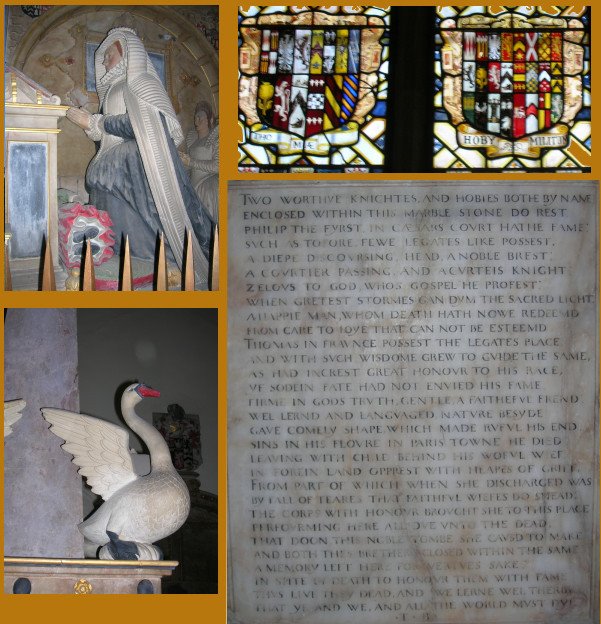
The DNB entry on her father describes her as 'formidable'. She became an habitual and angry litigant, while the churchwarden at Bisham repeated to me the local story that she caused the death of one of her children who had raised her ire by (literally) blotting his copy book. There's no record of a missing child, so one has to suspect that her reputation for learning and ill temper caused such posthumous local libels. In her own monument, her will having forsworn 'vain ostentation or pomp', she kneels in a coronet topping an almost Pharonic head-dress of pleated linen, with a full entourage of her children, both living and dead, her elder daughter kneeling before her in her robes as a Countess. A daughter-in-law had the marvellous enamelled glass windows created in 1609, they celebrate the lineage of the families, and were recently restored using a large grant of money from the Glaziers' Company, so precious are they. Margaret Hoby's own monument has the swans, the Hoby's used falcons (or otherwise the 'hobby' hawk) as their heraldic bird. Edward Hoby even named a bastard son he had 'Peregrine Hoby'.
But the main monument is that Elizabeth Hoby made for her husband and his older half brother. It is almost a surprise that the V&A hasn't long ago appropriated something so perfect. In full armour, the two men recline on rush mats, heads on their helms. Sir Thomas' armour is more decorative (if you click on the image to see it enlarged, you can pick up the 'hobby' motifs his suit features), but the modelling (in alabaster) of the faces and hands of both men is very sensitive. Placed together, their being represented at the age they died has obscured the 24 year gap between them, so they have become virtuous Renaissance friends, Protestant champions ('Zealous to God whos Gospel he profest, / When gretest stormes gan dym the sacred light', says Elizabeth's verses, refering to their Marian exile), Pyrocles and Musidorus: the type of male twinning in virtue Jonson praised in his Cary-Morison Ode. There's no sprezzatura here, no 'recklessness' or courtly nonchalance, but rather, a deep Protestant seriousness, and, not suppressed amid the solemnity, the love and bewildered grief of a woman who was clearly not easy to impress.

Monday, July 17, 2006

Early modern cryptozoology


Apart from the animals they knew well, much early modern zoology was suffused with folklore and traditional fantasies. I was reminded of this 'True and Wonderful' discourse of the Sussex dragon by the BBC's notice of the latest investigation of 'Ninki Nanka' in the Gambia - another of those sauropod- survival stories which hinges on tales told by people who knew someone, who knew someone, who definitely saw something one dark night (when he was a boy).


At least nobody is marching off up river in quest this time, the investigation seems to be more into the folklore of the story than conducted with any credulity regarding the creature's existence. See


http://news.bbc.co.uk/1/hi/world/africa/5180404.stm

The pamphlet about the Horsham beast of 1614 is not quite what it seems to be: I claim it as the first occurence of 'silly season' journalism in English. To elucidate, in my youth, when England was a more parochial country, in the high summer, serious news would run thin. Inveterate murderers would go to the seaside with surviving members of their family, bank managers were too busy out on the links to empty the branch safe and flee abroad, trials went into lengthy recess. There was no news, but news had to be found, and so we had 'silly season' stories. In these days of a global news reach, every day brings its bad news, and trivia to all tastes, then, the journalist made the silly season news.

If you read this pamphlet from the silly season of August 1614, you can sub-read the discussion between the hack ('A.R.') and his boss the publisher. There's nothing stirring. But a large snake has been seen on heathland near Horsham. A. R. is told to write it up, despite his protests that their last outrageous stretcher was exploded. The pamphlet shows some of his feelings. He starts off with a semi-apology, to the effect that some recent stories in print were perhaps a product of 'our forward credulity to but seeming true reports' or 'false copies translated from other languages'. But this one is true, he huffs, before signing off his introduction with an ambiguous protest, 'He that would send better news if he had it'.

A.R. then shows off for a few pages, with a gratuitous account of the matings of serpents, and of serpents in history: he is staking his claim to be a real writer and a learned man, far better than this subject allows him to be. Three or four pages of actually relevant material are sandwiched in the middle: it's a serpent ('some call it' a dragon - A.R. seems to mean, people like my get-penny boss here), about 9 feet long, which preys on a rabbit warren in Sussex. It is 'a quantity of thickness in the middest, and somewhat smaller at both ends' (so making it identifiable as a Monty Python). It might have feet, 'but the eye may be there deceived'. It apparently has lumps like footballs on its back, from which its dragon wings may one day grow. A. R. now fibs like the pro he is: it can project venom so far (with two human casualties and two dead dogs already) that no-one can really witness its horror properly and survive. A.R. opines that 'when it shall please God', the serpent will be destroyed, it is rather something to be afraid of in a metaphorical, not literal sense: it is 'to be feared as an eclipse or fearfull comet'.

And he is away again, happy to leave behind this doubtfully veracious subject, and onto the subject of 'serpentine sinnes that live amongst us'. The serpent is an allegory of the corruption of the legal profession, or of drunkards (as it leaves a nauseous mess in its wake). Finally A.R. 'applies' the serpent to 'the Serpentine sisterhood of Brotherly (sic), the diseased Strumpetrie of the Suburbs'. The serpent has a white band round its neck, while you get only 'a white tiffanie about the necke of one of those tugging Gally-slaves of damnation'. There has to be a significant connection there.

And having somehow covered ten pages, he takes his money and runs, while the printer gets a promising boy artist to do the unabashed woodcut that will really sell the pamphlet. It's so good that he puts it in twice.

Friday, July 14, 2006

Thomas Shipman requests a kiss


Thomas Shipman: 'The Kiss, To Mrs. C.'

Hold not your Lips so close; dispence

Treasures, Perfumes, and Life from thence.

Squeeze not those full-ripe Cherries; this

Becomes a Simper, not a Kiss.

There’s danger to lock up your Breath,

It Cousin-German is to Death.

None bags up wind, the Merchant swears,

Unless some wrinkled Laplanders.

What needs this Guard? It is small sence

Thus to hedge in a double Fence.

Clos’d Lips express but silent Blisses,

And at best are but dumb Kisses.

You are with Cupid little kind

To make him Dumb as well as Blind.

Such Smacks but shew a silent state;

Kisses should be articulate.

An open-mouted Kiss speaks sence,

It is the lover’s eloquence.

Let your speak out then! There’s no Bliss

To the Pronunciation of a Kiss.


~ a fairly standard 17th century lyric, but giving the impression of being personal and 'practical'. Some of Shipman's other poems have dedications after their titles to identifiable women ('Right choice at last, 1662' was his well-meant poem to his wife to be, though it does accidentally flaunt his track record with such as 'Mistress C', who perhaps had her own notions of osculatory decorum. Cavalier poetry featured lots of kiss poems, most graciously in the dialogue on a kiss Lawes set from Herrick. On the specific topic of what the 1930's began to call the 'French Kiss', this is a passage from Harington's translation of Orlando Furioso, with Rogero (Harington relishes his bawdy version of 'Ruggiero') getting it together with the sorceress Alcyna:

And look how close the Ivy doth embrace
The tree or branch about the which it grows,
So close the lovers couched in the place,
Each drawing in the breath the other blows:
But how great joys they found that little space,
We well may guess, but none for certain knows:
Their sport was such, so well they leere their couth,
That oft they had two tongues within one mouth.

(Book 7, canto 1, stanza 27).

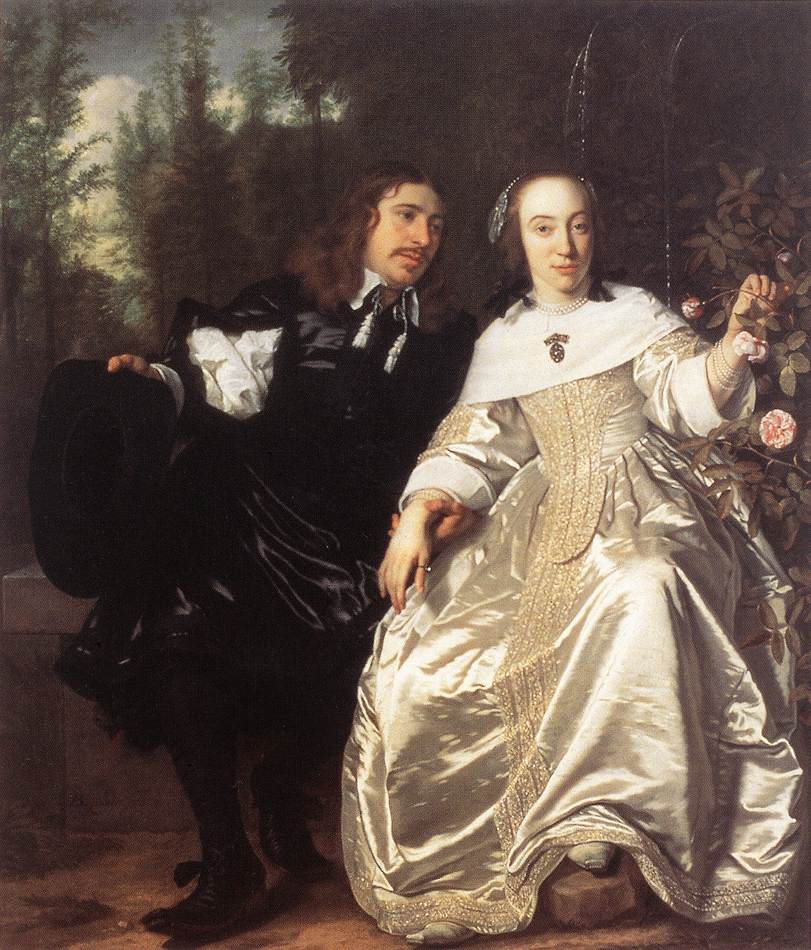
My image, from the Weg Gallery of Art, is Bartholomeus van der Helst, ' Abraham del Court and Maria de Keersegieter' of 1654: the gentleman courting, the lady in the role of a rose in bud, still attached to its native and thorny bush.

Sunday, July 09, 2006

Family Cycling, Burnham Beeches

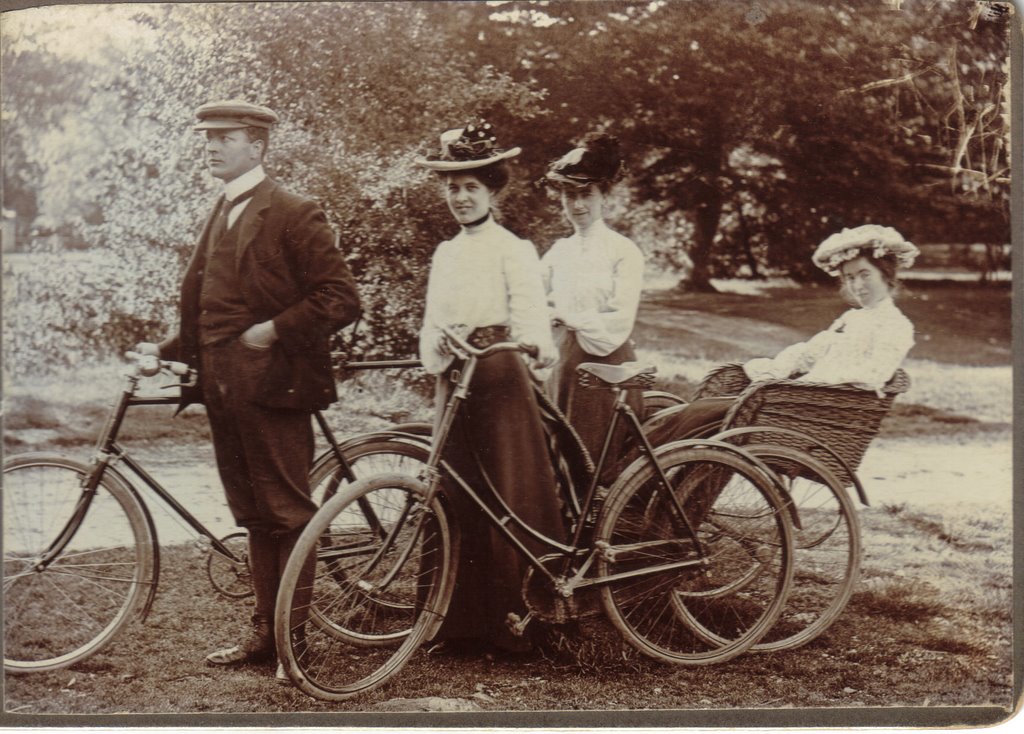
I bought this photographic print from one of my regular postcard dealers last weekend. There's no date or names, just the stamped 'Herb: Sharp and Sons, Burnham, Bucks' to locate the scene.
I surmise that they are a family group, the mother behind her children; it must be late Edwardian. I like the way that the three women look at the camera, while the young man adopts an 'I have got to here, next I will go to there' gaze, his stance resolute as an explorer's. He is towing his younger sister, a slight figure (perhaps she was considered 'delicate'), using a single speed bicycle with just a front rod brake. The tracks in Burnham Beeches roll up and down, and any kind of descent must have been potentially alarming as her weight started to push him along. His immaculate high collar makes no concession, but he must have to work hard on the flat, up any rise, and in using his fixed wheel to fight the rotation of the pedals on the down slopes.

Cycling in its days of high respectability; while the mixture of dark and white in their clothes, and the sun coming through the trees, makes them seem as if they could blur into an impressionist painting.

I must have a look for bicycles in such paintings.

http://www.cityoflondon.gov.uk/Corporation/living_environment/open_spaces/burnham.htm