Wednesday, November 06, 2013

Adam, Eve, and the young female artist


I was asking my students to point out for me, or find for me if they could, depictions of Adam and Eve by women artists prior to the nineteenth century (I’d thought of Suzanne Valadon). My notion was that the subject was perhaps one that involved too much naked man to be quite feasible for the woman artist to undertake, at least until the 19th century.

But I failed completely to think of one special category of female artist that valiantly, methodically and with epic concentration undertook the subject time and again: little girls working their samplers.


Why Adam and Eve were so favoured as a design element in the sampler is worth pondering. Paradise allowed lots of attendant animals, and they were fun to stitch. Adam and Eve were part of children’s iconography – in part because their homes might not feature much pictorial material (a less pious household might have some ballad sheets with woodblock prints pasted up on the privy walls). But Adam and Eve popped up everywhere – often they appear on title pages of Bibles. For the German market at least, cut out and paste Genesis I-III pictures were available.


One could take a grave view of this, that the little daughters of Eve were being made to focus on her role in bringing sin into the world. It is possible that some of the earlier women writers about Adam and Eve – I am thinking of Lucy Aitken, and possibly further back to women of the 17th century like Lucy Hutchinson and Ester Sowernam - may have had to demonstrate their skill with the needle in working Eve and her husband , and what they slowly worked onto the linen they also stitched into their minds as a subject they’d want to return to and say more about.


But there may have been, short of effects of indoctrination, some fun to be had in working these figures. It was probably fun to be judicious about doing the naked figures with suitable decency, and the serpent was a joy to work, wriggling in the tree.


On the wonderful Google Art Project, several such samplers can be seen. On the 18th of April 1737 Margaret Grant began her work, aged just nine. Perhaps the materials for making her sampler were a birthday present. She will use silk and linen threads in many colours, it’s a big project, with an outlay involved. It’s easy to imagine that work on the sampler inaugurated the girl’s own sewing box, and her mother passing on some material, but also buying new to set the project off to a good start.


But Margaret, obviously a painstaking child, went far beyond the usual proof of being able to read in displaying the conventional elements in a sampler of an alphabet and her name: she included a whole poem


Neither the Google Art Project nor the Museum that holds the item http://collection.cooperhewitt.org/objects/18564339/ seems to have identified the poem, but it is easily found, being Francis Quarles’ ‘On Adam’: 

How soon, poore Adam, was thy Freedome lost!
Forfeit to death ere thou hadst time to boast;
Before thy Triumph, was thy Glory done,
Betwixt a rising and a setting Sun:
How soon that ends, that should have ended never!
Thine eyes nere slept, untill they slept for ever.

The poem was first published in Quarles’ Divine Fancies in 1632, but that was an astonishingly popular work, going through edition after edition. (On EEBO I see 1632, 33, 41, 52, 53, 57, 58, 60, 64, 65, 71, 75, there might have been more, clearly if a 17th century household had a book of verse, it was quite likely to be this). Resonantly gloomy, the poem briefly expresses (and finds relish in expressing) the commonly agreed view that Adam and Eve fell on their first day in Paradise. It’s not a view that enhances anyone’s sense of God’s sense of proportion, but it seems as though anxiety about Adam and Eve sleeping together, and immediately conceiving a child while sinless, alarmed everyone to thinking it was all over between 9am and 3pm (or similar). There was also that inveterate desire to read the Old Testament typologically, so the sequence of events in the original sin must match the time taken for Christ to die on the Cross, in redeeming that sin.

Lord; if our Father Adam could not stay 
In his upright perfection, one poor day; 
How can it be expected, we have power 
To hold out Siege, one scruple of an hour …

exclaims Quarles in his Meditation 21 (“See, how the crafty Serpent, twists and windes / Into the brest of man!”, etc).


 A nine year old slowly stitches out this horrible ‘wisdom’, product of so much hard-driven extrapolation from the Bible. Quarles, wanting a strongly conclusive final couplet, leaves Adam dead and unredeemed, a first man who lost his freedom before he could formulate an appreciation of it, and who never knew any triumph.

Well, at least it wasn’t a verse about Eve…


Monday, September 23, 2013

'My worst of fates attends me in my grave': joining Lord Rochester at Spelsbury

An interesting weekend for me: on Saturday, I was one of the group of old members of the college had taken up the invitation to return to Jesus College on (just about) the 40th anniversary of our matriculation.

Here I am at breakfast: 'Self portrait in a convex teapot':


On Sunday morning, despite feeling that port has yet to have its moment as an energy drink, I drove out to Eynsham, got my second best bicycle out of the car, and headed off to Chastleton House (NT). It's a lovely old place, and my sister last year was re-gilding the clock face from the courtyard, so I was minded to see that back in place. But I got there early, and was going to have to wait three-quarters of an hour with a dreadful thirst, so I switched to Chipping Norton, where I felt sure there would be a cafe, and where I was minded to see the Rickards tomb in the church:


It is beautifully done, though like many of these things, it has attracted the graffiti of idling youths with knives in their pockets. I wonder if it were fully restored, would a restorer have to leave the incised graffiti, which have become a kind of town record?


The tomb side tells us that Thomas Rickards had died in 1579. Elizabeth Rickards, nee Fiennes, lived until 1603, but was still living when the monument was erected, and they never got round to filling in the blanks - but that she would not outlive the millenium had occurred to the person doing the lettering:


As usual, the drapery on the recumbent figures does not hang, and I can only suppose that this shows the strength of conventional depiction: whoever executed this fine piece of sculpture would have been able to render hanging drapery, but somehow that would not have done. Elizabethans liked the starchy look. This is the mastiff at Elizabeth's feet.


I then decided to loop back to Spelsbury, where John Wilmot, Lord Rochester is buried. I didn't know if there would be a ledger slab, or a wall memorial. In fact, neither: Rochester was placed in a vault under the church. This had been opened back in the 1960's or 70's, and the coffin lid's brass plate, a memorial plate from the coffin, and a lead tablet from his wife's grave were taken and put on display inside the church:


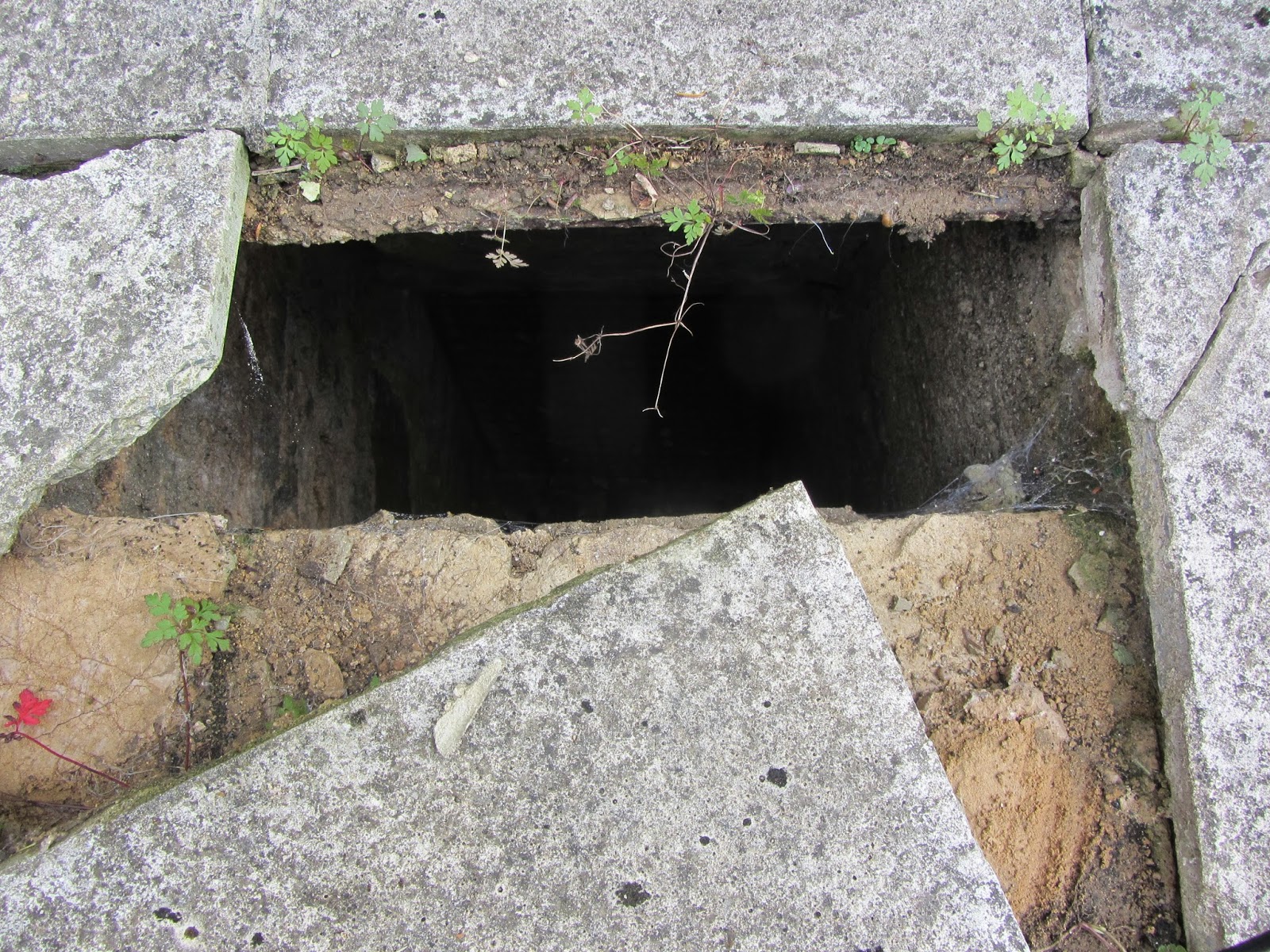
The vault was entered from the north side of the church: I went to have a look, and noticed that the cement holding the quite ordinary garden centre paving slabs that covered the vault entrance was completely loose, and the slabs cracked. I lifted two pieces aside:


Below, I could see that an iron grating was propped against the passageway into the vault underneath the church:


And at this moment, common sense prevailed: if I squeezed into this narrow gap, and got stuck down there, nobody knew where I was, there was no mobile phone signal even at ground level, I had no torch, and why on earth did I think that visiting Milord's pocky bones was a good idea?

 ... Dead, we become the Lumber of the World,  
And to that Mass of matter shall be swept,  
Where things destroy'd, with things unborn, are kept. 
Devouring time, swallows us whole  
Impartial Death, confounds, Body, and Soul.

It would, arguably, have been a suitable end for a literary scholar ('After a long search, Dr Booth's remains were found in the vault where the libertine poet, John Wilmot, had been buried in 1680. He was still clutching Rochester's pelvis.') 


Thursday, September 19, 2013

Old Nick and Young Nick in Paradise: Nicholas Billingsley’s 'The Infancy of the World' (1658)


Nicholas Billingsley began working on his The Infancy of the World (1658) when he was only fifteen. It had probably been set aside for some while when, gratified by the reception of his work, Brachy-martyrologia, or, A breviary of all the greatest persecutions which have befallen the saints and people of God from the creation to our present times paraphras'd by Nicholas Billingsly (a versification of Foxe full of hideous relish for suffering, and for divine retributions on the tormentors), Billingsley realized he could delight his new readers with a swift return to the press if he finished his poem on the Creation. I doubt that he did much re-working, he more probably looked back over his early work to check it was clear of unwise theological speculations or lines that might be misconstrued.


As a literary work, it has some interest, mainly negative. There was nothing here for Milton to learn from, but the outputs of eager and pious poetasters like Peyton and Billingsley do remind us that Milton was going to enter quite a crowded literary field. The generation brought up on du Bartas would naturally think of Genesis as a poetic subject. We can learn too from what Billingsley doesn’t do with his creation narrative: the direction he took was towards the pious encyclopaedia, rather than entering into the intellectual drama of the Fall.


The main part of the work consists, perhaps surprisingly, of eight sections – one would have expected six, as he is dealing with the six days’ labours from Genesis I. His sections consist of the start of creation (as in Milton, apparently not ex nihilo, but order created out of a material chaos), and the separation of the waters, corresponding to verses 1-9. Then, furnishing the earth with trees and flowers (Genesis I, 11-13); section 3, the heavens (I 14-5); the sun and moon (I 16-9); the waters populated with fish occupies his fifth section, and the birds in his sixth – the material for both sections comes from Genesis I 20-3. The seventh section is the creation of the animals, and the eighth, of course, Adam and Eve.


To round off what he had achieved, Billingsley ventured into the Fall itself:


An Appendix 
Of God’s resting day. 
Of Eden garden. 
Of Man’s happiness before his fall. 
Of Man’s misery after his fall.


His treatment of the fall borders on the cursory: this is the Fall of Adam. Eve is talking


… What? frownes my Adam ? wilt thou not draw nearer, 
And taste my love, then whom my life’s not dearer 
For Eves sake eat, and know both good and ill. 
Adam: 
Seeing thou invit’st me eat, my joy, I will. 
Ah! we have sin’d in medling with this Tree, 
This cursed Tree; Oh whither shall we flee? 


Like Stanley Holloway’s lion, Wallace, swallowing Albert, ‘ ’E were sorry the moment   ’e’d done it’. Maybe Billingsley had seen one of those depictions of the temptation where Adam turns away, clutching at his throat after his first bite.


As you will have noticed, Billingsley adopted loose rhymed couplets. Here are some examples of him at work:


An authorial interjection (he has just mentioned dolphins):


“Sweet Jesu! beare me to the Port of Sion, 
Be thou my Dolphin, I’ll be thy Arion.” 

Enumerating the varieties of fish:


“A world of Paper, and a Sea of Ink, 
Would scarce suffice to hold them all I think.” 


Some fish are tasty, others are large:


“Are you a hungry, go and catch a Conger 
What fish is larger then the Whale or longer?” 


God himself speaks to Adam:


“Be thou obsequious, thou shalt finde me mild, 
I’ll be thy father, thou shalt be my child.”


The vocabulary has its freakish moments too:


“Under him Scorpio exporrected lies” (a Latinism, ‘stretched out’). 


Phæbus his refulgent face, 
The upper and the lower world doth grace, 
With equal splendor; his irradient beams 
Refresheth all things; his ignivomous teams 

Run restless races…”


(another Latinism, and altogether a typical 17th century English word, well-evidenced in the OED: ‘fire-vomiting’)


That God should address Eve as ‘nefarious woman’ now sounds odd to us, as the word has become comic, but the basic sense of ‘offending against the moral law’ makes perfect sense: 
Nefarious woman, ah! what hast thou done, 
That thus my awful presence thou dost shun?


Billingsley’s mind moves instantly from the examples of God’s profuse creation to the wondrous behaviours these animals exhibit in the postlapsarian world. He isn’t troubled about what the birds, fish and beasts did, behaviourally speaking, prior to the Fall. The author himself had experienced desperate ill-health when young, and is recurrently emphatic of the curative things a provident God has placed in His creation: the congregation of the waters leads Billingsley rapidly onto an enumeration of the curative wells, and it rather sounds as though he had spent his time at Tunbridge and Bath taking the waters, and the herbs are all orientated to cures


Of Tunbridg famous in our Kentish county, 
For casting up their subterraneous bounty, 
Which relishing of Iron, and sulph’ry veines 
Cures well nigh all infirmities and paines, 
Nay lengthens life causing the fates t’unspin 
Lifes drawn out thred, hath any got the spleen? 
The dropsie? the vertigo? or the stone? 
These waters will yield remedy alone. 
Suppose th’art Lunatick, or Planet struck, 
Hear’s that will help thee, if thou hast the luck 
To come and take it …


Gouts, schyaticas, the French-mans pox, 
And what flows from Pandora’s opened box 
These Springs resist…


Here jaundis-cureing, Horehound, which is good 
Against the Asthma; heer is Southern-wood 
Good against Feavours; here the Worm-wood eases 
All Surfeits, drunk’ness, Cholerick Diseases. 
Cough-chasing Rocket, Rue-expelling vapors, 
Which dim the sight …


One thing that had not struck me before about these minor hexameral works – though it’s obvious enough – in both Peyton and Billingsley, their subject allows, even requires, the author to say his piece about Sabbath observance – and they both take a very insistent attitude about the sanctity of the holy day of rest. Milton doesn’t do this. At the end of His week of creation, God returns to elaborate praise in Heaven:


So sung they, and the Empyrean rung,               VII 633
With Hallelujahs: Thus was Sabbath kept.
And thy request think now fulfill’d, that ask’d 
How first this World and face of things began…


And there it is where it should be, biblically speaking, but Milton certainly doesn’t use this as a soap-box to insist on Sabbath observance. Not that this is a surprise in Milton.


Among Billingsley’s lines about the subject of the Sabbath day are these odd couplets – he is describing the waters of the world, and among the rivers, he gets to the Thames. He praises the watermen shooting London Bridge, and then says:


Great London is the Bow, the Thames the string 
The Boats are arrows which about do spring 
The Streams Sabbatical do rest and stay. 
In observation of the Sabbath day. 


He couldn’t really have thought that the tides in London stopped for the Sabbath, could he? Maybe - Billingsley was very pious (he would go on, as a clergyman, to have a lot of trouble conforming to the Church of England), and seems credulous of wonders he had picked up from books.


The largest portion of this whole work consists of a series of rhymed lists of the things and beings God has created. Dealing with the waters, Billingsley compiles seas, rivers, wells, until he admits his reading can carry him no further, and it’s time for him to turn in anyway:

My Muse hath touch’d the chiefest she hath read, 
And tir’d with search, discretion calls to bed. 

Next section, he busily lists trees, herbs and flowers, then on to the constellations and planets, section 5 has a long list of fish, 6, birds, 7, beasts. About all these aspects of creation, Billingsley is fideistic:

Look here, look there, nay turne I where I will 
I see Gods greatness and his goodness still. 

and willing therefore to believe any kind of wonders about whatever aspect it is of God’s mysterious design:


The envious Peacock hideth out of spight 
His med’cinable dung from humane sight: 
Treads softly like a theif, but from his throat 
Yels out a horible Tartarian note …


Pliny asserted that the peacock deliberately devoured its own dung; dried dung of peacocks seems to appear in most of the pharmacopeias. It was more effective if it was white, apparently. (I have a notion that bird poo contains vitamin B12, but this is not an idea on which I am prepared to act.)


Here he retails, quite uncritically, all the old lore about hyenas:


Alternately his sex Hyæna changes, 
His eyes assume all colours which as strange is; 
Such Dogs as on his shadow light grow dumb: 
His feet stick fast whoever sees him come; 
Calling the shepherds from their thatched bowers, 
He slayes them, and their slautered Corps devours… 


The elephant, meanwhile, understands human language, has its own elephantine faith, and is a royalist:


The Elephant next claimeth excellence, 
This beast comes nearest unto humane sense; 
He knows his country speech, he’s us’d in warrs, 
He worshipeth the Sun, the Moon, the Starrs. 
The greatest of all beasts the earth doth hold, 
He’s proud of trappings wrought with burnish’d gold 
Adores the King, his most ambitious spirit 
Aspires to glory, glory to inherit. 


Maybe I am being severe on Billingsley. If Pseudodoxia Epidemica, published in 1646, does not seem to have come his way, even if Browne dismisses the nonsense about the elephant’s legs having no joints, he was himself willing to credit elephants as writers and speakers, as they enjoy a ‘proximity of reason’:

“That some Elephants have not only written whose sentences, as Aelian ocularly testifieth, but have also spoken, as Oppianus delivereth, and Christophorus a Costa particularly relateth … we doe not conceive impossible; nor beside the affinity of reason in this Animall any such intolerable incapacity in the organs of divers other Quadrupedes, whereby they might not be taught to speake, or become imitators of speech like birds; and indeed strange it is how the curiosity of men that have been active in the instruction of beasts, have never fallen upon this artifice, and among those many paradoxicall and unheard of imitations, should not attempt to make one speak; the Serpent that spake unto Eve, the Dogs & Cats, that usually speak unto Witches, might afford some encouragement, and since broad and thick chops are required in birds that speake, since lips and teeth are also organs of speech; from these there is also an advantage in quadrupedes, and a proximity of reason in Elephants and Apes above them all.”

But occasionally Billingsley the fifteen year old appears in his verse:


“The Stockfish is a fish that wil not boyl 
Unless you beat it with a stick a while


Billingsley does not seem to have registered that dried cod needs to be tenderized before cooking, that you can’t just boil it without doing this first seems to have stuck in his mind as a miraculous property of something called a ‘stockfish’.


As I said, Billingsley added an appendix about the Fall to his poem about the Creation. here, he daringly ventures into dialogue.


God and Adam he treats using a figure of the two as landlord and tenant:

Of all the trees that in the Orchard be 
I set them for thy use, one only tree 
Shall be my rent; that tree thou shalt not tast, 
Which in the center of the garden’s plac’d 
The rest are freely thine, by my permission, 
Rent-free: but yet on an imply’d condition: 
What I injoyne be studious to fulfill, 
Touch not the tree of knowledg, good, and ill; 
For by my sacred majesty, I vow, 
And by my venerable name, if thou 
Break but thy Lease, “thy very lips that shall 
“Let in this fruit, shall let in death withal. 
But if thou please me well, this tree shal be 
A sacred pledg between thy God, and thee. 


Adam replies in kind, and sounds up-to-date on property law


                        shall I fail 
To keep from thee thy right? shall my transgression 
Displease the Landlord of my free possession. 
O no, I will obey …


Adam then produces a series of impossibility tropes, including some that show him creditably knowledgeable about the world he has so recently entered:


Sooner shall sun-burnt India grow cold, 
And Icy Zealand hot, and heav’ns grow old. 
E’re I from my first principles retreat, 
And disobey my God, so good, so great… 

But Satan does his thing:


(His) plot the better to accomplish, he 
Goes wriggling up on the forbidden tree: 
Assaults the woman, with his baited gin, 
And thus he drawes the silly woman in:

 
Serpent. 
Great Empress of the world: I humbly sue 
To be resolved of a doubt, which you 
Can satisfie me in: have you indeed 
Your appetite restrain’d? what, mayn’t you feed    
On evr’y pleasant fruit? why so? doth God 
Limit your pow’r? if so, 'tis very odd.


At this point, Billingsley opts to make Satan into a bad Cavalier poet:


Coy woman tast, behold their beautiful 
And cherry cheeks, coy woman do but pull. 
Cannot those mellow-delicates, invite 
Your wat’ring palate, to an appetite? 
Methinkes they should, taste, and you shall have skil, 
To know the diference 'twixt good, and ill. 
Why draw’st thou back?

                                    To the possessed Snake, 
The cred’lous woman this reply did make. 
Eve. 
Wisest of beasts, all that you speak is true, 
You counsel for the best, all thanks be due, 
For your great love your love which doth transcend 
All merit of mine, thanks to my loyal friend: 
My life’s to small to hazard for your ease, 
Friend I could give’t, your speeches doe so please. 
This fruit is marv’lous pleasing to the eye; 
And questionless, 'tis to the taste: I’ll try. 
And eat thereof and give my husband Adam . 
Serpent. 
They bow to serve you, at your pleasure, Madam. 
Eve. 
Ah! how delitious is this fruit, how sweet! 
A finer Apple I did never eat …


The commendatory verses Billingsley solicited from fellow students and relatives are kind, and lay judicious stress on his youth. If we made him touch Josuah Sylvester’s corpse, asks William Jacob, would it cry out ‘murder!’? No, not a bit of it. John Swan notes that
Whiles others of thine age mispent their  times
In toys and pastimes, thou in sacred Rhimes
Applied thy self …
D.R. of Merton College says that this ‘accurate’ poem that it confutes Epicurean atomism.

My illustration, of an Adam reacting instantly to the ‘bad fruit of knowledge’, comes from a Book of Hours, Use of Rome, French, first quarter of the16th century http://bodley30.bodley.ox.ac.uk:8180/luna/servlet/detail/ODLodl~1~1~4230~104346:Book-of-Hours--Use-of-Rome-#

Wednesday, August 28, 2013

'Eutopia nothing to it yields': Thomas Peyton on Paradise and the Fall, 1620


The youthful and pious Thomas Peyton published two books of his intended verse paraphrase of Genesis, The Glasse of Time, in 1620. Peyton was not a very inventive narrator of the sparse story given in Genesis (he got as far as Noah), while as a versifier, it is easy to suspect he was pushing on too quickly, often filling out his lines to meet obvious rhyme words, achieving no sustained style. But his reflections on other people’s reflections on what might have happened to Adam and Eve must have catered to a taste not even the scale of Du Bartas’s Divine Week could satisfy, and his work was reprinted in 1623 and 1625. One can imagine the young Milton looking at it for maybe five minutes, at least until he read something like this suggestion of the devil lying in wait to accost Eve alone
 … watching Time, when Adam stept aside, 

Even but a little from his lovely Bride, 
To pluck perhaps a Nut upon the Trees, 
Or get a combe amongst the honey Bees…

(as stepping aside ‘to pluck a rose’ was a euphemism of the time, this was doubly inept).


Peyton hoped that “my speech as generall to all, /May like a Sermon in the Pulpit fall: /And not to wade in curious questions deepe…” - that he would be instructive and not over-curious. “In God’s book we love to pry and peeke’, he wrote, deploringly, while doing exactly that himself. But he was unable to inhabit mentally, and so fill out the life of Adam and Eve in Eden and afterwards; instead he is drawn into rabbinical lore and all the other speculations about their lives after the Fall, as well as such matters as the location of Paradise, or what the forbidden fruit actually was.

His own multiple retelling of possible events after the Fall follows a distraught Adam after his expulsion all the way east (Adam’s quest is to reconnect with the divine light) to the final insurmountable barrier of the River Ganges, where Adam (“some say”) circumcised himself, and then stood in the river until he was “overgrown with green”. Then Peyton withdraws all this agreeably zany rabbinical legend with a comment that it’s unlikely Adam was so long separated from his wife, or even be able to bear to be so far away from Paradise itself, but have stayed close to her and their former dwelling place.

The quest for the site of Paradise takes Peyton rather willingly back on another excursion to the Far East, this time to Zeilan (Ceylon), and Adam’s Peak http://en.wikipedia.org/wiki/Adam’s_Peak

which Peyton says is surrounded by a freshwater lake eighteen miles across and four foot deep, ‘distilled’ from the tears of the penitent Adam and Eve (we can be generous and imagine that distilling their tears would make the lake freshwater), while a ‘flaming hill’ nearby symbolized the flaming sword guarding paradise (Ceylon does not have volcanic activity).

Describing Ceylon and its climate makes Peyton as paradisal in description of a place as he ever gets – but his account then moves on to Mount Amara in Ethiopia, and finally to Assyria ‘the likeliest place indeede’, and also equipped with a ‘smoky hill’ to memorialize the sword guarding the Tree of Life. On the great mystery of the nature of that carefully guarded ‘Tree of Life’ Peyton offers a suggestion that the tree was probably not yet ripe: for it was a symbol of the Christ to come.  


These long sections of his poem where he canvasses various possibilities are only remarkable as illustrations of that characteristic mix of Bible history and world travel they went in for in the Middle Ages and Renaissance. When it comes to the Forbidden Fruit, Peyton learnedly opts, in the end, for the banana, which has to his mind the right combination of taste, scent and multiple cropping, and has a built-in ‘signature’ which shows its nature:

            more like and probable it is: 
If that their iudgements do not erre amis, 
The dainty tree that in their country growes, 
And twice a yeare his pleasant fruite that showes, 
Yeelding a fragrant and a lovely scent, 
If but the same be either crusht or rent: 
A Cucumber much like it is in shew, 
Of pleasing taste, and sweet delightfull hew. 
If with a knife the fruite in two you reave, 
A perfect crosse you shall therein perceave: 
The spatious leaves are full a fadome long· 
In breadth three spans…

It is rather a pity that no artist ever adopted this identification – an Eve by Titian or Rubens tempting Adam with a banana would have been glorious.

But what gives Peyton some individual interest is his gradual superimposition of his own story onto his retelling of Genesis. Evil came into the enclosed and ideal world he shared with his beloved Urania (meaning, of course, the muse of Christian poetry he shared with Du Bartas). Peyton, identifying himself strongly with innocence and true faith, inserts his account of what envious folk did to him, into the main narrative of the Fall under Lucifer’s envious assault.

It is not certain that Peyton would have seen any incongruity in this, had it been pointed out to him, rather, it is all one (as far as he’s concerned), and his own life experience validates the Bible truths. Peyton is not in the least abashed about his faith, which is of the right kind, as is his art: God sends Urania down to him on a mission up there in importance to Peyton with the ministry of Christ: 

That thou my Breast dost with Urania fill, 
Sending her Downe as thou didst send thy Son … 

Whatever it was happened to Peyton, it was clearly something he felt very aggrieved about, but it is never made entirely clear what it actually was. A self-righteous and touchy man (I infer), it may have been the case that adverse comment on his opinions, which he considered to distort them, prompted him to sound off about Envy, whose venom which has besmirched even his beloved Urania:

Urania (deere) thy very case is mine, 
How did my Foes still to this day combine, 
Backe sliding friends (much like to slippery Eels) 
Have undermin’d, to turne up both mine heeles: 
With fawning tearmes my company have sought, 
Inverted that (which yet) I never thought; 
Reported words, the which were never spake… 

Nothing about The Glasse of Time itself strikes me as heterodox. When he invents, he tends to do so under the influence of Spenser, in highly descriptive allegory. We hear a lot about the daughters of God, the allegorical figures of Mercy, Justice, Charity and Truth. Here, God just sounds indecisive when faced by female tears (of course, the compassion is His own, talked out of Him by His justice):

But God himselfe his daughter deare that sees, 
With weeping eyes before his face to crave, 
That but on Eve he would compassion have: 
Began to stay his minde, to alter cleane, 
And to the woman now began to leane: 
But that hard by stood Justice in the place, 
And urg’d him much to prosecute the case: 
When all the reason Mercy well could render, 
Was that her selfe was of the female gender …

And this following passage is not well handled, in which a fit of papal petulance about a lost peacock (Peyton repeatedly denounces both Catholics and ‘Puritants’) unluckily collides with God’s reaction to the disappearance of the Forbidden apple (wasn’t it a banana?):

What may we thinke of that ambitious Pope, 
Which dar’d to scoffe under heauens glorious Cope, 
Against that God, that in his sacred frowne 
Turns up his heeles, and hurles his pride soone downe? 
When having mist a simple childish toy, 
A Peacocke bird which seem’d his onely joy. 
Distempered much began in heate to chide, 
That few men could his holy presence bide. 
And afterward asham’d of what was past, 
To shew his choller not long time did last; 
Excusde himselfe, that he might angry be, 
As well for that, as was the Trinitie. 
When discontented for an Apple lost, 
Both Eve and Adam to their paine and cost, 
From Paradise were thrust quite out and beaten, 
And much disgrac’t for one poore Apple eaten …

Peyton’s major problem was most likely vexatious litigation, causing him great losses to his estate, and spells in prison (I assume that people he had thought his friends, turned legal opponents, had paid for him to be arrested).

Nay thou thy selfe, noble Urania deere, 
Since first thy landing and arrival heere, 
Hast thou not beene on every side turmoyl’d, 
Tost too and fro, by Envy overtoyl’d? 
Whose viprous tongue within a sacred place, 
Hath belcht her venome, aim’d at thy disgrace; 
Like to the Divell in Paradise at first,  
That banefull poyson in his Brest hath nurst, 
To wrong thy person, weaken much thy state, 
Enrich himselfe to satisfie his hate, 
 Tooke all advantage working on thy youth, 
Suggested lies instead of naked truth: 
Lock’t thee up close (Immur’d) within a Wall, 
When not a Groate was due to him at all; 
But by the order of this noble Land, 
He in that place for debt to-thee should stand. 

But holy God, what will become of those, 
Which in an open publike place shall chose, 
To give occasion first to shew their gall, 
Do call a man both this and that and all, 
And afterwards shall lye upon the catch, 
Their friends estate, into their hands to snatch, 
By Deedes, Conveyance, Obligations, Bonds, 
To wring and wrest, to make them sell their Lands, 
Before such time as any thing is due, 
To clap up such with Cerberus his crue, 
In wofull prison sick to lye and rot … 

Complaints about how he had been treated continue, and with him, his Muse suffers

 … all the spight against me she [Envy] can use, 
May waste my State, and hinder thee my Muse. 

                        by her I am misused, 
Hurried about by slandrous tongues abused, 
Kept long from home, unto my great expence, 
Weakened my Lands and living ever since, 
On all sides crost (by Greatnesse) over sway’d, 

… So deerest Muse here in this mortall life,  
That swarmes in troupes of those delight in strife, 
Which never rest till all my state be spent, 
But at my Ruine all their aime is bent, 

The importance to Peyton of money, and hanging on to the wealth you have, impinges on his Paradise narrative. His Garden of Eden is surprisingly opulent; Adam has wealth just lying about. Then of course he loses it all, and hangs about in the vicinity, hoping to get it back:

.. all the world thou hadst in ample store, 
Plenty of wealth and gold at thy command, 
And all the creatures in the earth to stand, 
Before thy face subjected to thy will, 
And thou the Lord of Paradise yet still.

 … How is thy ground exceeding rich and faire· 
A region seasoned with a temperate aire, 
Thy channels crawling full of golden Ore …

One might think the excluded Adam could pick wealth enough off the outside walls of this opulent Paradise:

The lofty walls were all of Jasper built, 
Lin’d thick with gold, and covered rich with gilt 
Like a quadrangle seated on a hill, 
With twelve brave gates the curious eye to fill, 
The sacred luster as the glistring Zone, 
And every gate fram’d of a severall stone…

I deduce that Peyton got married too. He makes some passing remarks about having, regrettably, less time for Urania than he’d wish: “And what if Hymen something doe annoy / Thy tender Fruit, yet shalt thou live in joy…” 

One of his favourite motifs as he deals with the Bible patriarchs is to praise their continence of life until marriage at mature years, marriage contracted out of a spirit of duty to the church rather than any youthful lust. 


Though I can’t quite see exactly how it connects to his legal problems, Peyton seems to have got into a quarrel about Eve, perhaps with a clergyman who then litigated with a mind to “Enrich himselfe to satisfie his hate”.

Prior to the Fall, Eve is (conventionally enough), for Adam a “Glittring sugred hooke, / She drawes thy love to mind her speeches more, / Then God himselfe that gave thee her in store.” Peyton does not attempt to describe her, he actually pays more attention to the beauty of Adam:

As the two lights within the Firmament,  
So hath thy God his glory to thee lent, 
Compoz’d thy body exquisite and rare, 
That all his works cannot to thee compare, 
Like his owne Image, drawne thy shape divine, 
With curious Pencill shadowed forth thy line: 
Within thy Nosthrils blowne his holy breath, 
Impal’d thy head with that inspiring wreath, 
Which binds thy front, and elevates thine eyes …

I suppose Peyton imagines Adam with a kind of Bacchic wreath. But the second book includes a sudden upsurge of sympathetic interest in Eve. As Peyton tells it, Adam (after the Fall), quite ignorant of what he is doing, has sex with his wife:

                                    upon a time it fell, 
The circumstance I must forbeare to tell, 
Playing with Eve within that shady bowre, 
And in his armes his loveliest sweetest flowre, 
Embracing, toying, smiling, kissing sweete, 
The sports most chaste unto a Spouse bed meete, 
Thinking the time he had with her beguil’d, 
Forgets himselfe, and she conceives with child. 

Peyton is fond of projecting innocence onto Adam – alone in Paradise prior to the creation of Eve, in one of the many similes Peyton proudly points out to us in his margins, he’s like a school boy, peeking in every bush for birds’ nests. Adam’s eyes do not seem very much opened by having tasted the Fruit of Knowledge. After this inadvertent coupling, Adam is baffled by Eve’s behaviour – she keeps eating bizarre things, and demanding that Adam find a way back into Paradise and get her the stuff she really has a fancy for:


Strange is the change she in her selfe doth find, 
An extreme Passion working in her mind, 
Longing oft times some sops in Tarre to lick, 
Her bodies altred, and her stomack sick, 
Black ugly Berries, fulsome unripe Plums, 
And every thing that in her way next comes, 
The goodly fruits which are within the walls, 
Of Paradise, she to her husband calls, 
Desires, intreates him, as he loves his Wife, 
Forth with to hast, and fetch to save her life. 

But this erratic and conventionally anti-feministic Eve, cursed by God after the disobedience with ‘Sick loathsome vomits’ in pregnancy, suddenly starts to receive what seems to be Peyton’s sincere tribute. When Adam returns from one of his excursions for Twiglets, he finds that she has given birth in his absence, and Eve explains to Adam:

She knew not well how first to her it came, 
But that she thought although her sence was weake, 
This was the Seed the Serpents head should breake, 
Told him in words and gentle speeches mild, 
That by the Lord she had conceiv’d that Child.

Peyton underlines his point, insisting that Eve would not have known where her baby had come about, and that her deduction was pious and correct. He suddenly breaks out in anger:

How damn’d prophane are those accursed lips,  
Which in Gods Church shall make such dangerous slips, 
Within the same to belch to thy disgrace, 
Even in a sacred and most publike place, 
Behinde thy back when thou art dead and past, 
And canst not answere what their mouth out cast, 
Thus to be lye, mens soules to sin allure, 
Wresting thy speech with banefull breath impure: 
Not terrifide with Heavens all threatning Rod, 
But dares to teach (that thou didst sweare by God  
Thou hadst a Child) and oftentimes to speake it, 
If it were true, unto the world to breake it, 
Is worse then was that Serpent damn’d accurst, 
In Paradise which wrong’d thy Person first. 

As far as this is coherent, it indicates a fierce dispute about Genesis 4, 1 (“And Adam knew Eve his wife; and she conceived, and bare Cain, and said, I have gotten a man from the Lord”), in which Peyton took the text at face value, and someone else, a clergyman, asserted that Eve was telling a profane lie (with the possibility that this other person asserted the common enough notion that the real father of Cain was the devil).

For Peyton, however, such opinions are another assault upon well-meaning inexperience: it’s what happened at the Fall, it is what happened when he was ensnared by litigants. The plain words of a pure mind, such as his, or Eve’s, get ‘inverted’ or ‘wrested’ into something scandalous to the person that uttered them. He continues with a vision of Eve in heaven:

Deare Eve, thy worth I ever must admire, 
Thou sitst above within the Angels Quire, 
Tuning thy voyce unto their sacred layes, 
To sound forth Glory to the Prince of prayse.

while her detractors (like his, for so we can extrapolate)

“headlong downe to damned divels shall reele: 
Whilst Eve shall sit triumphant on the skies, 
Viewing their fall, hearing their moanes and cryes, 
Joying to see the sacred Truth prevaile, 
Her meaning clear’d, her foes to weepe and waile.

Eve goes on to have “about some threescore more / Of sons and daughters”. For Peyton, Cain’s story is just another example of the poisonous nature of Envy, a man who set out well, but was then polluted (Peyton makes a parallel with Faustus).

I’m sorry to say that Peyton opts completely for the mark of Cain as being black skin:

That Cains most fearefull punishment and marke, 
For raking up his brother in the darke 
Was that his skin was all to blackensse turn’d, 
Like to a Coale within the fire halfe burn’d.

He scoffs at the notion that dark skin is something to do with climate:

If this be true, how is it that there bee 
In Africa, America, to see 
Under the line both people white and faire, 
As many men that now in Europe are …(?)

Here’s early modern racism in a couplet:

“The Southerne man, a black deformed Elfe, 
The Northerne white like unto God himselfe …”

I will end with Peyton at his most paranoid. In this personal anecdote, even as he is working with Urania on this divine poem of his (it’s a wonder he didn’t get it printed in white ink), his enemies gather outside, just as happened to Lot in Sodom. But his good friend God (that would be the white one) sends him a dream that makes him wake up, secure his doors, and escape:

(Ah dearest God) even whilst my Muse was working 
Upon this Place, how were my foes all lurking 
About my house, to undermine my state, 
With secret traines, close to my dores and gate. 
But thou didst wake when I was fast asleepe, 
To make me know that thou dost alwayes keepe, 
Thy sheepe from danger of a Wolfe most fierce, 
Which in my bloud (next to my state) would pierce 
Then didst thou give me at that instant howre, 
A Vision strange to shew thy secret powre, 
That in a dreame when once my body wak’t, 
My inward thoughts and all my sences shak’t; 
But Reason guides and swayes me downe her streame, 
To make me prize it 'bove an usuall dreame. 
Whereat I went, lockt up my dores most sure, 
To keepe me safe from treacherous pawes impure, 
Which never yet in all my life was done, 
The hatefull lawes of cruell foes to shun; 
But (Heavenly God) when least I knew of harme, 
How did they then about my house all swarme 
On every side, with raving speeches hot, 
Like Sodomits about the walls of Lot,  
Till thou protectedst broughtst me safely out, 
From the curst fury of that griping Rout; 
Stroke them with blindnesse all like Tygers lay; 
While thou conveydst my body sure away, 
To sound thy prayse, and blaze thy glorious name, 
To end (this worke) to thy renowned fame. 

My illustrations are from the book: the title page ‘vinnet’, as he calls it (‘vignette’), with Time leading forth Truth, Noah’s Ark, either Paradise or the heavenly Jerusalem, pious scenes, and himself. Then we have bowlers sinfully bowling on the Sabbath when others are in church (Peyton has much to say about this, and how God has punished even Geneva, which allowed shooting on Sundays, by bringing war to it), a temptation scene with Time and his glass rather oddly intruded, and the death of Adam and Eve, four of Seth’s sons bearing them away.