Friday, April 29, 2011
Two early modern royal souvenirs
Well, royalty is the theme of the day, so I thought I'd post two early modern royal images, or (at a stretch) souvenirs. My first is this quite astonishing portrait miniature in silk, from the collection of the Metropolitan Museum of Art's collection. They don't have it on show, and one imagines its colours are most probably kept from the light of day in a black velvet-lined box. But their web exhibit is very good, here:
http://www.metmuseum.org/toah/works-of-art/39.13.7,29.23.8
As they rightly say about it, "this embroidered portrait miniature ... is one of the most beautifully executed examples of professional embroidery from the seventeenth century". It is all worked in stitching: "All of the elements, from the lace collar and medallion of the Order of the Garter worn by the king, to the highlights in his eyes and hair, are rendered in minute stitches of silk and metal thread." The Met's website gives magnified close ups so you can appreciate the work that went into it:
The image of the martyr-king is after Wencelas Hollar, and before him, of course, Van Dyck. The same image is used as the frontispiece for the 1651 Reliquiae Sacrae Carolae. The execution of the portrait is a work of extreme skill, and reverence too: this level of work could only be paralleled in vestments or copes (which sometimes have pictorial elements). The Met site says that "a number of similar portraits survive in public and private collections". Someone bought a late example at this sale for £3,400:
http://www.tooveys.com/lots.asp?WEBLOTID=163601&LOTID=890
Here's the other end of the scale, from the single sheet publication of 1613, The Royall line of kings, queenes, and princes, from the vniting of the two royall houses, Yorke and Lancaster
Here are the Tudors and the Stuarts: Henry VII and Henry VIII, Edward VI, Mary and Elizabeth, James I, Prince Henry (who has just died), Anne of Denmark, the youthful Prince Charles, Princess Elizabeth and her husband, Frederick, Count Palatine, labelled 'R.B'. for Rex Bohemiae. The verses are these:
OF these, the first, is He, that did Unite,
The two sweet Roses; made Contention, Peace:
The second, He, at whose Majestique sight,
All that opposd him did recoile and cease.
The third, young Edward, of that name the sixt,
Where pious thoughts and Royal blood were mixt.
The Fourth Queen Mary; (in this steame, a staine,)
To Rome, a friend, but to the Truth, a Foe;
The Fift Eliza, in whose blessed Raigne,
Not any room was left, for Rome, to show
A wooden God, to kneele to: Truth and She.
One Septer swayed, with one cleere eye did see.
The Sixt is He, that now makes Englands Seat,
The Seat of Vertue, (that including all,
The Stock of Goodnesse) One, as Good as Great,
Before whose Shine, Clowded abuses fall:
The seaventh, that Prince, that while he here did liuv,
As Faire Hopes gave, as ere fresh youth could giue.
The Eight, Queene Anne, The Ninth, the Royall Charles:
The Tenth Elizabeth (of these) the last
Her Royall Husband: All these, Lucent Pearles
That in their Vertues, such a luster cast,
As all admire, and Love. Who to the Fame
Of these bear Envy, may they end in Shame.
The prominence of Frederick makes this a souvenir for the 1613 royal wedding.
Wednesday, May 24, 2006
"I have nothing of new to direct you in"

Imagine scholarship without the OED (if you can). Now that the power of the computer has been integrated so consummately with that dictionary’s vast resource, just what a resource it has become.
A feature of the online OED which I find irresistible is the search facility for ‘first cited author’ and ‘quotation author’. My last posting was a Charles Cotton poem, in which he is amused (I take it, because he knows that ‘chambre’ means bedroom) by the term ‘valet-de-chambre’, which sounds nicely naughty to him.
The first recorded use of ‘valet-de-chambre’ in English is in a letter from Charles I to Henrietta Maria (so it was quite a new term for Cotton). This set me off looking at Charles’ other potential contributions to the language. The readers who compiled quotations for the OED tended to spot rare words, and also to be drawn, Dr. Johnson-like, to striking quotations. But whoever read Charles I, did so attentively (and without any obvious bias towards noble utterances written by or reported from the King).
Charles had a French wife, and so certain words not recorded prior to his usage may well be very early or even actual first usages. There’s that ‘valet-de-chambre’, and his idiom ‘nothing of new’ is one that the editors suggest may stem from French usage. He adds a new usage to the surprisingly early loan word ‘vogue’ with the idiom, ‘in vogue’. ‘Apostil’ (to annotate or write marginal notes to) failed as a loan word, but is a very characteristic type of usage, for of all kings, Charles was involved (to say the least…) in politics. New political applications of words, fresh military ones, and a vocabulary for the scrutiny of documents (and the characterisation of them) all feature prominently:
A ‘cabalist’ (one who cabals), ‘engage’, ‘anti-monarchical’, ‘agitate’, ‘round-dealing’, ‘misunderstanding’, ‘illiberal’, ‘distractions’ are all entries with developed senses not recorded before Charles’s usage. For military words, ‘home-defence’, ‘enquarter’, and ‘forage’, and from Charles studying documents and attempting to characterise positions taken, words like ‘absolute’, ‘demonstrably’, ‘unconfutable’, ‘counsellable’, ‘paraphrase’, and ‘hyperbolic’ have significant quotations, illustrative of the word’s semantic development, from Charles.
The King’s characteristic usages are recorded: ‘malignant’ meaning ‘sympathetic to the Parliamentarian cause’ seems to have been habitual. His complaint about “The malignant Party which have … begot this Misunderstanding between us and our good subjects” has ‘malignant’ in new sense 1 c and ‘misunderstanding’ in new sense 2 together in one utterance. Charles, a man with a developed aesthetic sense seems (probably) to have regularly used ‘unhandsome’ to deplore something he disapproved of (“his unhansom quitting the Castell and forte of
I didn’t really see Shakespearean usages crop up in this great reader of plays, but sensed that you might have a basis for claiming that Charles had spent a lot of time listening to John Donne, from whom he might have picked up ‘pre-pardon’ and ‘refractariness’.
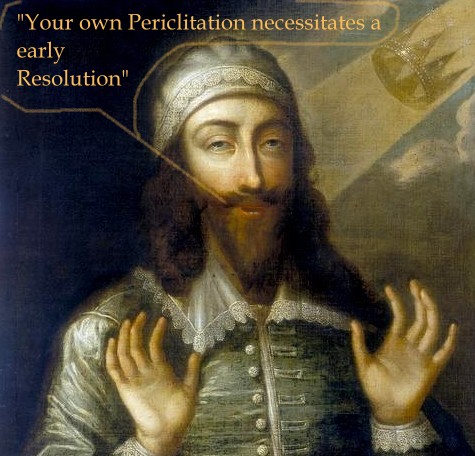
My doctored hagiographic portrait has one of Charles’ locutions, as picked up by the dictionary. But it isn’t ‘periclitation’ that was the new word there (it seems to have had some circulation among these classically-educated men of the 17th century for ‘nearness to danger’), but ‘necessitate’ as a verb which is the potential new usage.
Rather beguilingly, I had to search for Charles’s quotations as both ‘Charles I’ and ‘Chas I’, for the dictionary was compiled in an earlier age, and without electronically introduced internal consistency (as the search guides point out).
With his tendency to stutter, Charles I is not associated with any great moments of eloquence or outbursts, and his words may well have undergone loyal working-over. But the situation he found himself in seems to have made him a more varied linguistic performer than one might have expected from a king more famous for iconic than verbal self-projection.