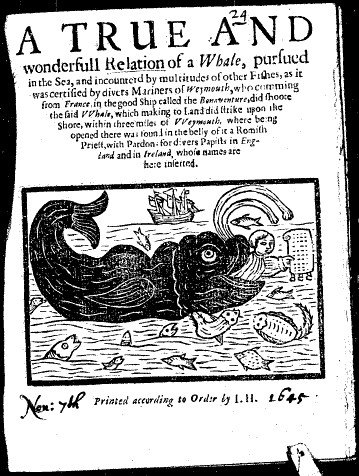
The tagging of last week's stranded whale, SW2006/40, made me think of earlier examples of whales that got into the Thames. On June 3rd, 1658, a genuinely large whale was sighted at Blackwall, near Greenwich. The brief pamphlet published about this unfortunate animal reveals large changes in the response of Londoners. Just as they did last week, people streamed out on foot, also by coach, and, very characteristically for London transport of the 17th century, by boat. But they travelled (at least, the pamphlet gives this impression), not to see the animal, but to see it being killed.
As the title page shows, it was instantly assailed, with all means to hand, and the pamphlet commends the "vigellency, care and industry" of the watermen, who finally killed it after a six hour struggle. This was not a stranded whale, but one that thrashed, leaped, and hauled the boats that had been used to fire improvised harpoons at it.
If you look at the wider field of references to whales in early modern literature, they are seen as, at the least, prophetic of storms to follow. A wider metaphysical dread attaches itself to them, here "this whale (coming thus contray to custom) is some sign or token of heavens displeasure" and "a sign of some dangers approach". As a "monstrous fish", the animal's natural bulk makes it, for them, unnatural, tainted by a fear both of itself, and what it portended. Hence their eagerness to see it killed.
Klaus Barthelmess, in his web-posted essay, 'Stranded Whales in the Culture and Economy of Medieval and Early Modern Europe'
http://www.whaling.jp/english/isana/no27_02.html(I don't think that we should necessarily judge a man by the company he keeps, but, really, Klaus) produces a word I'd not come across before,
hierozoika a word for animals sanctified by being mentioned in the Bible. However, Jonah and the whale was not a story that conduced to helping the whale's image: yes, it was a Biblical animal, but typological readings associated Jonah in the whale with Christ descending into the tomb: the whale became deathly, and got itself associated via its vast mouth with the mouth of hell.
The Jonah story turns up in almost surreal form in another early english whale pamphlet, the one at the head of this post, with the not easily credited account of the dead Catholic priest being found in the carcass of a whale. In this passage from Ben Jonson's
Volpone, the credulous Sir Politic Would-Be readily belives that a whale just has to be connected to some anti-English conspiracy:
Peregrine.
The verie day
(Let me be sure) that I put forth from London,
There was a whale discover'd, in the river,
As high as Woolwich, that had waited there
(Few know how manie mon'ths) for the subversion
Of the Stode-Fleet.
Sir Politic Would-Be.
It's possible? Believe it,
'Twas either sent from Spaine, or the Arch-dukes!
Spinola's whale, upon my life, my credit!
Will they not leave these projects?
Shakespeare has one very famous whale reference (the cloud that is "very like a whale") in Hamlet, but the really odd allusion in 2Henry IV, IV iv, is perhaps more remarkable, when King Henry IV advises Prince Hal's younger brother on how to cope. The elder prince is seen as dangerous, of a strength that cannot be countered, just allowed to play itself out, like a stranded whale's:
 Chide him for faults, and do it reverently,
 When thou perceive his blood inclined to mirth;
 But, being moody, give him line and scope,
 Till that his passions, like a whale on ground,
 Confound themselves with working.
In The Merry Wives of Windsor, the enormous Falstaff has turned up in Windsor, and this prodigy strikes Mistress Ford as equivalent to a whale getting as far up the Thames as to Windsor itself (Falstaff will end up thrown into the river, among other humiliations):
 What tempest, I trow,
 threw this whale, with so many tuns of oil in his
 belly, ashore at Windsor?
Let's round this off with a couple more early whales in the Thames references. These lines from the satirist Thomas Oldham, translating and adapting Juvenal, explain themselves:
A man of Faith and Uprightness is grown
So strange a Creature both in Court and Town,
That he with Elephants may well be shewn.
A Monster, more uncommon than a  Whale
Whale
At Bridge, the last great Comet, or the Hail,
Than Thames his double Tide, or should he run
With Streams of Milk, or Bloud to Gravesend down.
(Oldham, John, 1653-1683: THE THIRTEENTH SATYR OF JUVENAL)
In the parodies published in 1673 as Ovidius Exulans, the fate of whales caught in the Thames is reveealed: showmen buy up the body parts:
Or that great Whale was come up tumbling,
Through Br. with fearful noise & rumbling
To show himself with jaws so wide
In Booth at fair next Bartelm-tide.
Klaus Barthelmess gives other examples of whale carcasses being exhibited. A student of Rubens undertook a less smelly mode of preserving the record, painting a minke whale at life size, a painting that still survives in the German Maritime Museum at Bremerhaven.
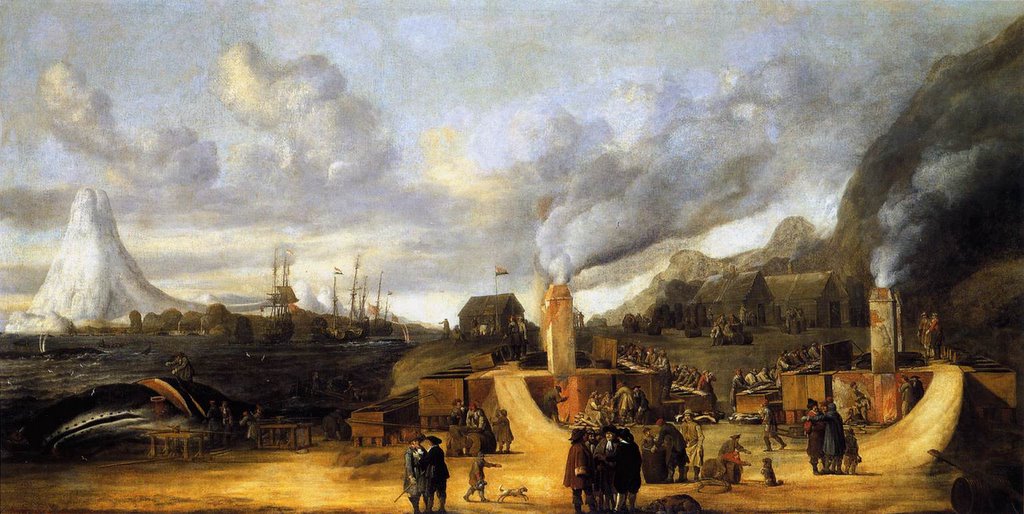 Continuing with thoughts on whales, this is a Dutch painting of 1639, of whales being flensed and reduced to whale oil in Spitzbergen. It is in the Rijksmuseum. Not the kind of thing you expect to see in an oil painting, but Dutch art had adapted itself so flexibly to recording realities, that, on second thoughts, it appears inevitable that such a subject would be executed. These would be 'Right' or bowhead whales. It seems that the fishery (mammalery?) was effective in the usual unthinking way of these things. According to the History of Whaling on the Wikipedia site http://en.wikipedia.org/wiki/History_of_whaling