Simon Sheppard is one of the few mid 17th century humourists who remain funny. Saturated in the media in which he worked (ephemeral print journals, prognostications and other pamphlets), Sheppard was an accurate parodist of others’ prose styles, inventive at producing his own absurdities, and adopted a winningly self-deprecating persona (he is usually poor and hung-over). His politics seem to be conservative, but he never seems to write with real animosity about contemporary issues or personalities.
In 1653, 54 and 55 he published (alongside his usual stream of newsletters) three parodic prognostications, Merlinus Anonymus.
My first image is of two of the absurd monthly charts from his prognostication for 1654. In place of the usual feasts and festival days, which would normally feature traditional names like Swithun, Valentine, ‘The 7 Sleepers’, Sheppard fills a column with wildly incongruous names, ‘martyrs quite forgotten by Fox’, as he puts it. Among them are the festivals of Macbeth, Othello (‘Moor of Venice’) and Venus and Adonis. He then, in the next column, gives a silly weather forecast, and finally a ‘micro chron[icle]’, which memorialises a sequence of completely trivial occurrences (‘Mr. E.R. wip’d of his nose with his handkerchief’) with the precise date of these striking non-events.
Sheppard was quite capable of writing well: in his mock prognostication for April 1653: “The JESUITS this month are like Apricoks, (formerly) here and there one succour’d in a great mans House, which cost him dear, now you may have them for nothing in every cottage…”
But Sheppard was probably filling paper at great speed, and his productions are full of unacknowledged quotations. The 1653 and 1654 mock prognostications are seamed throughout with large extracts from John Donne – satires, verse epistles, and the anniversaries, even the mock commendation in verse of Thomas Coryate. The lower part of my image is from his ‘General Prognostication for the year 1653’ in Merlinus Anonymus, where Donne’s 4th Satire, which he first quotes in verse, is turned into prose – Donne’s encounter with the libellous courtier is turned into a meeting with the astrologer Nicholas Culpepper.
It is hard to ascertain the status of these extracts. Sheppard acknowledges none of the lines as being by Donne. Whether readers were meant to recognise them as wittily chosen, or take them to be Sheppard’s own effusions is uncertain. By the 1654 prognostication, Sheppard is lifting quotations from other literary sources, and slotting them around his charts: bits of Thomas Lodge’s satires, Fanshawe’s translation of Il Pastor Fido: a set of verses about money ruling the world, and literary endeavour too, comes from Thomas Randolph’s play, Hey for Honesty!:
Did not Will Summers break his wind for thee,
And Shakespeare therfor writ his comedy:
All things acknowledge the vast power divine,
(Great God of money) whose most powerful shine
Gives motion life, day rises with thy sight
Thy setting though at noon, makes night.
Sole Catholick cause of what we feel, or see
All in this all, are but th’effects of thee.
Sheppard too was writing for money, and probably didn’t care what people thought.
The Author of The women’s petition against coffee representing to publick consideration the grand inconveniencies accruing to their sex from the excessive use of that drying, enfeebling liquor: presented to the right honorable the keepers of the liberty of Venus by a well-willer (1674) is almost certainly the same as the author of the sequel pamphlet from the same year, The Mens answer to the womens petition against coffee vindicating their own performances and the virtues of that liquor from the undeserved aspersions lately cast upon them by their scandalous pamphlet.
This is well written knockabout stuff, five minutes of amusement for a coffee house goer. The women’s petition is a complaint of male sexual failings since men took to coffee drinking:
“to our unspeakable Grief, we find of late a very sensible Decay of that true Old English Vigour; our Gallants being every way so Frenchified, that they are become mere Cock-sparrows, fluttering things that come on Sasa, with a world of Fury but are not able to stand to it, and in the very first Charge fall down flat before us…
The Occasion of which Insufferable Disaster, after a serious Enquiry, and Discussion of the Point by the Learned of the Faculty, we can Attribute to nothing more than the Excessive use of that Newfangled, Abominable, Heathenish Liquor called COFFEE, which Riffling Nature of her Choicest Treasures, and Drying up the Radical Moisture, has so Eunuch[ed]our Husbands, and Crippled our more kind Gallants, that they are become as Impotent, as Age, and as unfruitful as those Desarts whence that unhappy Berry is said to be brought.
For the continual sipping of this pitiful drink is enough to bewitch Men of two and twenty, and tie up the Codpiece-point without a Charm. It renders them that use it as Lean as Famine, as Rivvel’d as Envy, or an old meager Hag over-ridden by an Incubus. They come from it with nothing moist but their snotty Noses, nothing stiff but their Joints, nor standing but their Ears: They pretend 'twill keep them Waking, but we find by scurvy Experience, they sleep quietly enough after it.”
At the high point of the comedy occurs a misquotation from Donne – it was probably made from memory, and if the author checked afterwards, he might have kicked himself, as the original words even more apposite:
“can any Woman of Sense or Spirit endure with Patience, that when priviledg’d by Legal Ceremonies, she approaches the Nuptial Bed, expecting a Man that with Sprightly Embraces, should Answer the Vigour of her Flames, she on the contrary should only meet A Bedful of Bones, and hug a meager useless Corpse rendered as sapless as a Kixe, and dryer than a Pumice-Stone, by the perpetual Fumes of Tobacco, and bewitching effects of this most pernitious COFFEE, whereby Nature is Enfeebled, the Off-spring of our Mighty Ancestors Dwindled into a Succession of Apes and Pigmies: and
---The Age of Man
Now Cramp’t into an Inch, that was a Span.”
The tag derives fromAN ANATOMIE OF THE WORLD The first Anniversary, when Donne laments the shortness of human life in this decayed world, and then makes a rapid transition to our diminished stature:
Old Grandsires talk of yesterday with sorrow:
And for our children we reserve to morrow.
So short is life, that every peasant strives,
In a torn house, or field, to have three lives.
And as in lasting, so in length is man,
Contracted to an inch, who was a span
As I say, Donne’s original words would have gone better in the bawdy context. One can see that the author remembered that Donne was talking about longevity (who could forget those resonant first couple of lines in the quotation?), but forgot about the shift to our diminished ‘length’.
The pamphlet author, working at speed, gives an amusing enough account of the working relationship between coffee and alcohol, with the male clientele alternating between coffee house and ale house:
“Some of our Sots pretend tippling of this boiled Soot cures them of being Drunk; but we have reason rather to conclude it makes them so, because we find them not able to stand after it: 'Tis at best but a kind of Earthing a Fox to hunt him more eagerly afterward: A rare method of good-husbandry, to enable a man to be drunk three times a day! Just such a Remedy for Drunkenness, as the Popes allowing of Stews, is a means to prevent Fornication: The Coffee-house being in truth, only a Pimp to the Tavern, a relishing soup preparative to a fresh debauch: For when people have swill’d themselves with a morning draught of more Ale than a Brewers horse can carry, hither they come for a pennyworth of Settle-brain, where they are sure to meet enough lazy pragmatical Companions, that resort here to prattle of News, that they neither understand, nor are concerned in; and after an hours impertinent Chat, begin to consider a Bottle of Claret would do excellent well before Dinner; whereupon to the Bush they all march together, till every one of them is as Drunk as a Drum, and then back again to the Coffee-house to drink themselves sober; where three or four dishes a piece, and smoking, makes their throats as dry as Mount Aetna enflam’d with Brimstone; so that they must away to the next Red Lattice to quench them with a dozen or two of Ale, which at last growing nauseous, one of them begins to extol the blood of the Grape, what rare Langoon, and Racy Canary may be had at the Miter: Sayst thou so? cries another, Let's then go and replenish there· with our Earthen Vessels: So once more they troop to the Sack-shop till they are drunker than before; and then by a retrograde motion, stagger back to Soberize themselves with Coffee.”
The Mens answer to the womens petition, which I imagine the writer had ready for the very next week, voices the male response, which protests against the immoderate demands of the women, representing men knocking themselves out to give the women of England pleasure:
“Have we not condescended to all the methods of Debauchery? Invented more postures than Aretine ever dreamed of? Been Pimps to out own Wives, and Courted Gallants even with the hazard of our Estates, to do us the Civility of making us not only Contented, but most obliged Cuckolds…
That our Island is a Paradise for Women, is verified by the brisk Activity of our Men, who with an equal Contempt scorn Italian Padlocks, and defy French Dildo’s, knowing that a small Doze of Natures Quintessence, satisfies better in a Female Limbeck, than the largest Potion infused by Art.”
“Tis not this incomparable settle Brain that shortens Natures Standard”, the pamphlet exclaims, and even offers the argument is that coffee houses keep men in sexual top form: “Every coffee house has a Tawdry Woman, a wanton daughter, or a Buxom Maid.”
And anyway, it says, the long hours men take at the coffee shop are just another sexual opportunity for women: “The news we chat of there, you will not think it Impertinent, when you consider the fair opportunities you have thereby, of entertaining an obliging friend in our absence, and how many of us have you dubb’d knights of the Bull-Feather, whilst we have sate innocently sipping the Devils holy-water.”
From the earliest, quasi-medical, or traveler’s reports of coffee in the 1650’s, by 1662 there is an exuberance of coffee house titles, some of them very racy. The Maidens complaint against coffee, 1663, is a playlet. I will leave with the pungent sentiments of ‘Dorothy’ about men who drink too much coffee:
“Before I’le fling my self away upon any such dry whorson as drinks Coffee, I’le wrap my Maiden-head in my smock, and fling it into the Ocean to be bugger’d to death by young Lobsters.”
I travelled from London on Tuesday the 15th by the 3.45 train, in the 1st class Restaurant Car. When I got to Chesterfield I found that a gentleman who was sitting on the opposite side of the carriage had taken my hat and left his own. The Car-attendant said that he knew the gentleman, who lived at Bedford, and that he would arrange for me to get my hat back.
Although the exchange was, of course, a pure accident, my hat happened to be a new one, or I would not have troubled about it. It had my name in full on the leather lining.
As I have heard nothing through the Car-attendant, I should be obliged if you would have the matter enquired into.
Yours faithfully.
Item 2.
June 19, 1909
Midland Railway,
Office of Superintendent of the Line,
Derby.
Sir, I beg to acknowledge the receipt of your letter of the 18th inst. which shall have my attention.
Yours truly,
J. Elliott.
(Part-printed postcard addressed to H Westlake, Esq, Brimington Hall, Chesterfield)
Item 3.
June 26th, 1909
Dear Sir,
Referring to my letter of the 18th., and your acknowledgement of the 19th, I spoke to the Attendant in the Restaurant Car about the matter on Thursday when returning from London by the 3.45. It appears that he had spoken to the gentleman who took my hat, who acknowledged that he had it, but did not seem at all concerned as to returning it.
I send you the hat that was left in place of mine; and refrain from commenting upon it.
The action of the gentleman in question is most extraordinary; more especially as my hat had my name in full inside it, and was entirely different in shape to the one he left: and as it was a new one, I must ask you to be good enough to procure its return at once, or send me 12/6, the cost of it.
Yours faithfully.
Item 4.
Midland Railway,
Office of Superintendent of the Line.
DerbyJune 28th, 1909
Dear Sir,
In reply to your letter of the 26th. instant, I regret that your hat has not yet been returned to you. On receipt of your first letter I at once took steps to recover the hat, and hope to be able to give you a definite reply shortly.
Yours truly,
For J Elliott
Item 5.
Midland Railway,
Office of Superintendent of the Line.
DerbyJuly 13 1909
H. Westlake Esq,
Brimington Hall.
Dear Sir,
In reply to your letter of the 11th inst. I beg to say that your hat has now been obtained from Mr Blackstone and was forwarded from Bedford to Chesterfield for you yesterday.
Yours truly
For J. Elliott
Item 6.
July 14th 1909
Dear Sir,
I am obliged by your letter of the 14th in regard to my hat which was taken from a Restaurant Car, and note that it has now been obtained from the man who took it.
After it has been in his possession for a month, it is, of course, utterly worthless to me; and perhaps you will have it destroyed, or otherwise disposed of.
Yours faithfully.
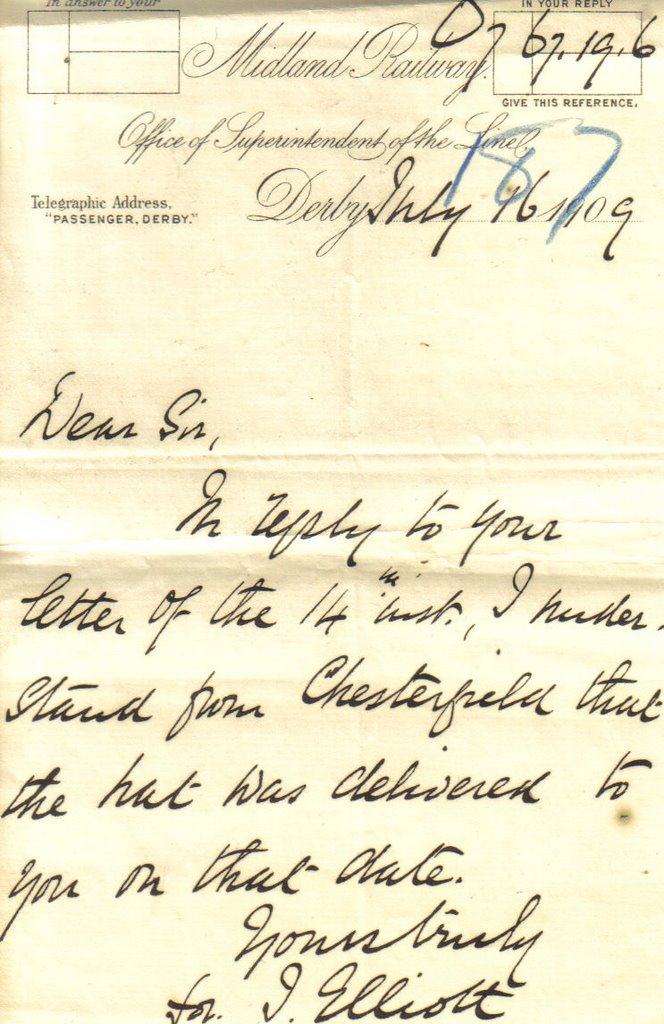
Item 7.
July 16th 1909
Midland Railway,
Office of Superintendent of the Line,
Derby.
Dear Sir,
In reply to your letter of the 14th inst, I understand from Chesterfield that the hat was delivered to you on that date,
Yours truly
For J. Elliott.
Item 8.
July 17th, 1909
Dear Sir,
The Hat was returned to me on Thursday.
The Hat-box was smashed in; but that was of no consequence, as the Hat was completely spoilt, and I at once had it destroyed.