Showing posts with label paintings. Show all posts

Tuesday, February 23, 2016

A votive painting to the witchcraft cult?


A rather pleasing witchcraft image, from the Prado’s online collection: ‘Anonymous’ and ‘17th century’, ‘oil on board’ is all they have to say about it.

As you see, we have a variant, unique as far as I know, on the type of composition that puts an elaborate garland of flowers round a devotional image. Somebody like Jan Brueghel would do the flowers, and in the centre, the virgin and child. The figures might be work (sometimes) of a different hand. Rubens worked with Brueghel on this type of decorative/devotional art.


By the model of divided labour, ‘anonymous’ here could well have been an anonymous two. The painting in the middle, a witch at her cauldron, might be by Daniel Teniers: it certainly collects witchcraft motifs from Teniers paintings. Elements from the left and right side of this 'witches' kitchen' scene have been moved outdoors:


So we have the hag with her hair blown forwards, at a cauldron mounted on a tripod over a fire. She stirs the cauldron, while she consults the book of spells in her other hand, earnest as a cook tackling a difficult recipe. At her feet, a skull, ointment pot, and perhaps,  her athame. Music is provided by a zoomorphic attendant wearing  a peculiar hat, who is playing a nose flute, another zoomorph stands and holds a dim taper, while a crouching small demon blows the fire. Other weird faces gaze from the gloom at the scene, toad-like, bat-like, fishy or reptilian. The moon, banded by clouds, is high in the night sky.


The charm and novelty lies in the surrounding cartouche and swags of foliage. A carved lugubrious face of a dog stares from the top. Mushrooms are tied in bunches with coarse string. They seem to be ordinary boletes, rather than any poisonous type of fungus. The foliage is yew (at the top), ivy (of course), wild hops, acorns and a cherry oak gall. Spiky plants are accumulated: briars and thistles.
Notes of subdued colour are provided by a single bluebell, a buttercup, a clover head, a sow-thistle and a larkspur. The artist has not gone for melodramatic flora: it isn’t deadly nightshade, henbane, hemlock, monkshood, but just a set of ordinary enough plants. Seasons have not been observed, for we have a bluebell and ripening blackberries.


The insect life is also mundane, consisting of large and small flies on the upper volutes, balanced by a grasshopper and a wasp on the shelf or plinth below, like miniature armorial bearers. A meadow brown butterfly perches on one thistle head, a wasp or bee on another, then there is a caterpillar on a mushroom, with a shiny beetle adjacent to it. No scorpions, no great big hairy spiders, no devil’s coach men.


Who commissioned or bought this painting? It was obviously created as an object of curiosity. In itself, a fantastic world of impossible beings is surrounded by a thick border of unremarkable things: the type of plants you might ignore or tread upon, annoying little creatures you’d swat away. As a parody of the floral-devotional image, it has a sly mischief to it, prompting  a double-take from the onlooker, who might have taken it for one of those paintings that make a tribute of flowers to a divine figure that had got darkened by smoke or discoloured varnish. Instead of Mary with a verge of vibrant flowers, a composition that pushes towards us with colour and a reminder of faith, this image recedes away past mundane things into a haunted night. A familiar form of cult object is wittily - or daringly - turned into an object apparently venerating another cult.


Tuesday, September 23, 2008

'Make the jewel which you paint seem Rich'


I am gearing up to take a party of students off to ‘Renaissance Faces’

http://www.nationalgallery.org.uk/exhibitions/renaissancefaces/default.htm

The image above is a Hilliard of an unknown lady (in the collection of the Metropolitan museum on their pleasing website here: http://www.metmuseum.org/toah/hd/liza/hd_liza.htm); but I thought I’d expound a little on one of his lost works, one that would have been the companion piece to his famous ‘Young Man Amongst Roses’. The lost portrait was commended in a sonnet by Henry Constable:

‘To Mr Hilliard, upon occasion of a picture he made of my Lady Rich’


If Michael the archpainter now did live,
Because that Michael he an angel hight,
As partial for his fellow-angels, might
To Raphael’s skill much praise and honour give.

But if in secret I his judgment shrive,
It would confess that no man knew aright
To give to stones and pearls true dye and light,
Till first your art with orient nature strive.

But think not yet you did that art devise;
Nay, thank my Ladie that such skill you have;
For often sprinckling her black sparckling eyes,
Her lips and breast, taught you the [.....]
To diamonds, rubies, pearls, the worth of which
Doth make the jewel which you paint seem Rich.


In his rather stilted first quatrain, Constable sets off on Michaelangelo having a high opinion of Raphael, product of an angel-Angelo’s bias towards another angelically-named painter. But, says Constable, if I had a living Michaelangelo’s secret opinion disclosed to me under confession, he would drop this bias, and confess to Hilliard’s superiority. The specific superiority is in representing jewels with undiminished lustre. Joan Grundy in her edition of Constable makes a very apposite citation of Hilliard’s own ‘Arte of Limning’: ‘Limning excelleth all other painting whatsoever in sundry points, in giving the true lustre to pearl and precious stone’. This shows that Constable was following Hilliard’s own opinion: the highest art is shown in rendering the most precious things.


But he was also working towards a play on ‘Rich’. He next tells Hilliard that actually he owes these skills to having painted Penelope Rich’s eyes, lips and breast: it was doing this that taught Hilliard how to render jewels. The sonnet ends with a clever commingling of Penelope Rich in the miniature (a true likeness), and the miniature painting as a piece of composite jewelry, because of her brilliant eyes, ruby lips, etc. Only by being very convincing can the precious things depicted contribute to a convincing Penelope Rich.


The gap in the manuscript leaves us three syllables short. Park in 1812, Joan Grundy noted, suggested ‘art you gave’. I thought ‘way most brave’ – the best way to learn how to depict precious stones, with a hint of the authentic 16th century attention to getting riches for yourself from your patroness.

But, so sadly, the miniature doesn’t survive. Joan Grundy suggests that Henry Constable may have taken the miniature up to the Scottish court in 1589, when the Earl of Essex and Penelope his sister were making overtures to James VI of Scotland, indicating their future loyalties lay with him rather than Arabella Stuart. How could the greatest miniaturist’s portrait of Sidney’s Stella ever have been so undervalued as to be lost? It must have been comparable to his famous image of her brother as the young man among roses. I imagine its fate: King James subsequently gave it to Charles Blount, it passed down in that family until someone wanted to re-use the case for another portrait miniature. Lady Penelope, limned on uterine vellum wrapped round card, got placed in a drawer. A 17th century teenage boy thought she was the most wonderful thing he’d ever seen, and stole her away.


So we have to make do with a sonnet about the painting of the lady in the sonnets. Lady Penelope Rich, a dark-eyed blonde, is associated throughout ‘Astrophel and Stella’ with light, as ‘star’ and in many other imaginative ways (‘and Stella spied / Who hard by made a window send forth light’, 53 – ‘and hath she vanished by?’, 105). I imagine, then, Hilliard’s miniature as Lady Rich wearing stunning jewels, and with glittering dark eyes. The care Hilliard took in painting the pupil of an eye! Freshly made paint of the blackest black, the pigment made utterly smooth with a mounted tooth of a squirrel as a diminutive grinder, the finical care lest a mote of dandruff fall down from the artist’s head… If only we had the portrait that complemented those Sidney sonnets!


Thursday, February 28, 2008

Panoramas of paradise, and early modern dodos.


I am faintly surprised to have the privilege of giving a lecture on book IV of Milton’s Paradise Lost. (I half expect a distinguished former Hildred Carlisle Professor to stir from retirement, and intervene personally, to stop such a potentially damaging mismatch between poet and expositor.) But I have been scurrying round EEBO: Willet’s Hexapla … on Genesis, Moxon on Sacred Geography, Salkeld’s Treatise on Paradise and others.

Among the minor finds on this tour, I came across another piece of 17th century advertising, put together by I.H. Gent in 1661:

Paradise transplanted and restored in a most artfull and lively representation of the several creatures, plants, flowers, and other vegetables, in their full growth, shape, and colour: shown at Christopher Whiteheads at the two wreathed posts in Shooe-Lane, London.

‘J.H.’ claims to have been solicited by ‘some persons of quality’ that have already seen this combination of panorama and perspective box (as I think it must have been) to put pen to paper to praise ‘the incomparable Artist’ and ‘recommend this Elegant and curious piece of Art to all Noble and Ingenuous Persons’. He gives it a hard sell, but no-one could fault the ambition of the main display:

‘The Design, is a Model, or Representation of that Beautifull Prospect Adam had in Paradice, when the whole Creation of Animals, were together subjected to his imperious eye, and from his mouth received their several names.”

J.H. (who may well be the man himself) notes of the artist that:

“His researches and inquiries after Foraign, Outlandish Creatures, whose names are not so well known to these Quarters of the World … was a costly Labour; but to present them to view in their natural shapes and postures to the Life, and beyond all former Figures and Descriptions of them, as that every man may be as wise as Adam, and read their names and qualities in their Aspects, is a most meritorious obliging work …. Here …are placed from the greatest to the least, from the Elephant to the Mouse, from the Eagle to the Wren, from the Crocodile to the Glow-worm.”

You are advised, confides J.H., to make sure you see the basilisk before it sees you, lest your imagination accord the image with the beast’s power to petrify, while the centre piece of the display was equally or more involving: “you cannot without indignation of minde see the accursed Serpent putting the deadly Apple into out Grand mother Eves hand: and were it not that this malicious fraud is acted at the furthest end of the Room; and out of your reach, you would put forth your hand to prevent that destruction.”

The panorama came with its own trompe d’oeil audience:

“On the left side of the Room, are five beautifull Ladies seated, beholding these curiosities, a person of quality standing by them, attended with three Blackmore Lacquees in rich blew Liveries.”

J.H. affirms that these paintings (or just possibly wax effigies) are so realistic, other visitors bow to them ‘and have wondered at the non-return of their Civility’, while a ‘Consort of Musitians of commonly known faces’ – 17th century pop stars, look you - was also represented behind the door, ‘all so exact and to the Life, that people on a sudden glance, suppose they shall have Musick too, as in other Shows and Plays, for their money’.

As with Dutch panoramic paintings of Eden, the animals seem to have been the main subject, with Adam and Eve just the opportunity and pretext. Even in the main room, the subject matter extended from the biblical scene into ‘the divertissement of Hawking, in the several Flights of the Tassel, the Lanner, the Marlyn, and that merry sport of the Hobby.’ This said, Andrew Willet’s Hexapla … on Genesis does mention, in solemnly deciding that all animals lived off the super-nutritious herbs of Paradise before the Fall, that one commentator had suggested that Adam could have enjoyed hunting as a sport even in the pre-lapsarian state: God had given him all the animals, therefore he could legitimately kill some of them for his pleasure.

The Artist of the 1661 show must have been English rather than the whole assemblage having been brought over from Holland, for J.H. reports that the painter still makes daily additions, ‘replenishing this Work’, and also does visitors a commentary on the animals he had so consummately brought to life.

Downstairs from this main room, things were more secular, with a depiction of Heliogabalus’s feast - as it were, all the animals just seen upstairs now cooked and served up for consumption. J.H. is artful enough to hint that there may also be a naughty final display, ‘a Banquet (tis not for a masculine palate, and therefore I shall not insist upon those sweet Kickshaws) there is nothing wanting here, to serve a Ladies desire, and to keep it; for its twenty to one if here ye be not bigger then her belly’. Might it have been of Adam?

London in 1661, a few years before Paradise Lost, and Milton’s forthcoming subject matter as a raree-show in a tavern.

My image is one of Roelandt Savery’s paradise pictures, with the Holy Roman Emperor’s dodo at bottom right. Savery worked for Rudolph II over in Prague, and Peter Marshall’s account in The Mercurial Emperor: the Magic Circle of Rudolph II in Renaissance Prague mentions its presence in the menagerie there.

Tuesday, November 06, 2007

You make me feel like (not) dancing: early modern Salome


I was spending an idle but contented hour this last Sunday afternoon looking at YouTube clips of Rita Hayworth dancing, and singing (I mean, gosh, chaps), sometimes with Fred Astaire, sometimes solo. I do not think I have ever seen her as Salome in the 1953 film, and maybe this is one of those things that will always be better in one’s imagination, for all that inimitable Hollywood style surely turned cheesy when historical or biblical subjects were attempted.

But I was led back to the early modern versions: mainly, and predictably they disapprove mightily. Salome as a name doesn’t have its later resonance: she is generally referred to as either ‘Herodias’s daughter’, or simply as ‘Herodias’. She crops up with regularity in general dispraises of women, and stars in that most woman-hating of early modern plays, Elizabeth Cary’s Mariam. But for the early modern stage-hating Puritan (John Rainolds, and William Prynne, and to an extent in Thomas Beard) Salome is the great Bible instance of the wickedness of performance. Prynne is apoplectic (and silent about David dancing before the Lord):

“All these, with sundry others, unanimously condemne all mixt, effeminate, lascivious, amorous dancing, (the epidemicall pastime of our dancing, loytring age) as sinfull, hurtfull, unlawfull to all chaste, all sober Christians, as the reasons they alleage against it will more plainely evidence. For first, (say they) as there is no allowance, no approved example of any such dancing in the Scriptures, the Primitive Church, the Fathers, or in the lives and practice of the Saints of God in former ages, (who as appeares by the fore-quoted Councels and Fathers have alwayes censured and exploded Dancing:) (Prynne here supplies dozens of bible citations) doe either absolutely in expresse tearmes, or else by way of necessary consequence, condemne such dancing as Idolatrous, Heathenish, carnall, worldly, sensuall, and misbeseeming Christians.

Prynne now moves on to the revelation, derived from various fathers of the church, that the girl who danced before the leering Herod was in fact the multi-talented Devil himself:

“Secondly, the very Devill himselfe (write they) who danced in the Daughter of Herodias Math. 14 6. 7. (as Chrysostome, Fulgentius, Theophylact. and others write) was the originall Author of this dancing, the onely instrument who excites men to it; the onely person that is present at it, that is honored, pleased, and delighted with it; (he being ever-more present and president where such dancing is) as Chrysostome, Basil, with the other Marginall Authors have plentifully recorded.

I wonder in what church father or rabbinical tradition the death of Salome was first invented? Joseph Beaumont had something of a specialism in writing disapproving poems about the bible’s best dancing girl (so we can imagine he was particularly susceptible to these things). So his (for him) short poem about John the Baptist ends with a vehement account of her fate:

One Dance for Thee is still behind
By which Revenge thy Crime will find:
The Ice perfidious to Thee,
But unto Justice true shall be,
When it shall catch
Thy neck, & snatch
Its Head away,
Which there shall play
And dance a tragik Measure on
That fatall Pavement: then shall John
Wth greater glory view Thee from his Sphear,
Then Herod at his Feast beheld Thee heere.

Here we see that her command of a performance space leads to appropriate retribution: the thin moral ice on which she fandangoed was literalised into ice which broke beneath her, and as she went through, visited on her the decollation she’d inveigled out of Herod. All positions having changed, the Baptist is now the gloating spectator. Henry Vaughan has a similar poem, which also alludes to this, and here it is with his marginal note:

‘The Daughter of Herodias

Vain, sinful Art! who first did fit
Thy lewd loath'd Motions unto sounds,
And made grave Musique like wilde wit
Erre in loose airs beyond her bounds?

What fires hath he heap'd on his head?
Since to his sins (as needs it must,)
His Art adds still (though he be dead,)
New fresh accounts of blood and lust.

Leave then yong Sorceress; the Ice*
Will those coy spirits cast asleep,
Which teach thee now to please his eyes
Who doth thy lothsome mother keep.

But thou hast pleas'd so well, he swears,
And gratifies thy sin with vows:
His shameless lust in publick wears,
And to thy soft arts strongly bows.

Skilful Inchantress and true bred!
Who out of evil can bring forth good?
Thy mothers nets in thee were spred,
She tempts to Incest, thou to blood.

*Her name was Salome; in passing over a frozen river, the ice broke under her, and chopt off her head.

My image is taken from the impressive collection assembled over in Bucharest by the owner of this weblog:

http://brechto.blogspot.com/2007/05/salome.html

It is by Guido Reni, and shows a fabulously demure Salome receiving the Baptist’s head. I chose this from Mihai’s scholarly collection of these things because I thought it was latently self-subverting. Surely, here, there is some kind of contamination from memories of David with the head of Goliath? The boy staggering under the weight of the Baptist’s severed bonce giganticises the prophet: Salome is so modest, that she becomes saintly, a Judith.

But, of course, appearances are deceptive, and I must remember that Mr Prynne has let me know that she is really the devil. All change places now.

Saturday, April 07, 2007

His winged Monitor


When they had gone, an angel of the Lord appeared to Joseph in a dream. "Get up," he said, "take the child and his mother and escape to Egypt. Stay there until I tell you, for Herod is going to search for the child to kill him." So he got up, took the child and his mother during the night and left for Egypt, where he stayed until the death of Herod. And so was fulfilled what the Lord had said through the prophet: "Out of Egypt I called my son."

Matthew, 2, 13-5


I suppose I had seen this painting before on the WGA, but came across a far better scan of it on the excellent Giornale Nuovo, http://www.spamula.net/blog/

Elsheimer’s (now I see it properly) beautiful ‘Flight into Egypt’. The WGA also has other artists handling the theme, while Olga’s gallery at

http://www.abcgallery.com/religion/flight.html

includes the subject in the topical index.

But I don’t think that any approach the quality of Elsheimer’s version, with the Holy Family benighted, beneath a sky which seems to me to be ostentatiously unsupernatural. It is the night sky as people must have known it then (the painting dates from 1609), with the Milky Way very apparent: but no glories, no angels, nor cherub heads. Many painters take their cue from the angel that appears to Joseph in Matthew’s Gospel, and add in a set of celestial companions. This Holy Family are alone, traveling rather than resting, and heading for the painting’s left border (rather than the right). But they are certainly travelling South: the Great Bear, accurately seen at the top right, points as it must to Polaris over their shoulders. Elsheimer gives Joseph more dignity than the rather blockish (bald, bearded) senior citizen most artists come up with when prompted to imagine a Jewish carpenter married to the B.V.M. I cannot work out what it is that, held like a pen, Joseph is holding near the child’s hand.

Odd, too, are the shepherds with the fire at the left: that swaying ascent of sparks, and the goat on its pinnacle of rock, combine make these otherwise quite innocent figures look like an allusion to a witchcraft scene. A full moon reflected in water, wind-burnished stars, dark trees, sparks from an open fire: by these means Elsheimer communicated mystery and peril to the viewer. A New Historicist would say that a circulation of social energy makes the fireside scene at the left resonant.

There's a lot of scholarship on the painting: Anna Ottavi Cavina was interested in the faint chance that Elsheimer knew something extra about the Milky Way from Galileo, who would publish his telescopic findings in the year after Elsheimer's work, and Keith Andrews riposting in a long series of commentaries. Apparently Elsheimer would never part with this picture.

Not a common subject in poetry: there’s a Southwell poem on the subject, and I found in Joseph Beaumont’s Psyche, Canto 8, ‘The Pilgrimage’, a long excursus by the poet on his namesake’s biggest biblical moment:

Now therefore as in Slumber's arms they lay
(For 'twas high midnight) Joseph's winged friend
Rousing his soul up by a mystic ray
Bids him his speedy flight to Egypt rend;
For Herod's spite contrives to slay, said he,
The Infant, and in him thy Wife and Thee.

This said; his nearest way the Angel took
Homewards, loud fluttering as he mounted up:
The noise made Joseph start; who strait awoke;
But his wing’d Monitor had gain’d the top
Of heav’n, and in the spheres inclosed was
Ere Joseph's following eye could thither press.


Yet by his blessed influence left behind
Th’instructed Saint the Spring entirely knew;
The privileg’d eyes of his religious mind
Had long acquainted been with Him, and now
He doubts not but 'twas his dear Guardian, who
Had taught him oft in straits what he should do.

Whilst by her sable curtains Night as yet
Muffled up Heav’n, and kept the World in bed;
Into his cloths he leapt, and made all fit
For his long journey: On the Ass he spread
His Coverlet, and his best Pillow (sweet
And cleanly hay) afforded him to eat.


The Beast thus baited; He his Axe, and Saws,
His Planes, Rules, Mallets, and his other store
Of busy honest Implements bestows
Close in his Bag, the treasury of his poor
Industrious subsistence; which he ties
Fast to his staff, and on his shoulder tries.


Which done; two bottles (all the good man had)
Fresh filled at a neighbour fountain, he
Hangs on his girdle, with his pouch of bread:
With all things thus accouter’d, reverently
He stepped to the bed where Mary lay,
Crying, Arise; Heav’n calleth us away.


When She the business heard, and saw how He
Had all his honest sumpture ready made;
Far be it, she replied, that I should be
At any hour to follow Heaven afraid:
Or loitering for the morning’s light should tarry,
Who in my arms my fairer Day shall carry.

I can be nowhere lost, dear Babe, while I
Travel with Thee, who never canst depart
From thine own home: so far thou canst not fly,
But thine own Land will meet thee still, who art
By thine eternal Right, the Prince as well
Of Ham, and Egypt, as of Israel.

… This early Master thus the noble Art
Of Patience 'gan to teach his world below;
To sanctify all Persecution’s Smart,
And make it by his owning glorious grow:
Who but new-born, designed is to die,
And long ere he can go, is fain to fly.

… O pity then thy Lord … who though
Spurr’d on by fear, was forc’d to use a pace
Below the name of speed; whilst Joseph, who
Himself was laden, leads the heavy Ass.
He led him, and although he made no stay,
Alas his very going was Delay.


For on his breast a thousand massy Cares
More sadly sate, than on his back the load
Of all his Tools: what thoughts of Herod's fears!
What studies how to 'scape the full-eyed Road!
What tenderness to keep the Mother warm!
What dainty dread that God should take no harm!


… There did the careful Mother light, to give
Her Son his diner from her lovely breast;
Whom with right seemly welcome to receive
Kind Earth those sweetly-swelling Cushions drest.
Where’r you see th’officious flowers meet
In such a junto, know it was her seat.


Friday, May 05, 2006

A book that says something about someone else: Margaret Roper reads her Seneca


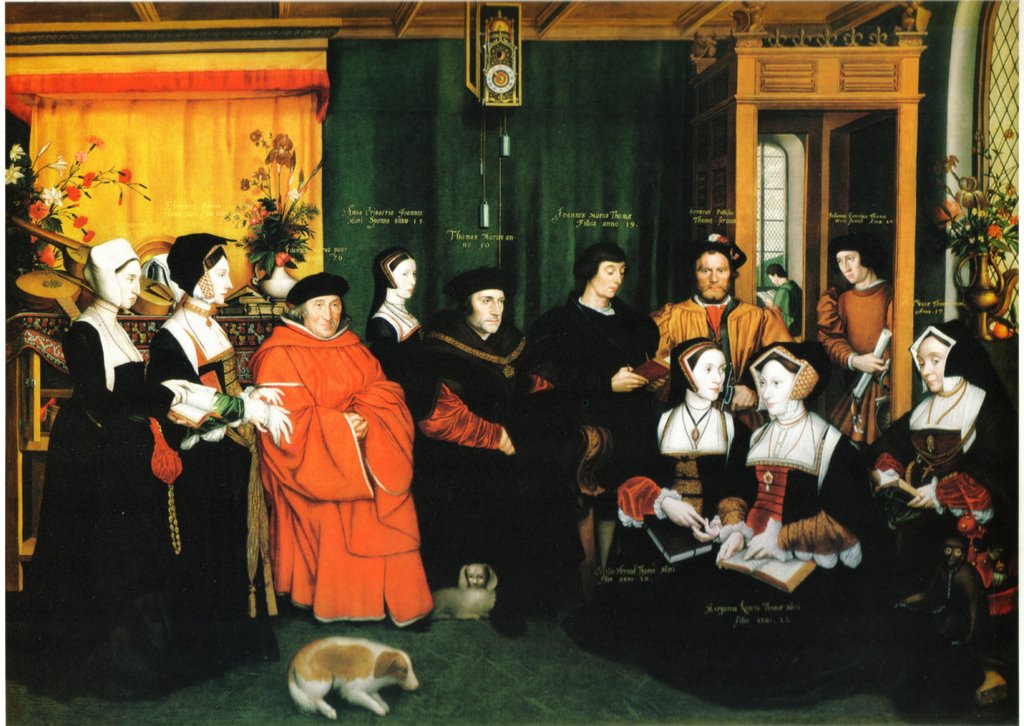
Rowland Lockey's copy (so attributed) of the lost Holbein, 'Sir Thomas More and his Family', in the Nostell Priory version. The Utopian household, learned and harmonious. From the left, Margaret Giggs, his adoptive daughter, and Elizabeth Dauncey, More's daughter (21). More's father John (76), then Anne Cresacre, a fifteen year old about to marry More's son John. She has wandered into this family of early modern egg-heads, and was the one who unwisely asked for a 'billement of pearls' as a wedding present. Always ready with a jest at the expense of young women and vanity, More gave her a 'billement' of dried peas. More himself, central, but deferring a kind of centrality to his father (in the approved Utopian manner) through the brilliant scarlet of the older man's robes pulling the eye left. More is 50. John More the son (19). Then Cecily Heron (20), and to continue along the front row of women, Margaret Roper (22), and Alice, Lady More (57), seated in this version of the composition, and looking aside, rather than kneeling at prayer. As More's second wife, the More children in this group are her step-children. A back row of male servants: first of them Henry Patenson or Pattison, fool to the household, the one sitter who looks out at us (he seems to grip, left-handed, the scabbard of a sword at his belt). Some would have you believe that the man in the background, more reasonably identified as Dr John Clement (tutor to the children of More, and husband to Margaret Griggs), is one of the lost Princes in the Tower, living incognito in More's Chelsea household. It is almost 11am. The clock in the picture was reputedly at Nostell until the 19th century, when it was sold to an American, and has never been seen again. As there are peonies, carnations and lilies, it is early summer 1527. More has not yet replaced Wolsey as Chancellor; trouble is three years away, he will be executed eight years later.

As Susan Foister points out in her Holbein and England (2004), the picture has a quality of stillness. Holbein assembling the 11 sitters from solo drawings, so interaction was not easily caught. But to the point of this post: Margaret Roper is reading Seneca. My memory failed me in my earlier post: it is a text of Oedipus, which I once deciphered by standing contorted in front of the painting. The passage which she points out is line 882 onwards, the Chorus at the end of Act IV: 'Fata si liceat mihi / fingere arbitrio meo...':

'Had I the chance, to shape my fate / To my desire, then I would trim my sail / To gentle winds, not fight against the gale / Till timbers trembled at its weight. / Not buffeted from side to side, / But borne by the light breeze's gentle force / On a safe middle course / My ship of life would ride.'

The Chorus goes on to repeat the tale of Icarus, and its final sentiment is: 'Wherever man exceeds the mean, / He stands upon the brink of danger.'

Not Holbein being amazingly prescient, but his later copyist's way of epitomising the daughter's view of her father's fate, the inability to compromise that doomed him. More's wife was incredulous at his folly: 'You have at Chelsea a right fair house, your library, your books, your gallery, your garden, your orchard, and all other necessaries so handsome about you, where you might in the company of me your wife, your children, and household be merry. I muse what a God's name you mean here still thus fondly to tarry.' By the quotation singled out for her, some of that incredulity has been transferred to More's more comprehending daughter.

Wednesday, May 03, 2006

A book that says something about you


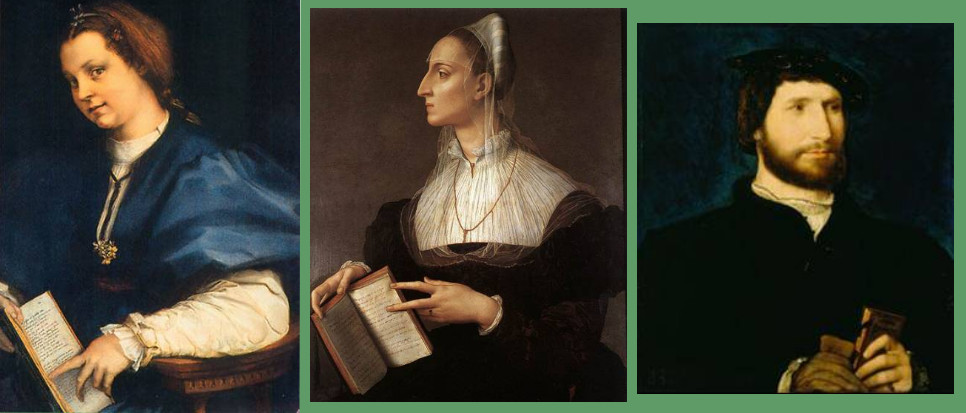
I was interested by this http://earmarks.org/archives/2006/04/19/91 posting on the 'Earmarks in early modern culture' blog. Off at a bit of a tangent, but these images (Andrea del Sarto, 'Lady with the Petrarchino', Bronzino's portrait of Laura Battiferri, and Jean Clouet's man reading) all advertise the importance of a particular book, and use Petrarch to say something about the sitter. Both lady sitters clearly invite the reader to locate a particular poem. There must be many more portraits like this, where a culturally prestigious text is hoisted into view. Not quite the same thing, but the Rowland Lockey copy of Sir Thomas More and his Family at Nostell Priory I have seen close up, where his daughter Margaret Roper points at a text of Seneca's (then attributed) 'Octavia' - a chorus about shaping your sails to gentle winds. At a cursory search, there's no good web image around of that painting, so I might scan my own reproduction as a future post. The Van Dyck portrait of Sir John Suckling with his copy of the Shakespeare folio daringly flaunts such a modern allegiance. Ahead of his time, was Sir John!

Thursday, April 27, 2006

Oh my Africa, my new-found land?

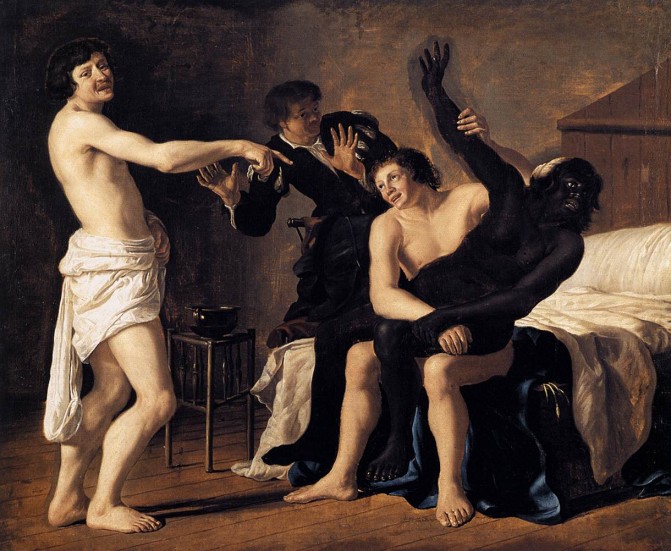
This is a very offensive image, and I curtail my parody of Donne before I make things worse. The artist is Christiaen van Couwenbergh, and the date 1632. What was going on in his little head when he painted this?

Rape has always been a subject for art, in its most imperially sanctioned form in the various handlings of the Rape of the Sabine women. Lucrece next, and you can add all the mythological victims – Proserpina, Europa, Dejanira, the daughters of Leucippus, Helen, the struggles of the Lapiths and Centaurs. The handling tends towards the queasily sumptuous, even sometimes, with Lucrece, to the tragic.

In the early 17th century poetry of England, interracial love poems (of sorts) get written, they develop a popular motif of dissimilar or unequal lovers (more commonly love across the generations). Cleveland has ‘A faire nymph scorning a black boy courting her’. This is Henry Reynolds turning a lyric:

Stay lovely Boy, why fly'st thou mee
That languish in these flames for thee?
I'm black 'tis true: why so is Night,
And Love doth in dark Shades delight.
The whole World, do but close thine eye,
Will seem to thee as black as I;
Or op't, and see what a black shade
Is by thine own fair body made,
That follows thee where e're thou go;
(O who allow'd would not do so?)
Let me for ever dwell so nigh,
And thou shalt need no other shade than I.

Such poems go into the song books of Henry Lawes, with answer poems of the same kind. Rather more substantially, this is John Collop, ‘On an Ethiopian beauty, in Poesis Rediviva (1656)

Black specks for beauty spots white faces need:
How fair are you whose face is black indeed?
See how in hoods and masks some faces hide,
As if asham'd the white should be espi'd.
View how a blacker veil o'respreads the skies,
And a black scarf on earth's rich bosome lies.
When worth is dead, all do their blacks put on,
As if they would revive the worth that's gone.
Surely in black Divinity doth dwell;
By th' black garb only we Divines can tell.
Devils ne're take this shape, but shapes of light;
Devils which mankind hurt, appear in white,
When Natures riches in one masse was hurl'd,
Thus black was th' face of all the infant world.
What th' world calls fair is foolish, 'tis allow'd,
That you who are so black, be justly proud.

It was the mention of black patches that set me off on this train of thought. Collop’s poem perhaps develops all the poetry about (native English) women who had the non-regulation black hair, with perhaps a touch of ‘The Song of Songs’ stirring in the writer’s memory.

But Couwenbergh’s painting! I do not think that he was a Dutch Goya, recording horror. He is at best a lumpen type of dauber. The Web Gallery of Art offers his aggressive and beefy Adonis with Frau Venus, and a bad costume drama ‘Samson and Delilah’. His mythological and biblical subjects all look so stereotypically Dutch that he might as well have given them clogs. If he had any aesthetic intention here, it was perhaps a desire to contrast black skin and white, and if this were the case, then he failed his own challenge. Maybe the painting is damaged and overpainted, but the modeling on the black girl fails completely, large parts of her are two dimensional. Her upper body writhes in a horrified attempt to escape, her lower body sits inert. The younger man who has (perhaps) betrayed her to this attack gazes slavishly for approval at the older man, who gloats on behalf of the viewer. The clothed man at the rear is there, it seems, to emphasise that her Nubian or Nigerian blackness is at once funny, and shocking.

The Dutch were building an empire, and this is what empire means: human beings to degrade in play. She is, I take it, a servant (I think she is wearing a maid’s cap). Her unheeded cry of distress will be in the pidgin she has learned to use when meeting other Africans or Asians when out on her errands, a funny Portuguese-Dutch that also makes her suitable for this maltreatment, this palaver.

Who owned this painting, and where did they hang it? How could it have survived so long after its pornographic moment?

It is in the Strasbourg Musee des Beaux Arts, though their website does not draw any attention to it. One of my favourite pictures hangs there: http://www.musees-strasbourg.org/F/musees/bbaa/beauxarts_oc2.html
Nicolas de Largillière, La Belle Strasbourgeoise (1703). Only a small image, there is a better one at:
http://artyzm.com/e_obraz.php?id=950


Friday, April 21, 2006

The Proposition: and a woman's reply


As we are interested in the notion of women using art to reply to a male exponent of the art form, this painting by Judith Leyster of 1631, ‘The Proposition’. It took me a while to re-find it on the invaluable Web Gallery of Art, and all I know (and vaguely remembered) about it and how it has been interpreted comes from there, where it says (with my italics):

“An intriguing painting … offers a view of an old man displaying coins to a dramatically lit young woman sewing by lamplight. His hand resting on her shoulder suggests that he is not offering payment for her labour as a seamstress. Is he making a proposition for sex which she virtuously ignores? This interpretation has been offered, and with good reason. The theme had been used by northern artists since the Renaissance … To be sure, Leyster's young woman has nothing in common with the readily seductable recipients of offers of purchased love depicted by earlier artists. Leyster's young woman steadfastly remains occupied with her sewing, a model of domestic virtue. If this reading of the subject is accepted, the painting can be viewed as Leyster's critical response to the salacious treatment of the subject by male artists who demean woman by representing them as sex objects exploited by men. It also would qualify the picture as Leyster's only painting that treats a feminist issue.”

It is an interesting painting, its slightly off-balanced quality helping to make it feel to the viewer (too) that the man simply should not be there. He comes from behind her, black to her white, and encroaches. His effrontery is captured in his intrusive stance, the suggestion of his forced smile, his raised eyebrows: he will chink those coins to get her to look at them, a good handful too, he thinks. She has gone rigid, and tries to keep her focus on her work, but into the light of that very naked flame he puts what he thinks will buy her. You can read her tension, her resentment. If she looks at the coins, she is close to the flame; for her virtuous labours are not well paid.

A dear friend of mine told me that once, when she was dancing at a disco, a moneyed fellow student, scarcely known to her, approached her with, as she put it, ‘a straight cash offer’. Of course, I asked her how much it was, but this she was not willing to disclose, whether for fear of creating a bidding war, or because the sum was ultimately unimpressive (for she was a vibrant young woman) I don’t know. Dare I guess that any woman in the position of this eminently respectable, neatly coiffed and immaculate girl will have at least some curiosity as to just what has been offered for her ultimate favours? That is why she must not even look at his hand, for then she is on the way to putting a value on herself, and she knows that she is beyond price. She can smell the drink on his breath. Go away, greasy man!

http://www.wga.hu/art/t/terborch/3/soldier.jpg
on the Web Gallery of Art gives Gerard Terborch doing the same kind of theme: though in his picture, the girl is assessing the money offered.

Saturday, March 25, 2006

Two Interiors


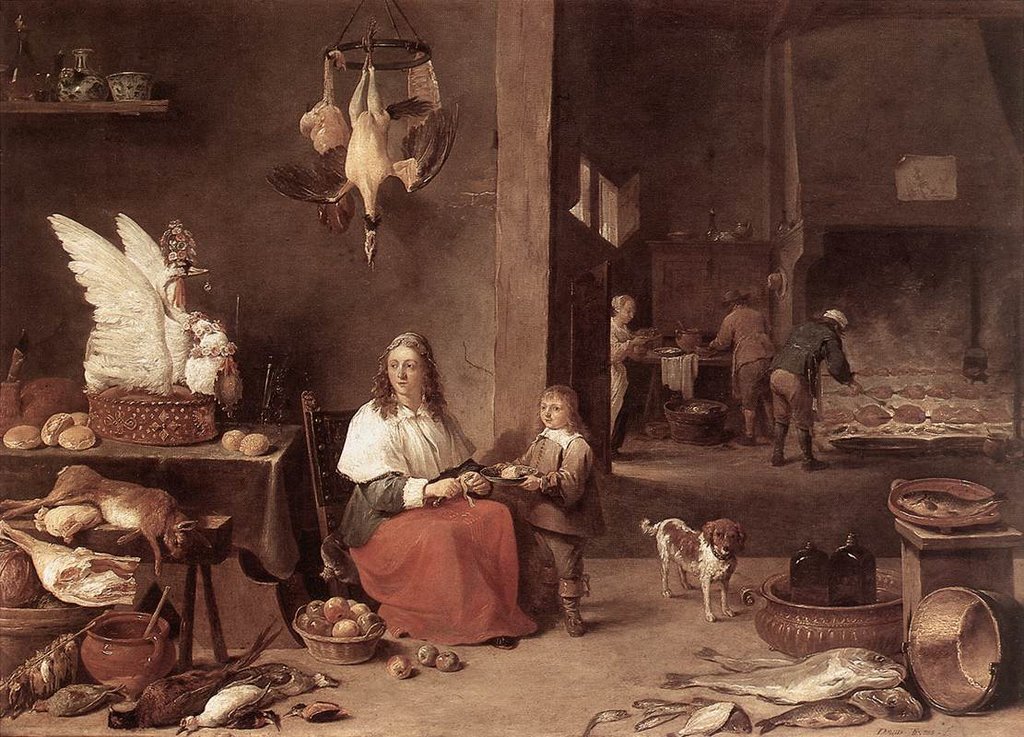
Two interiors by David Teniers the Younger (1610-90), one a kitchen scene, the other, witches preparing for a sabbath. What amuses me is, which is the scene of horror? Mrs Teniers sitting peeling apples among a hecatomb of slaughtered animals, or Mrs Teniers getting ready to meet Satan? The swan pie, decorated with a floral crown and (I think) with the bird’s beak gilded (for that was the classy way to serve swan) is scarcely less grotesque than any of the zoomorphs and serras in the witchcraft picture. The dead things hanging overhead are merely brought back to life as transitional beings in the sabbath scene, the hag making witches’ brew is just another cook preparing soup, in both interiors, the chimney has prime importance: wide enough to roast birds on spits six in a row, or to fly up, preceded by a spirit in animal form. And Mrs Teniers, demurely looking round in both pictures: is that her husband arriving, or is it the Devil?

That the ‘embarrassment of riches’ looks so like the chaotic accumulations of witchcraft perhaps indicates that Teniers was doing these pictures rapidly, reproducing poses that he knew, quoting himself. I see that he is the 9th ‘most stolen’ painter in a list inevitably headed by Picasso: lots of minor, ill-guarded galleries must have pictures by this indefatigable and long-lived artist. What he lacked in outright quality, he made up for in quantity. Yet Teniers could be subversive: another kitchen scene is populated solely by macaques, as if he did see the strangeness of ordinary things, and then the ordinariness of the strange.

The town of Reading still has a proper game butcher, Vicars: not everybody is affronted by meat still in its fur, or feathers. Black blood shows at the nostrils of hares, sometimes a few redder drops show in the sawdust. Tell me, I say to my students, lecturing on Hero and Leander (‘Even as a bird, which in our hands we wring / Forth plungeth, and oft flutters with her wing…’ – that most subversive appeal to common experience, as Leander finally gets his way with Hero), has anyone here ever had to kill an animal to eat? And sometimes, someone has had to do that, in the normal course of things on the farm. That kitchen, in the painting, is so close to the exterior world - in through the open door and onto the spit it goes. In supermarkets, the meat counter is always far from the daylight, the rain and the wind.

(The Teniers picture of the kitchen and that of the apes are at http://www.wga.hu/index1.html

if you enter 'Teniers' in the 'Author' search box.)