Wednesday, November 29, 2006

‘In Xanadu did Bin Laden, / A stately pleasure dome decree’

The effect of too much (and too easily accessed) information on practical criticism.

I was preparing a class on some Coleridge poems, for a set of first year students/victims.

I'd fairly quickly located the exciting hypertexted ‘Kubla Khan’ at

http://www.webwritingthatworks.com/CPOEMSXanadu.htm

and after not very much browsing in that ‘three dimensional’ rendering of the poem and its sources, I came across Samuel Purchas’s account of Aloadine, the Old Man of the Mountain:

http://www.webwritingthatworks.com/EXanPurchas04.htm


I leapt from there to read the on-line OED’s entries on the related words ‘hashish’ and ‘assassin’, and then scramble off to the Wikipedia to read more about the drug:

http://en.wikipedia.org/wiki/Hashish

and there, with gathering interest, I also read all about Hassan-i-Sabah and the assassins:

http://en.wikipedia.org/wiki/Hassan-i-Sabah

~ the Wikipedia is most alive as a resource when the heading for an entry indicates that its neutrality is disputed (as this material is) and so I buzz through it all and the related talk page:

http://en.wikipedia.org/wiki/Talk:Hassan-i-Sabah


Coleridge’s poem is now small in my rear view mirror, as I speed away. Pursuing the Old Man of the Mountain, from link to link, by now has opened up a continuum from Marco Polo to present day Shiite against Sunni violence: the tangent I have gone off on is so interesting that the poem just has to be about that - so in the end, the poem is going to be read with more violence than it has ever been read before: the poet as the drugged assassin, insane with desire to get back to the paradise he had been allowed to glimpse, and ready to go off:

And all should cry, Beware! Beware!

His flashing eyes, his floating hair!

Weave a circle round him thrice,

And close your eyes with holy dread,

For he on honey-dew hath fed,

And drunk the milk of Paradise.

I declaim my new version of the poem (‘And mid this tumult Osama heard from far’) to a class stupefied by my bad taste and glaring desire to provoke. Sweetly reasonable, they fend me off, and the poem as expressive of Coleridge’s suppressed desire to stick a dagger deep in Wordsworth manages not to happen (to my retrospective relief).

We move on to ‘The Aeolian Harp’, and have to troop off to a wireless zone so as to listen to one:

http://members.aol.com/woinem1/index/

http://members.aol.com/woinem2/sounds/windharf.mp3

The students, relaxing now they are out of the room where they were sequestered with this mad interpreter, seem to think that it would be an OK noise if you were on drugs. This at least seems relevant.

Just think, we used to have to look at the poem on the page.

Saturday, November 25, 2006

More fleeting things

Another busy week, with some first year teaching again outside my usual Renaissance repertoire. Wordsworth this time, 'The Leech-Gatherer', which I coupled with Lewis Carroll's ineffable parody, 'I met an aged, aged man', which ever so delicately turns Wordsworth's tale into an encounter between two raving lunatics. The deadly accuracy with which Carroll locates Wordsworth's failure to tip the poor old chap a shilling amused me, though my class seemed to feel that I was being uncharitable about Wordsworth's failure to be charitable. I didn't force the point, though the complacency of Wordsworth's reference to the homeless leech-gatherer housing 'with God's good help' 'by choice or chance' is a bit provoking.

Anyway, all the students are to find two poems on the same theme from different centuries, and compare them. This alarming demand has distressed one or two of the less confident, who want to be pointed in the right direction.

One way or other, I found myself on LION looking for poems about bubbles, the kind of thing I would recommend, to the consternation of those students who like poems to have big subjects, ideally World War One. Quarles the emblematist seems to be the champion bubble poet of early modern England. His efforts are, of course, predictably moralistic, and so I was pleased to find this lyric by Robert Herrick, previously unknown to me among the vast tracts of the Hesperides:

'The Bubble: a Song'

To my revenge, and to her desp'rate fears,

Fly thou made Bubble of my sighs, and tears

In the wild air - when thou hast roll'd about,

And (like a blasting Planet) found her out,


Stoop, mount, pass by to take her eye, then glare

Like to a dreadful Comet in the Air:

Next, when thou dost perceive her fixed sight,

For thy revenge to be most opposite,

Then like a Globe, or Ball of Wild-fire, fly,

And break thy self in shivers on her eye.


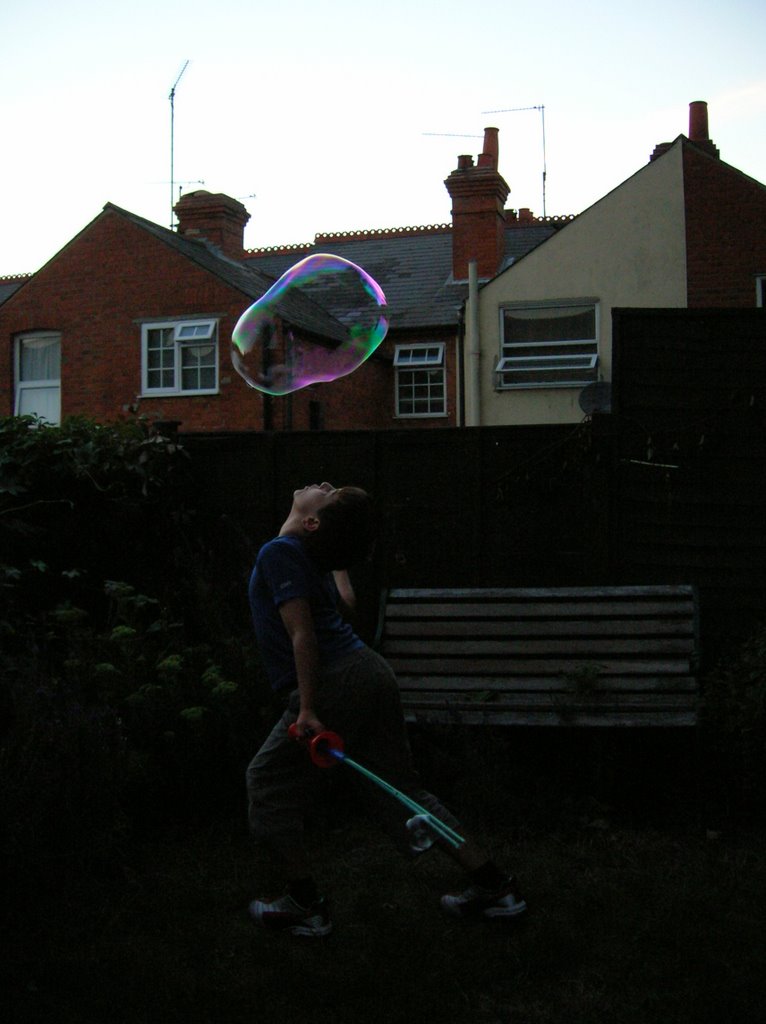
It's a bit like his 'Tear sent from Staines, to his Mistress', but more pleasingly malicious. My photograph is of Timmo adding lift to a monster bubble created with his bubble wand one summer evening. You know all about it when one of these pops and fills your eye with detergent.

The following web page describes the science of bubbles, and offers (groan) a 'bubbliography' (OK, I admit it, I wish I'd thought of it). From that bubbliography, I do recommend the Nasa link on water films in zero gravity: if you ever wondered if the ISS was worth the billions, doubt no more.

http://www.exploratorium.edu/ronh/bubbles/bubbles.html


Wednesday, November 22, 2006

(Non-) Awakenings, 1646

One of my students is writing a third year dissertation on sleep in Shakespeare: not dreams, just images of plain sleep. I've a feeling that a critical piece by David Roberts on this very subject may be hard to shake off.

But I've duly gone through a couple of early modern home doctors, talking about sleep (Humphrey Brooke, 1650, and Tobias Venner, 1637). Pretty much as one would expect - a lot of spurious advice, and that very English mania about the digestion (start off lying on your left, then turn onto your right, as that sequence aids 'decoction'; never on your back or you invite 'the Nightmare', and only under advice lie on your stomach). I suppose that we can draw some fine points about the type of conclusions audience members might have drawn had they seen Innogen or Bully Bottom lying flat on their backs.

But what turns up as well are the pamphlets and broadsides about 'wonderful sleepers': those who slipped into (I suppose) an encephalitic coma and who could not be roused by nose-tweakings, pinches, and dashings with water. The pamphlet illustrated has a healthy middle-aged woman going to bed in the daytime, falling and staying asleep, and finally dying without ever waking up again. The last paragraph gives some sense of the desperate haste of the compiling author to finish his copy, and not be drawn into too prolonged an investigation - for even as he writes, news of a second sleeper has come in (just when he'd got the job nearly done too!):

Whilst we were endeavouring to satisfie our thoughts on this melancholy contemplation, Newes is brought, that a man lies fast on sleep in the same manner in Gravell-Lane, I was desired to go and see him, to the end, that having taken a perfect observation of him, my Pen, my more readiness might follow the instructions of my eye: His name is as I am informed John Underwood; His age is about forty, or something upwards; And he sleeps so soundly, that they who have seen him tell me that you may heare him into the next roome. We heare that he hathe already slept out the full space of nine daies and nights: It seemes he is of a clear complexion, for his breast being uncovered, that the beholders might be the better satisfied, it is reported that the bitings of the Fleas upon his Necke and Brest, do looke like to many Strawberries strowed upon Creame. It is true in the Metaphysicks, that the outward sences being overcome by sleep, the Soule (incapable of sloth) doth actuate at that time more pure and lively. The people in the Suburbs have gained some little understanding of it, and therefore they come every day in crouds unto him, expecting when he awakeneth, to heare some wonderful intelligence.


I like (I recognise!) the way the author couldn't in fact be bothered to go along himself, but offers instead a secondhand report of the small crowd gathering at the sleeper's bedside in the expectation that he will have some remarkable vision to recount when or if he wakes. They'd all been reading too many broadside ballads in the vein of Saint Bernard's Vision. In the absence of L-dopa, not very much anyone could do - though they could at least have tried to get rid of the fleas.

Saturday, November 18, 2006

Strange and foreign forms, 1807

A busy week for me, but teaching prompted me to look at texts I’d never read before – Nahum Tate’s absurd version of Richard II briefly entertained me (what a silly project for a proponent of James II that was!). I also spent some time reading the poems of Charlotte Smith. The Elegiac Sonnets are, in Hugh Kenner’s term, counterfeit. But I liked ‘Beachy Head’, and as it is some time since I did a posting about geology in literature, I shall mount that hobbyhorse.

Smith begins her poem imagining the formation of the Channel, and later speculates about the fossil bivalves and ammonites she sees in the chalk. Her first line is to entertain the old notion that they are just freaks of nature. But that explanation doesn’t satisfy her, and she speculates (as in the opening of her poem) about real geological processes, of the chalk being formed under water, and uplifted to form her local landscape, the South Downs:

And still, observing objects more minute, 372
Wondering remark the strange and foreign forms
Of sea-shells; with the pale calcareous soil
Mingled, and seeming of resembling substance.
Tho' surely the blue Ocean (from the heights
Where the downs westward trend, but dimly seen)
Here never roll'd its surge. Does Nature then
Mimic, in wanton mood, fantastic shapes
Of bivalves, and inwreathed volutes, that cling 380
To the dark sea-rock of the wat'ry world?
Or did this range of chalky mountains, once
Form a vast bason, where the Ocean waves
Swell'd fathomless? What time these fossil shells,
Buoy'd on their native element, were thrown
Among the imbedding calx: when the huge hill
Its giant bulk heaved, and in strange ferment
Grew up a guardian barrier, 'twixt the sea
And the green level of the sylvan weald.

More interestingly, in a subsequent passage Smith is apparently reacting to large fossil bones being found, and she wonders if these might be the remains of elephants brought into England by the Romans: 'Some lone antiquary' she says

perhaps may trace,

Or fancy he can trace, the oblong square
Where the mail'd legions, under Claudius, rear'd
The rampire, or excavated fossé delved;
What time the huge unwieldy Elephant
Auxiliary reluctant, hither led,
From Afric's forest glooms and tawny sands,
First felt the Northern blast, and his vast frame
Sunk useless; whence in after ages found,
The wondering hinds, on those enormous bones
Gaz'd; and in giants dwelling on the hills
Believed and marvell'd---


There had been, and would be, worse guesses. The intriguing aspect of this is that her poem is published in 1807, while Gideon Mantell did not start finding local dinosaur bones until 1820, in the quarry at Cuckfield, North of Lewes. Perhaps Charlotte Smith was no longer thinking of local fossil finds, but has heard about Baron Georges Cuvier, who was already publishing on extinct mammalian fauna – though his study was not in English till quite a bit later. Cuvier himself would assert that Mantell’s iguanodon teeth belonged to an extinct rhinoceros. But bones from dinosaurs are not unheard of in the chalk, and Smith does seem to be writing with local reference. Mantell’s early collection was of marine fossils from that formation, so maybe his efforts to collect fossil bones owed something to what was being talked about locally.

This anticipation in poetry of the historically recorded moment of discovery reminds me of Shelley scooping Dean Buckland in Prometheus Unbound IV, 309 ff – writing in 1819, while Buckland would not name the first dinosaur till 1824 (Megalosaurus):

the might
Of earth-convulsing behemoth, which once
Were monarch beasts, and on the slimy shores,
And weed-overgrown continents of earth,
Increased and multiplied like summer worms

On an abandoned corpse, till the blue globe

Wrapped deluge round it like a cloak, and they
Yelled, gasped, and were abolished; or some God
Whose throne was in a comet, passed, and cried,
'Be not!' And like my words they were no more.


Shelley’s prescience outdoes Charlotte Smith’s, for he brilliantly surmises the extinction of the monarch beasts as a consequence of a passing comet, an idea that would wait for Luis and Walter Alvarez in 1980.

http://www.discoveringfossils.co.uk/chalkformationfossils.htm

http://en.wikipedia.org/wiki/Gideon_Mantell


My photograph is of Tim not enjoying being at Beachy Head a year or so ago.

Saturday, November 11, 2006

Child Art, 1914

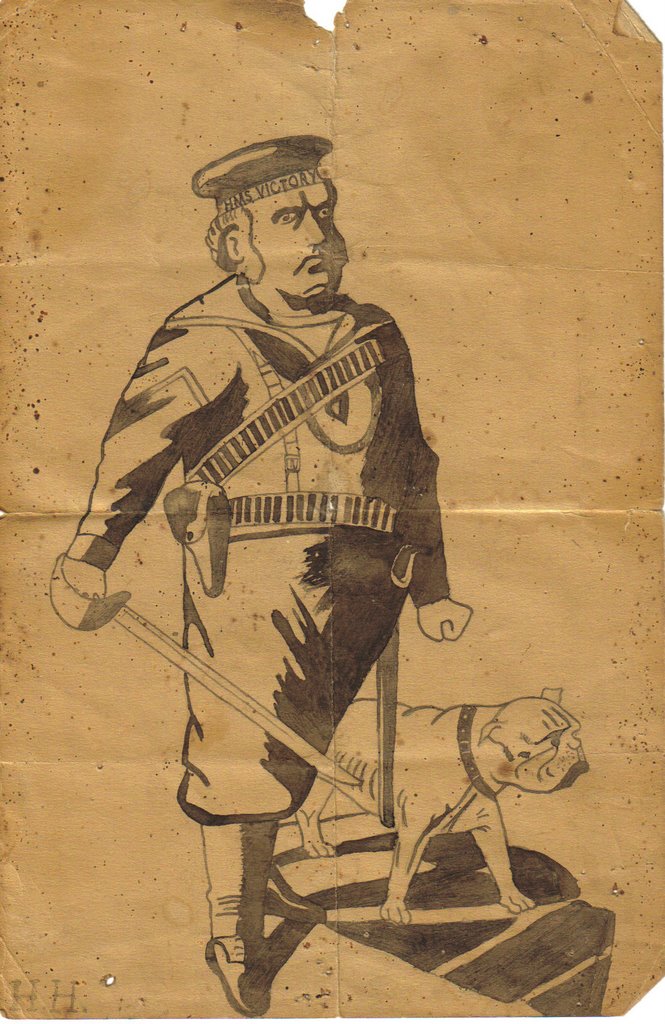
The eleventh of the eleventh, and Remembrance Sunday tomorrow, prompts me to post this drawing by my maternal grandfather, Harry Handforth, in 1914.

It was probably done at Apperknowle school (near Sheffield) some time around the outbreak of the war. He would have been 10 at the time, and one surmises that the children were given paper and the chance to express their feelings. This image of defiance was clearly thought to have been a great success, and it got taken home and was pinned up for years in the family cottage in Summmerlee, before finding its way into a book for safe-keeping.

Grandad left school at 12 to work on a farm, and would take cart-loads of turnips over to Sheffield to sell. Later, he worked down a coal mine called the Mackerel Colliery because its workings were so wet. He was a foundryman throughout World War 2, making tanks and repairing 17-pounder guns (some of those brought in still smeared with the blood of their former gun-crews).

My mother does not think that they had enough money at home for the drawing to have been done there (making such a luxury as sheets of drawing paper unlikely). My grandfather's mother had died when he was seven, seven weeks after the birth of her fourth child. All four children were taken in by their grandmother, who was 72, but who lived to see all the children married, and herself a great-grandmother.

There cannot be much surviving child art from World War One. Grandad got it all in - Nelson, jutting chin, a bulldog guarding the flag, sabre, pistol and bandolier. It might be a copy from a newspaper image, but Grandad was a good draughtsman, and used a fine copperplate script when he wrote. He was an awesome - and yet surprisingly tolerant - figure to me in my childhood, immoderately proud of my academic success. He died in 1993, just before the birth of his great-grandchild Tim, but the kind of patriarch that you made sure knew that the family was going to extend again.

Friday, November 10, 2006

My kind of scene.


I’ve been asked to declare myself. As ever, I wrap myself in the cloak of literature (maybe a little less tightly), and offer by way of reply John Berryman’s 4th Dream Song:


Filling her compact & delicious body

with chicken paprika, she glanced at me

twice.

Fainting with interest, I hungered back

and only the fact of her husband & four other people

kept me from springing on her


or falling at her little feet and crying

“You are the hottest one for years of night

Henry’s dazed eyes

have enjoyed, Brilliance.” I advanced upon

(despairing) my spumoni. – Sir Bones: is stuffed,

de world, wif feeding girls.


- Black hair, complexion Latin, jewelled eyes

downcast … The slob beside her ... feasts … What wonders is

she sitting on, over there?

The restaurant buzzes. She might as well be on Mars.


Where did it all go wrong? There ought to be a law against Henry.

- Mr. Bones: there is.

Laying it on thick

I’ve been reading the Miscellany Poems (1691) of Thomas Heyrick. In themselves, quite interesting, but surpassed in artistry by his prefatory material dedicating the collection to Katherine, Countess of Rutland. Being a clergyman obviously gives you a certain edge when it comes to the art of flattery (all that practice, after all), and Heyrick laid it on shamelessly:

“When I first intended to Dedicate these Poems to Your Name, beside the Thoughts of their Unworthiness, I was chiefly deterr'd by the Consideration of these Two Things, the Greatness of Your Quality and the Perspicuity of your Judgment: But then I was a little Encourag'd again, when I reflected, that the Meanest Creature was not debarr'd making Address to the Highest of Beings, but was rather commanded it …”

Isn’t that excellent in its kind? The cleric reflects that we are commanded to pray to God, and so (he humbly insinuates) this gives him an excuse for addressing her. There’s more, much more:

"… I confess even there what belongs to Me is full of Weakness; but it could be no otherwise, since in Subjects so Sublime, as Your Self, the most Towring Flights must of necessity flag, Things too High above Us not admitting a Definition; and as in Beauteous Faces there is something, We cannot Name, that exceeds the Pencil's Art, so in Excellent Personages there are Vertues, of which Common Souls have no Notion; but they Soar above the Description of the Loftiest Fancy … And doubtless though Poetry is usually suspected of Flattery, yet any One, who considers the Charms of Your Beauty, the Sharpness of Your Wit, the Depth of Your Judgment, the Candour of Your Temper, and Nobility of your Birth, will acknowledge, that You are plac'd above the reach of it; that, which would be Flattery to another, not measuring the least Part of Your Perfections."

In case her attention flagged when the poems themselves started, Heyrick followed up with another effusion, this time a rhapsody in verse:

‘To the Right Honourable Katherine Countess of Rutland.’

the bold Artist, that of You would speak,
Should Patterns from Celestial Natures take;
And stamp his Soul in an Angelick Mold;
Er'e he Your Vertues should attempt to' unfold …

… He that, how Good, of Great You are, would show,
Had need the Depth of Heavenly wisdom know:
For all we deal with here doth flag too low.
Angels the Mighty work should undertake …

… Had but the Early Centuries, that could find
The Vertues and the Graces Woman-kind,
Seen the Fair Draughts of Your Celestial Mind:
New Sexes to their Deities they 'had given,
Nor left one Single God to rule in Heaven.

This imagining of a heaven filled with Goddesses all modeled on her seems to leave reference to Olympus behind, and half-indicate that he is ready to worship her in place of God. As he has been doing: that he’s a clergyman just adds to the value of it all. Then he gets started on her children.

I’ve since been browsing on the MLA database, and really, there doesn’t seem to be enough scholarship on what was, for the early modern author, a most important form of writing. Among the potentially interesting pieces are Andrew McCrae on ‘The Poetics of Sycophancy: Ben Jonson and the Caroline Court’ and Frank Whigham on ‘The Rhetoric of Elizabethan Suitor’s Letters’, but there seems to be a large gap in relation to the master himself, John Donne, and no obvious single study. But it is the kind of thing that early criticism did remark upon: I recall Dr Johnson weighing up whether Dryden or Aphra Behn was the better butterer.

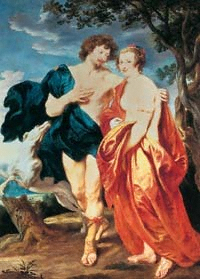
Maybe there have been conferences (and what fun they would have been, if everyone rose to the subject in an orgy of co-laudation). My picture is of course Van Dyck doing the Duke and Duchess of Buckingham as Venus and Adonis.

Sunday, November 05, 2006

The Itch of Learning


I ought to be forging ahead marking essays (thirty-odd first year students falling over themselves in an effort to sound like Emeritus Professors of Literature while discussing any two of Milton’s sonnets). Instead, I have been reading every Renaissance flea poem on the LION database. If someone has to do it, then why shouldn't that someone be me? As I pottered, the project shaped up into another of my visionary critical studies. Primo Levi would be my guide (because of his essay, ‘The Leap of the Flea’: “only a few decades ago [the flea was] part of European civilization and folklore”). But then I remembered Steven Connor's disquisitions on flies http://www.bbk.ac.uk/english/skc/flies/

and decided that fleas were clearly just too large a project to take on.

I'd been reading Thomas Heyrick’s Miscellany Poems of 1691, when I found that it includes, rather bafflingly, the following extravagance by one Joshua Barnes:

'On a Flea presented to a Lady, whose Breast it had bitten, in a Golden Wire, Extempore 1679.'


Here, Madam, take this Humble Slave,
Once vile, but, since your blood is in him, Brave!
I saw him surfeit on your Lovely Breast;
And snatch'd the Traitor from that precious Feast.
For his Attempt sure He by me had died;
But the respect I bore your Blood deny'd.
The Gods forbid, fair Madam, that by me
Your Blood be shed although in this poor Flea!---
'Twas Sacrilege in him those Drops to draw;
But now that Treasure in his skin doth lie,
It consecrates his Life and strikes an awe;
That no bold Nail dare make the Traitor die.
Nay if a Quaff of Nectar once could make
Mankind Immortal, as the Poets feign,
This Flea can never die for that Drop’s sake,
Which he hath suck'd, sweet Madam, from your Vein;
At least no human Power his life can spill,
(Which lies in your pure blood, that can't decay:)
But You, whose Property's to save and kill,
As you did lend that Blood, may take't away.
Then lo! ---this Royal Slave in chains of Gold,
Here I submit most humbly to your doom:
Either let Mercy him your Prisoner hold,
Or let your Ivory Nail prepare his Tomb!
Oh! could he speak, I'm sure the Wretch would crave
A Prisoner's life, to be confin'd with You:
Nay he could be content to meet his Grave;
If by your Hand death might to him accrue.
Go, happy Flea! for now to One you go,
Gives Bliss, if She's your Friend, and Glory, if your Foe.

I guess that spotting a flea springing from a lady friend was just one of those things that might happen - William Cavendish, a man not unfamiliar with a variety of bed companions, regards fleas as something that ‘females are moste given to’. Maybe such an incident was one of those mildly embarrassing moments of common frailty which it was polite to laugh off, like wind or a gurgling stomach. So Barnes’s poem makes gallant fun of it all, in a vein of comic exaggeration. If the Donne poem is in the background, it stays there, and any memory of its naughtiness served to render Barnes’s poem harmless fun (in the knowledge that the topic could have been exploited so much more insidiously).

I thought I’d done quite well to include in the notes to my Donne edition the other flea poem attributed to Donne (it begins ‘Madam, that flea which crept between your breast /I envied…’) and John Davies of Hereford’s try at this sub-Ovidian genre. But I missed William Drummond (who did two), this by Barnes, and many more references.

But that’s computer databases for you. I suspect that LION, and what it can do, is by now a bigger influence on what we study and write than, say, Stephen Greenblatt. Or maybe that's just me betraying my foibles.

The picture is Giuseppe Maria Crespi’s rather charming ‘The Searcher for Fleas’, of about 1730. The artist did two flea pictures, but Georges de la Tour’s take on the theme is the most famous. It’s on the Web Gallery of Art, whose estimable compiler takes a wild interpretative swing at it: “No authentic De La Tour depicts such an obviously banal theme without a deeper meaning. The only symbol in the picture is the solitary candle burning on the chair, and it is surely not too speculative to suggest that the picture might represent the pregnant Virgin, isolated by Joseph when he discovers that she is with child, the candle thus symbolizing the forthcoming Christ as the Light of the World.”

Which reminds me to get back to my year one essays.

Thursday, November 02, 2006

Such admirable art...


I was looking at John Dowland's First Book of Songes, and noticed that it concludes with 'an invention by the sayd Author for two to playe upon one Lute'. So I hied me to the in-house greenwood, etc, and was disappointed to find that my purported 'Complete Lute Music' of Dowland (vinyl LP's that already feel quite thrillingly ancient, almost Elizabethan themselves) do not include this rather jolly stunt - and frankly, my dears, the delicate young men who twangle their way through the five discs look as though the close proximities required by the two-men-on-a-single-lute business might have been just too overwhelming to contemplate.

But too the rescue comes the internet, with, amazingly, a whole collection of free mp3's of Dowland duos, including the 'Lord Chamberlain's galliard', the piece in question.


So here's the link:
http://www.emclute.com/download/luteduo/15chamberlain.mp3

and here's the full page of their other toys, fancies, dumps, almains (and the rest):

http://www.emclute.com/download/luteduo/index.html

(***Now, I hope repaired: 7th November)


What you don't get is any assurance that Kenji Sano and Jinke Nosa performed the galliard together on the single instrument. There are no giggles or brief breaks for self disentanglement. Maybe there's a film on YouTube one could use to verify. The galliard was very much a dance for male display, I think Dowland maybe did divert it a little here towards male intimacy. But I assume male players, rather we might imagine that if your plucking was up to it, you might have canoodled pleasantly in this manner with Lady Mary Wroth, bassus to her cantus (though the arch lute she totes in her famous portrait perhaps allowed plenty of space for chaste distance anyway).

Thomas Coryate, footing it towards Venice, heard another remarkable performance in the Tuileries Garden:
"At the end of this garden is an exceeding fine Eccho. For I heard a certain Frenchman who sung very melodiously with curious quavers, sing with such admirable art, that upon the resounding of the Eccho there seemed three to sound together" (Coryates Crudities, 1611, p. 27). The only example I know off-hand of a song with an echo is the wonderful 'In a dark shady grove/Our charms we prepare/Too dreadful a practice/For the open air' chorus in Purcell's Dido and Aeneas. But I am ignorant, and there must have been hundreds. But music sung to a literal echo?

One of our first year students happened to play me 'Greensleeves' on her psaltery last week. It is not often you can use a sentence like that (and it's hard to write without getting the giggles). On College premises too. No, literally. Things are looking up.


Sunday, October 29, 2006

'In love we live, in love we die/ But we conceive no reason why'


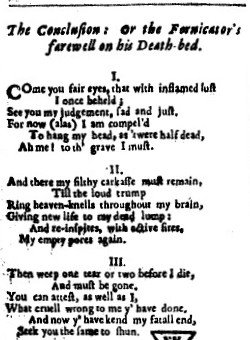
My latest bad 17th century poet is Hugh Crompton (and to say so means starting just like the 'snotty Zoilus' he heared would read his poems). 'O pity, pity him that fryes / Upon the grid-irons of thine eyes' ('The petition') - yes, that bad, but at least he half knows it, and anybody that can conclude one of his books of poetry with a 'Fornicator's farewell' cannot be all bad.

My students are all reading Donne, with various tasks on and about the much-belaboured Elegy 19 in mind, and with much stroking of our chins and shaking of our heads, we will doubtless come to some kind of compromise position between 'Good, but ...' and 'Bad, but ...'

Crompton's merit is that, being a bad poet, you get his feelings straight. The two topics closest to his heart were Venus and Bacchus, sex and drink. Over and over, he returns to having sex with women - poems imagining asking for it, expressing pleasure in it, advising how this end can be achieved ('The Way to Wooe'), and nattering on to women about 'The Mysterie' (my title, perhaps Crompton's best couplet, comes from that poem).

No-one could complain that the women in his poems are excluded from the imaginary conversation - he loves to write a poem that gets right to the point, and then an equally forthright answer (from 'The request to walk'):
... Speak then, where shall we dance a round?
On Sylvan's floor, or Ceres ground?
Or with Priapus shall we play?
Speak now, and chuse the best you may.
The Answer.
The thorny back't and rough Sylvanus
Shall not refresh nor entertain us:
... But 'tis Priapus I desire;
There we will play until we tire.

If we are all set to have a little moral agony over 'O, my America, my new found land', this is Crompton doing woman's body as territory:
Let my hand
Wander along thy unknown land,
To find how well the fruit doth rise,
(As in Canaan Israels spies)
And if the same I do approve,
Therein I'll plant my vine of love
And with a pleasant pain I'le frame
A fertile vineyard in the same.
Come, do not weep; 'twill do thee good
It will refine corrupted blood.
Then struggle not, nor do not shriek,
I have no weapon that can strike
A deadly blow...

At this tender moment, it occurs to him to head off any alarm she might have at the thought of getting pregnant. His poem is called, 'To Caelia, in the fields', and it's the pastoral scene which gives him a useful pointer:
See yon big-bellied ewe, that (late)
Receiv'd the marrow of her mate:
She looks most lovely; so will you
Now you receive your lovers too...

Caelia, perhaps surprisingly, is won by this gallant ovine comparison, and afterwards Crompton, typically, writes her a reply poem, in which she confesses that before 'I abhorr'd / Thy proferr'd love; / But now I see thy spirits, and their energie; / My soul to thee I will resigne'.

'Present your naked bodies unto men' says our poet, in 'To our Mistresses', probably remembering the end of Elegy 19, as he rounds off his set of stanzas with the resounding call to arms (or, a kind of 'Come, madams, come'):
Cast by your blankets once agen,
Present your persons unto naked men.
(cf, of course, Donne's 'cast all, yea, this white lynnen hence ... to teach thee, I am naked first').

But, once again, I don't feel that I have enough in this comparison to get Donne off on all charges. Crompton's amateurishly expressed enthusiasm for getting it on is so endearingly universal (and silly) that Donne just looks 'the worse for being clever', the remark with which a mature student once sank a previous scholarly investigation of the case.

I wonder if Crompton is the first writer to use 'frigidity' with reference to a woman not being interested in sex? The OED indicates that this lamentable sense to the word kicks in early 20th century with Havelock Ellis: "In dealing with the characteristics of the sexual impulse in women ... we have also to consider the prevalence of frigidity, or sexual anæsthesia".

But Crompton, as you'd expect from him, sees such a lapse as only a temporary thing:
So 'tis with my faire Rose, for she
But now ('cause with frigiditie
She's toucht) seem'd dul and dead; but when
Loves spring returns, she'l love agen ('The Comparison').

'Sexual anaesthesia' is not a concept he'd readily have taken on board, I think.

Wednesday, October 25, 2006

Henry Goodcole burns and saves you


I’ve been doing a lot of teaching, and among my texts, the very familiar Witch of Edmonton. Doing this prompted me to do what I haven’t previously bothered to do, that is, read all the writings of Henry Goodcole (usually mentioned only as the writer of the pamphlet used by Dekker, Ford and Rowley for that play).

The brief Oxford DNB entry on Goodcole mentions a series of salary increases and, later, a substantial loan he elicited from the court of aldermen in London – a body that at one point doubled his salary without any prompting. As ‘lecturer’ at Ludgate prison, then ‘visitor’ at Newgate prison, Goodcole clearly pleased his employers, and, looking at his pamphlets, one can see why.

Goodcole was assiduous in his praise of the system he served, and those who controlled it. His role began after the felon had been condemned: he dealt with the frightened, resentful, anguished or stupefied products of the brusque Elizabethan courts, which handed out sentences whose horrors in actual execution would in all likelihood have been well known to the condemned. People went en masse to see executions, and the recently executed: in one of his pamphlets Goodcole mentions those who owned the land adjacent to a gibbet petitioning successfully to get the executed man moved further away, so flattened were crops in its vicinity.

He represents himself (and probably was) as being highly conscientious in his duties. His recurrent image is of himself as a doctor to something more important than the body, the soul, and ‘Physitians of the Soule ought to immitate those learned Physitians of the body, [with] frequent visitations of those sicke patients, whose diseases are desperate and inveterate’ (The adultresses funerall day). ‘Miserable end, when men end in their sinne’ (Prodigall’s Tears, p.142), was his guiding thought, and he laboured to produce proper contrition in the condemned. Of course, he writes up his successes. The multiple murderer Thomas Shearwood, whose use of Elizabeth Evans as a decoy to lure his victims to their deaths impresses Goodcole as a new and unparalleled wickedness, died (in Goodcole’s view) in a valuable manner: “his death he joyfully embraced, and mortall life cheerfully did surrender up, and sent his soule out of his Body flying, calling on the name of the Lord Jesus to receive him. And all the people speaking to God for him, likewise with their lowd voices, and strong acclamations, Lord Jesu take mercy on him, sweet Jesu forgive his sinnes, and save his Soule”.

Goodcole lived a life you would think of as potentially traumatic, or brutalising, being in attendance at execution after execution. His writings manifest a typical ‘puritan’ concern with blasphemy – cursings bring the devil to Elizabeth Sawyer. A truculent end on the gallows is something he considersmost desperate, deuillish and damnable, and sauours no whit of the least sparke of Gods grace”. He wants to hear the right words, for the execution to have more than an aspect of a religious rite, with a congregation responding properly. Francis Robinson, a gentleman hanged, drawn, and quartered for forging the Great Seal of England and using it for fraudulent gain, was an ideal subject. Goodcole transcribes all Robinson’s prayers, and, at the end: “Like a Lambe going to the slaughter so went he unto his death, prepared before to suffer the same, willingly, patiently, and joyfully: and our confidence is such of him, that he is receiued into the Fold of that most blessed heavenly Flocke”.

That final note is one Goodcole recurrently makes: Londons Cry Ascended to God ends with solemn thoughts: ‘Judges, Men made of earth, turnes these miserable wretches unto the Grave, Dust, and Earth’, but then reflects that ‘they shall rise out of the dust of their Graves; for their Corruption, then to put on Incorruption’. He is apparently perfectly convinced that punishment here, and reconcilement to the true faith, will save the soul of the condemned.

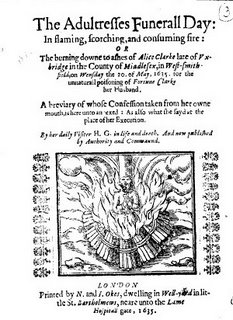
His most dramatic intervention came in the case of Alice Clark, who faced being burned at the stake for her adultery and murder: “Uppon Wensday morning, on which shee was executed, there assembled unto Newgate multitudes of people to see her, and some conferred with her, but little good they did on her, for shee was of a stout angry disposition.” Goodcole decides that, like Barnadine in Measure for Measure, she was, in her state of mind, “no fitting guest for the Table of the Lord Iesus. He then plays his last card: “thereupon, I made as though I would have excluded her thence, in denying the benefit of the holy Communion, of the Body and Blood of Jesus Christ, inferring the benefit of the unspeakeable blesse, by the worthy receiving of it by Repentance and Faith, and the most woefull malediction to all impenitent and unworthy receivers. Whereupon, it pleased God, so to mollifie her heart, that teares from her eyes, and truth from her tongue proceeded, as may appeare by this her ensuing Confession at the very Stake”.

He is convinced that his clients will go be saved if they die contrite, and that helps Goodcole with his dreadful duties. He also believes in a God whose anger is the model for the judicial system he so piously endorses. Londons Cry Ascended to God has the running title ‘Londons Cry for Revenge’. God’s anger is assumed, and is unquestionable, even if not always very discriminate.

Goodcole’s pamphlet A true relation of two most strange and fearefull accidents (1618) is largely about the death of a man taking the Lord’s name in vain with a false oath: “if I sweare amisse, (quoth he) or if I speake wrongfully, let God I beseech him make me a fearfull example to all perjur’d wretches, and that this house wherein I stand, may sodainely fall upon my head, and that the fall thereof may bee seene to bee the just judgement of God upon me”. That the court house collapsed at that very moment manifests God’s wrath. Goodcole is undaunted in detailing the multiple fatalities, including “certaine Esguires and Gentlemen of good calling, by the fall of the said walls and timber, [who] were sodainly strooke dead”.

God’s anger being so splattery in its operation, Goodcole was not going to baulk at the rough judgments handed down at court, which zealously imitates the divine displeasure (perhaps with a sense that if they act quickly, they prevent some larger chastisement). Maybe just once he almost wavers: he interlaces his zealous account of Alice Clark going to the stake with a tale of an unnamed woman, who he knows was abused hideously by her old and ‘peevish’ husband, and who resolved to poison her husband, then commit suicide. She administered the poison, but repented what she had done. The consequences were extraordinary:

But better motions now comming into her thoughts, and she truely repentant of what she had done, finding the confection begunne to work with him, fell downe before him upon her knees: First acknowledging the fact, then humbly desiring from him forgivenesse, with all, beseeching him to take some present Antidote to preserve his life, which was yet recoverable: on whom he sternly looking, as he lay in that Agony gasping betwixt life and death, returned her answere in this manner; nay thou Strumpet and murderesse, I will receive no helpe at all but I am resolvd to dye and leave the world, be it for no other cause, but to have thee burnt at a stake for my death: which having said, and obstinate in that Hethenish resolution, he soone after expired.

Goodcole clearly regards her case as having been a hard one, but they had duly carried out the judicial murder her horrible husband anticipated.

Friday, October 20, 2006

A Demonological Urine Test, Glasgow, 1693


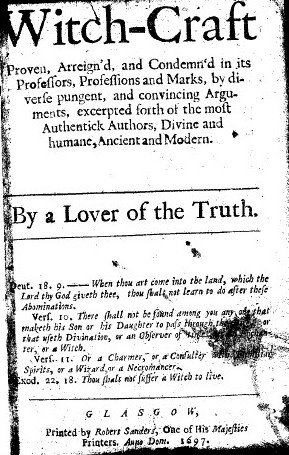
I’ve been reading a minor and belated Scottish demonologist, John Bell, who produced two brief pamphlets, in 1697 and 1700. Opinions may have moved on elsewhere, but Bell sounded the old notes of alarm.

His ‘evident and probable tokens, whereby a Witch, or such as have made express League and Compact with the Devil, may be decerned from all others’ starts conventionally enough. First, look for the insensible devil’s mark. Then, that witches can’t be drowned, either because they are rejected by the element with which they were baptised, or ‘perhaps … for that they be destinat for another Element’. Then, they cannot weep, with the usual Jean Bodin-style proviso that they will ‘distort, throw and wring their faces, making as though they were weeping’. Witches, he next alleges, have a ‘Basilisk, or Serpentine sight’, and they will not repeat ‘the heads of the Christian Religion’, the ten commandments, Lord’s Prayer, or Creed except ‘with several minckings, eikings, or inversions’.

At this point, Bell comes up with a sign that was new to me ‘if you put any great or gross Salt in the Pipe of a Kye (key), and put all into the Fire, upon hearing the crackling, and seeing the blewish low (flame) thereof, which is like that of Brimstone, instantly they shall let go their urine…’

Finally, witches have a ‘peculiar sent or smell … which neither flows from the nestiness of Cloaths, vermine, or the like, but a contradistinct smell from any such thing’. It is in fact the smell of the Devil, who ‘being in full possession of their Soul, must needs emitte his own sent even that of the Pit’.

Perhaps Bell’s list, in its very preposterousness, served the cause of enlightenment. It is hard to imagine anyone putting into practice his test of a witch being unable to hold her urine if salt is burned, or having much clue of how to identify the smell of the Devil.

In his other pamphlet, The Tryal of Witchcraft (1700) I was interested to see that, among the limited number of texts available to him, was the pamphlet of the ‘Witches of Warboys’, which I posted on a small while back. Bell, even 107 years on from the publication, reads that tract absolutely as the author intended it to be read, unable to see its inadvertent exposure of the three Throckmorton children in all their malignancy and narcissism.

Sunday, October 15, 2006

The lost hat, Midland Railway, 1909


Item 1. June 19th, 1909.

Dear Sir,

I travelled from London on Tuesday the 15th by the 3.45 train, in the 1st class Restaurant Car. When I got to Chesterfield I found that a gentleman who was sitting on the opposite side of the carriage had taken my hat and left his own. The Car-attendant said that he knew the gentleman, who lived at Bedford, and that he would arrange for me to get my hat back.

Although the exchange was, of course, a pure accident, my hat happened to be a new one, or I would not have troubled about it. It had my name in full on the leather lining.

As I have heard nothing through the Car-attendant, I should be obliged if you would have the matter enquired into.

Yours faithfully.

Item 2.

June 19, 1909

Midland Railway,

Office of Superintendent of the Line,

Derby.

Sir, I beg to acknowledge the receipt of your letter of the 18th inst. which shall have my attention.

Yours truly,

J. Elliott.

(Part-printed postcard addressed to H Westlake, Esq, Brimington Hall, Chesterfield)

Item 3.

June 26th, 1909

Dear Sir,

Referring to my letter of the 18th., and your acknowledgement of the 19th, I spoke to the Attendant in the Restaurant Car about the matter on Thursday when returning from London by the 3.45. It appears that he had spoken to the gentleman who took my hat, who acknowledged that he had it, but did not seem at all concerned as to returning it.

I send you the hat that was left in place of mine; and refrain from commenting upon it.

The action of the gentleman in question is most extraordinary; more especially as my hat had my name in full inside it, and was entirely different in shape to the one he left: and as it was a new one, I must ask you to be good enough to procure its return at once, or send me 12/6, the cost of it.

Yours faithfully.

Item 4.

Midland Railway,

Office of Superintendent of the Line.

Derby June 28th, 1909

Dear Sir,

In reply to your letter of the 26th. instant, I regret that your hat has not yet been returned to you. On receipt of your first letter I at once took steps to recover the hat, and hope to be able to give you a definite reply shortly.

Yours truly,

For J Elliott

Item 5.

Midland Railway,

Office of Superintendent of the Line.

Derby July 13 1909

H. Westlake Esq,

Brimington Hall.

Dear Sir,

In reply to your letter of the 11th inst. I beg to say that your hat has now been obtained from Mr Blackstone and was forwarded from Bedford to Chesterfield for you yesterday.

Yours truly

For J. Elliott

Item 6.

July 14th 1909

Dear Sir,

I am obliged by your letter of the 14th in regard to my hat which was taken from a Restaurant Car, and note that it has now been obtained from the man who took it.

After it has been in his possession for a month, it is, of course, utterly worthless to me; and perhaps you will have it destroyed, or otherwise disposed of.

Yours faithfully.

Item 7.

July 16th 1909

Midland Railway,

Office of Superintendent of the Line,

Derby.

Dear Sir,

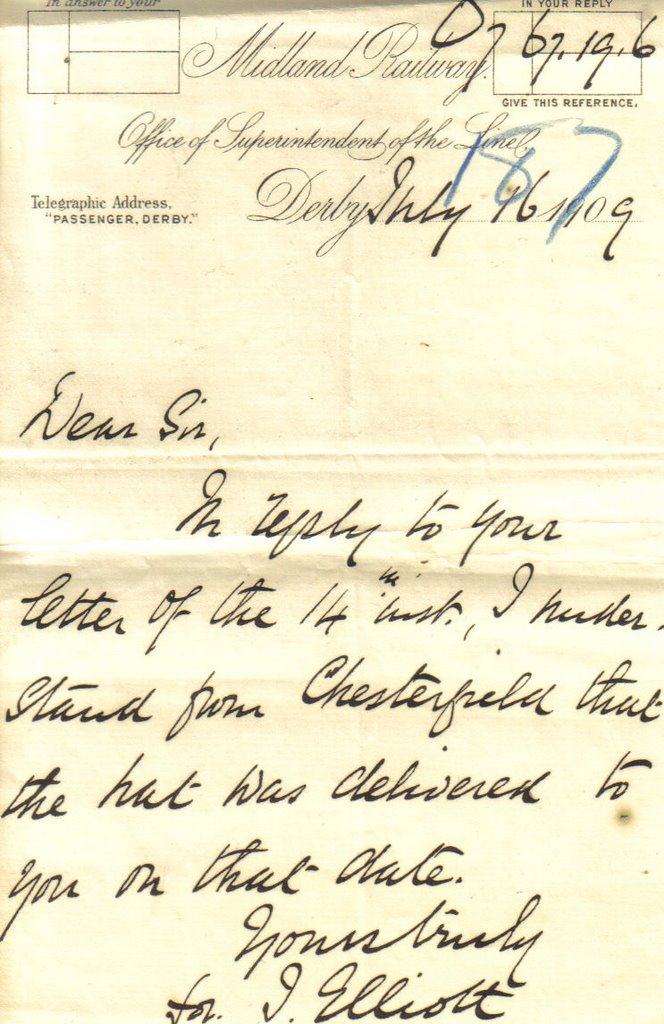
In reply to your letter of the 14th inst, I understand from Chesterfield that the hat was delivered to you on that date,

Yours truly

For J. Elliott.

Item 8.

July 17th, 1909

Dear Sir,

The Hat was returned to me on Thursday.

The Hat-box was smashed in; but that was of no consequence, as the Hat was completely spoilt, and I at once had it destroyed.

Yours faithfully.

Friday, October 13, 2006

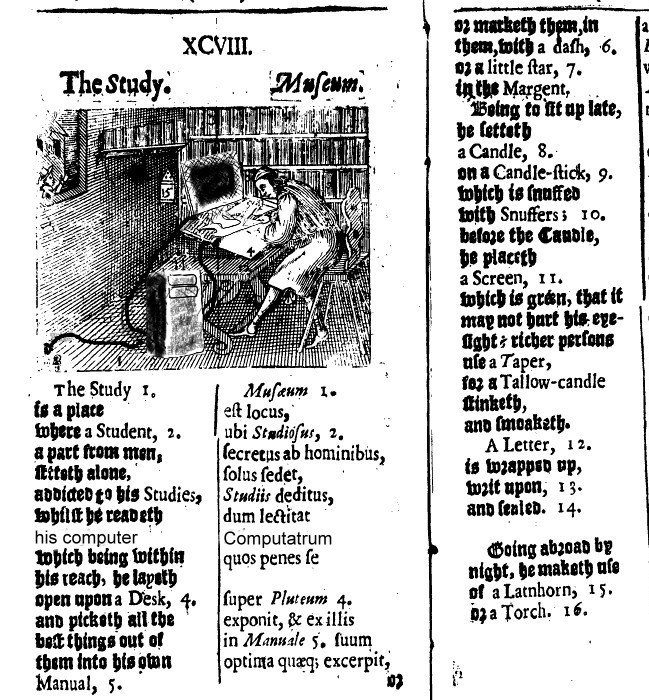
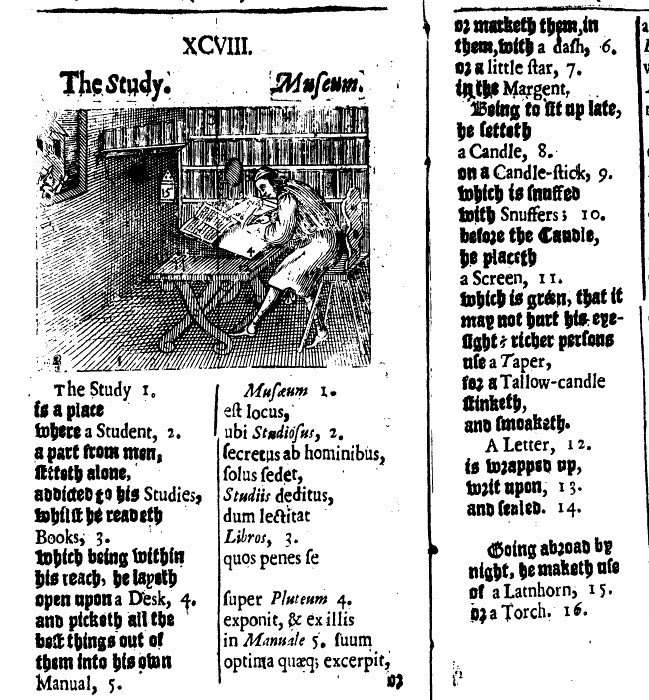
The Student, apart from men, sitteth alone


A Latin vocabulary for computer terms:
http://www.obta.uw.edu.pl/%7Edraco/docs/voccomp.html

I am spending too much time at the claviatura, and really must exire. The woodcut, before I messed about with it, is another from that Comenius book for children I posted about. As excitements for a Friday evening go, well, what can I say?

Wednesday, October 11, 2006

Stuck in the mud.


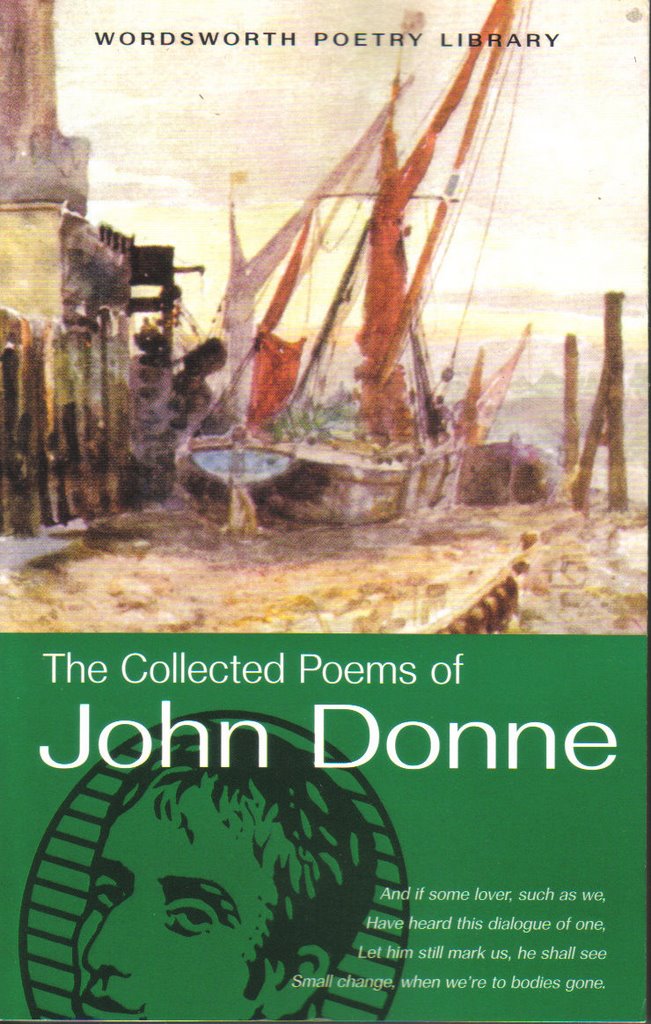
Back in 2002 I did an edition of Donne for Wordsworth Classics, wrapping Introduction and Notes round a slightly modified Grierson text. They paid me a three figure sum as a one off, and it was published with a tasteful cover, the Lothian portrait made into a black oval, against a background of brown laid paper.

Well, it retails at £3.99 still, and I imagine my students like that price, and are mildly interested by having the editor in their midst. So I order it in to the campus bookshop each year. But look at it now! A late 19th century painting of the Thames side at Southwark at the top, and rising from below, the face of William Wordsworth, backed by the suggestion of a Byzantine halo.

What the image says to me first of all is "stuck in the mud". A blurry and tepid watercolour has been selected for a poet who was all about precision and passion. Was it left over from materials gathered for a cover design on a Dickens novel? And since when has Wordsworth become the official face of poetry?

Does it speak an attitude of "It's just poetry, innit? Wishy-washy stuff, all the same, dont'cha know?" or "This is the corporate design we have adopted after due process of consulting ourselves"?

Actually, this botched job makes the edition look ignorant about the who, when and whatness of John Donne, and so will not help sell the book to its primary promoters, teachers with students to instruct. So a futile editorial raspberry to Robert Mathias at the 'Publishing Workshop'.

I took the cheque, I cashed the cheque. Just leave it, Roy.

Sunday, October 08, 2006

Early Modern Whale Boy


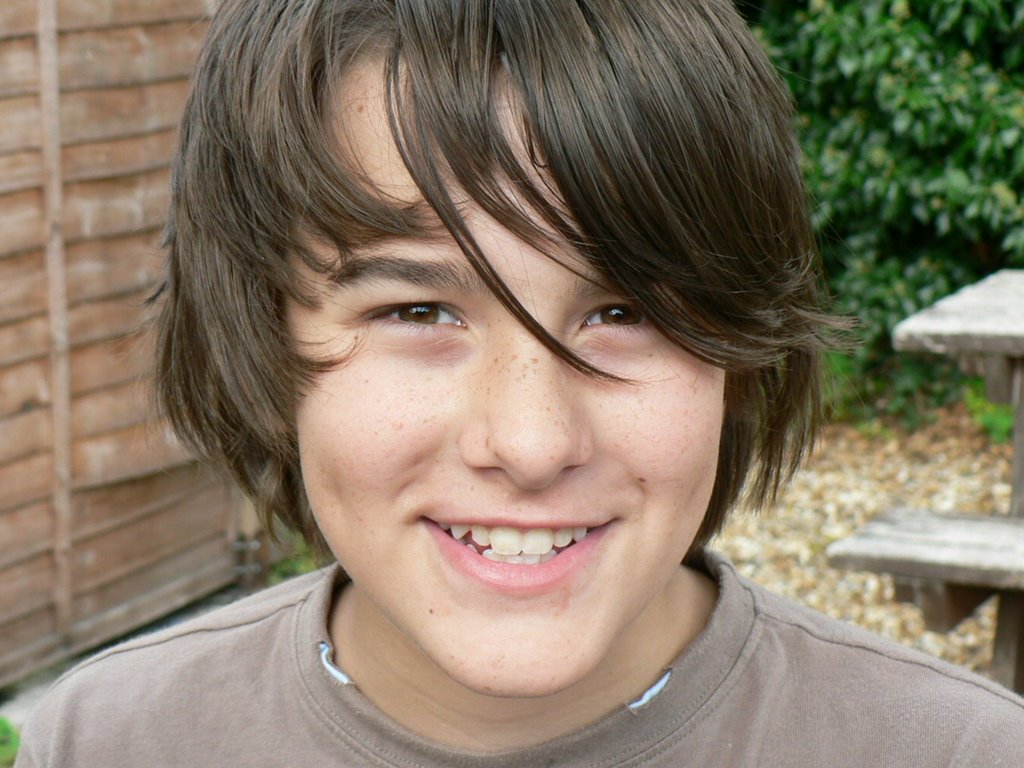
My last posting about demonic children naturally led my thoughts on to the apple of his father's eye, Timmo, and here he is in the hirsute form that, to his chagrin, had to be chopped back for the start of school term. My judgement is of course biassed, but here's a young man who is going to be rated cute, and perhaps already is. My eyes, but his good looks from his mother.

I was a bookish child, but suspect that if I'd been born in 1993 like Tim, I would not now be heading that way. He reads, but I can understand his fascination with on-line games like 'World of Warcraft' and 'Guild Wars', and console games like the much-esteemed Zelda series. His school was telling parents this last Wednesday that we must tell them if anything at home was going to be disrupting school work: I almost piped up and said "8th December: release date for the Nintendo Wii and 'Zelda: Twilight Princess' - so after that, expect homework with extra short-cuts applied". I'd imagine 50% of the parents of these 13 year olds would have groaned with recognition. But the school is so solemn about work, I kept quiet. No, it can't wait till Christmas, the much-postponed game has been waited for for something like 18 months already, and every delay has been bewailed. I'm just going take the easy (and only) way, and lie down in front of the Juggernaut.

Tim needs the present devices that read e-books to move on apace: yes, the straight e-book text, but with an instant manga button, which converts some plodding canonical masterpiece into graphic form, or, better still, can scurry off at any point and gather snippets of moving pictures from across the net to create a video mash-up (with a 'more ridiculous' dial that he can twist up to 11). It should work very well, and then he can talk about Sir Walter Scot with his Grandma (" I liked the bit where I galloped to Ivanhoe's rescue", he will say, bewilderingly, for what use is a narrative into which you cannot insert yourself, or chosen avatar?)

Come on, Sony, catch up with Sonny:
http://www.learningcenter.sony.us/assets/pa/prs/reader_features.html

A sour footnote to the history of childhood: Warboys, 1593.


A busy week for me, with a return to teaching, and four lectures to give: and hence, no mid-week surfacing by the whale. I gave one session to our new MA students in which, having conscientiously shown them the way to 'Instute' and 'The Voice of the Shuttle' literary portals, I steered them towards a webpage I put up giving links to academic blogs - and my thanks to Sharon Howard at 'Early Modern Notes' for a major hand in the selection. They all seemed delighted by what they found.

The best thing this last week for early modern era scholars has been, I think, Michael Monpurgo's series on the History of Childhood reaching the Puritan child:

http://www.bbc.co.uk/radio4/history/childhood/

The first week was concerned with children in the middle ages, Monday of week 2 was the Puritan episode, and one can 'listen again'.

The gruesome inculcations of 'learn to die' delivered by some of the earliest books aimed at children were very effectively delivered by having the adult voice (reading out the Puritan writer) fade into the voice of the child recipient of such spirit-quenching ghastliness.

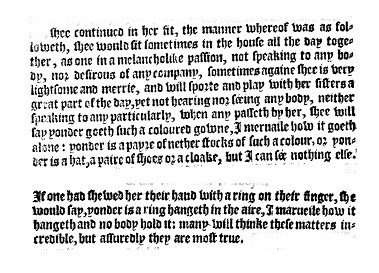
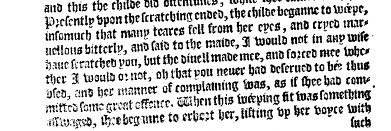
It came back to me while giving the introductory lecture on my 'Witchcraft and Drama' course, where I talk about the case of the 'Witches of Warboys' in 1593. That pamphlet doesn't show children as victims of a miserable ideology: in its highly detailed but credulous account, the Throckmorton children, led by the three eldest girls, utterly subvert their devout household, and contrive the deaths of a neighbouring family, by turning back hatred of life, transformed into murderous hostility. With astounding hypocrisy (I extract, above, one of the children's "Oh that you never had deserved to be thus used" -said to one of the victims, after 'scratching' her face), an astonishing consistency of purpose, and sustained by the household's implicit faith the the power of the devil, the girls both got to do pretty much as they pleased (play cards and bowls), and kill three people.

No-one intervenes effectively, but simply goggle in pious and complacent horror. The local clergyman takes the 'no smoke without fire' line about the accused, like King James did: if God allows you to be accused (by innocent children) it must be true. He fails to test the veracity of the children by, say, professing that he will read Psalm 51 in Greek to the possessing devil sent by the witches, and substituting a passage of Sophocles. They get their way unchecked, and contrive judicial murder.

One can only imagine that the two adults in the family they destroy suffer as surrogates for their latent hostility to their own pious parents, and that they punish their own filial wickedness in having the daughter Agnes hanged: the wretched Agnes whom they always cast, scandalised, as a daughter who beats her own Mother.

One older daughter develops advanced blanking techniques, in which, notionally steered by the devil the witches have put into her, she will only acknowledge the presence of the adult who has been dragooned into playing cards with her (so as to stave off her fits). The third daughter, in the other extract I give above, develops this further, professing to be simply incapable of seeing adults, while she can see items of clothing moving in the air. Making adults disappear by imaginative means is one thing: but of course, they went to the extreme of making adults disappear terminally.

Utterly remarkable, and not without precedent, but showing what children could do with the idea of the devil. It does seem curious that Puritan thinking (yes, they are a little early historically, but within the Anglican church, that's the way the family seem inclined) didn't alert the adults to the possibility of wickedness among children, but throughout, these gentry children are assumed to be innocents, driven by the devil to their cruelties, hapless instruments of the spirits who are determined to expose the witches.

But the child as perpetrator was probably not a line that Mr Monpurgo and his researcher wanted to take.

Saturday, September 30, 2006

Comenius in English


I have been clearing from my son’s room the books he has now outgrown – down to the Amnesty International bookshop with them all. Children (I was reminded while doing this) are still given encyclopedias when young, books that offer to tell them everything about the world before them.

Thinking about such books led me to Jan Amos Komensky, ‘Comenius’, the Czech pansophist and ‘Father of Education’. Between 1650 and 1654, working in Transylvania, he produced his enormously successful Orbus Sensualium Pictus, which appeared in English editions in 1659, 1664, 1685, 1689 and 1700 as: Joh. Amos Commenius's Visible world. Or, a picture and nomenclature of all the chief things that are in the world; and of mens employments therein. A work newly written by the author in Latine, and High-Dutch (being one of his last essays, and the most suitable to childrens capacities of any that he hath hitherto made) and translated into English, by Charles Hoole, M.A. for the use of young Latine scholars.

It is the first illustrated encyclopedia for children, simultaneously giving a huge push to their Latin vocabulary. It sets off with a bizarre alphabet, in which every letter is alleged to be pronounced by a suitable animal. Thus fired to surpass the mere animal kingdom, the child is led into the word clusters and basic concepts associated with God, The World, Heaven, Fire, Air, Water, and onwards to the things in the earth: its fruits, metals, gems, flowers, animals, and then into the human world, with its life stages, trades, activities, amusements. It is strictly Eurocentric, with one brisk account of Mohammadism. The ‘visible world’ notion does not stop the book from discussing moral concepts.

And every page is illustrated, with a woodcut, many of them highly engaging. I imagine that the text was tinkered with in transmission. Comenius advocated such advanced notions as universal education (both sexes equally, and for all abilities), minimal rote learning, and regarded corporal punishment in schools as inevitably counter-productive. When the Orbuscomes to describing all aspects of a school, it is in a section which must have been adapted to local and normal conditions during the book’s progression across Europe: “Some talk together, and behave themselves wantonly, and carelessly; these are chastised with a Ferrula and a Rod’ (concludes section XCVII).

This link below is to an essay on Comenius which I recommend: it is rather moving to hear of such amazingly advanced notions being put forward by a man whose life was one of harrowing sequential exile and loss. No wonder the Czechs are proud of him:

http://www.ibe.unesco.org/publications/ThinkersPdf/comeniuse.PDF

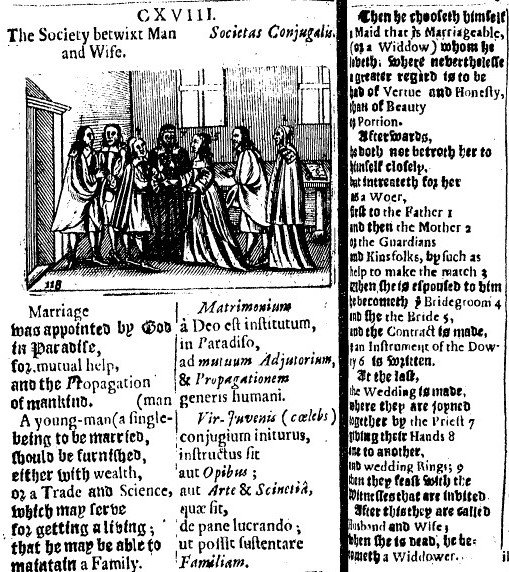
I have put together in a single image the intriguing way the woodcut artist chose to depict the soul; the seven ages of man (and woman); the picture of domestic pets (“The Dormouse and other greater Mice, as the Weesel, The Martin and the Ferret, trouble the house” explains the text); and a depiction of a domestic amenity I did not know early modern Europe had, the ‘Stove’ room, designed to be warm and cosy. It is depicted adjacent to a bedroom, complete with chamber pot. I doubt many 17th century children needed to be told its function (“A chamber pot is for making water in”), but the Latin word ‘Matula’ can’t have cropped up that often.

Alongside, I’ve put most of the double page about marriage, as a specimen, and because it appealed to me (“After this they are called Husband and Wife; when she is dead, he becometh a widower”).

Supposing Comenius’s project had triumphed… He was a Bishop in the Moravian Brethren, a Christian Church that did NOT teach that only its adherents were the saved. Suppose Comenius had managed to teach such tolerance, alongside the vital importance of a universal education based always on practice and encouragement. Suppose his vision of Europe as a Utopia had somehow taken hold...


Wednesday, September 27, 2006

Two lost daughters, Sonning Church


"Here lyeth Elizabeth Chute, Daughter of George Chute Knight and Dame Anne his wife, whoe lived 3 yeares and 6 monthes and dyed the 18th of May Anno 1627.

What Beauty wold have lovely stild
What manners sweet what nature mild
What wonder perfect All were fild
Upon record, in this one child
And, till the coming of the Soule
To call the flesh, wee keep ye Roule."

This miniature version, amateur and heartfelt, of Donne's Anniversaries on Elizabeth Drury, is complemented by the memorial brass, showing a very adult-looking Elizabeth Chute.

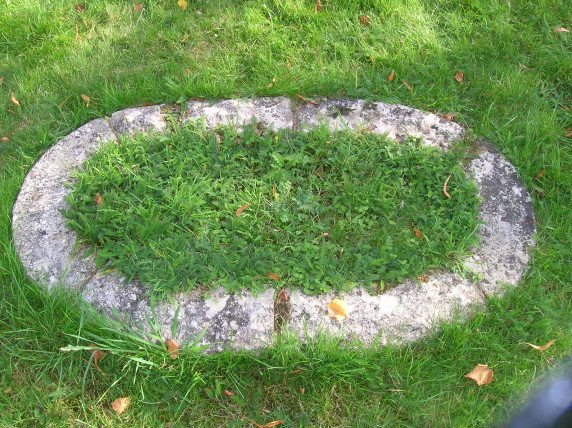
Outside, another set of parents, in 1940, somehow mastered their grief to create a very moving grave for their daughter. The inscription, on the top face of the end stones, is almost effaced, as the stones were laid flat. It is worth recording:

'With sweet memories of our darling daughter Emerald Green, [ ]- 1940',
and at the foot of the grave, the text (a version of Matthew 10, 16), 'And he took little children into his arms and blessed them'.

The diminutive grave employs a 17th century 'conceit': for their brilliantly named daughter, a visual pun, in which the stones define a gem in the grass. The parents must have been remarkable people; it is not often that the product of mourning is a work of art.

Saturday, September 23, 2006

Miraculous swarms of flies, 1675


I missed my favourite, large-size teacup this morning, and eventually found it upside down on my son's desk, imprisoning a wretched crane fly that had been blundering around in his room in the night.

They are currently swarming, not to any Biblical extent, but enough to keep popping up in the news: http://www.guardian.co.uk/uk_news/story/0,,1876307,00.html

This took my thoughts to this, well, 'flyer' would be the appropriate term, of 1675, when London was hit by a genuinely prodigious swarm of insects: 'they seemed to be descending like Showers of Rain, to the great Wonder and Admiration of several Spectators, who for some considerable time stood to behold them as a great Prodigy'.

The main body seems to have drifted around London: 'this wonderful sight continued up and down from one Place to another till Night' ... 'These Insects fell down in such great Numbers in Southwark that in the Borough the Market people swept them off their Fruits, Meat, and other Commodities, by whole handfuls ... in the Gardens, at Sir John Oldcastle's near Islington, and the Long-Field, near Blooms-bury, the Flies fell down there in such swarms, that they swept them up by Pecks'.

The sheet unfortunately gives very little entomological detail: the flies, or their wings, were white, they made 'a great sort of Buzzing', the insects' wings were 'very long'. Perhaps the mention of the 'strange appearance' of the flies might refer to both their individual unfamiliarity as well as their numbers: 'the General Consternation they have put the Town in, has made the Prodigy the only Talk and Discourse of all People both in City, Town and Country.'

It doesn't sound much like a stray swarm of locusts, swept by some freak of the weather across Europe. The news sheet has no room for speculation, and is almost surprisingly un-apocalyptic, no obvious Biblical identification is made. Locusts would surely have prompted some remark about the size of the insect; these suggested rain and snow, and were swept up in handfuls. A 'Prodigy', but, by this date, nothing to suggest that heaven is sending a message, it is just one of those odd things that happen. These days, we would be in a pother about it as a sign of global warming, 'apocalypse-nouveau'.