Thursday, June 29, 2006

In bed with Nicotiana


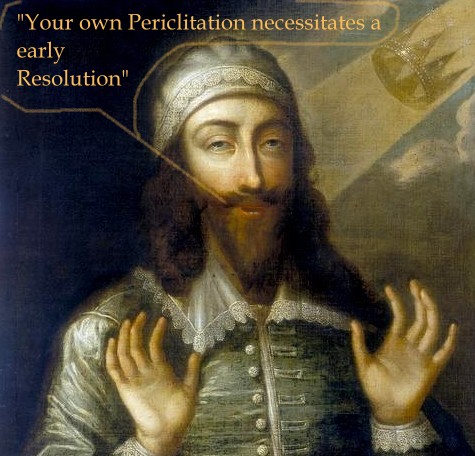
George Daniel, of Beswick (his dates were 1616–1657) vowed that he would never again take razor to his beard after the execution of Charles I. In this self-portrait, he is looking understandably surprised about the immensity of the consequence three years later: he is just 32, but has the beard of a patriarch, which he boldly complements with a balancingly vast furry hat. A friend confronted him with a mirror, and he wrote this poem about his new self:


How am I lost! though some are pleased to say
My mossy Chops estrange
All former Knowledge; and my Brother may,
At distance interchange
Discourse, as to a man he ne’re had known;
It cannot be, persuade
Your Selves; for when you made
Me take a Glass, I knew my Face my own.

The very Same I had three years agoe;
My Eye, my Lip, and nose,
Little, and great, as then; my high-slick't Brow,
Not bald, as you suppose;
For though I have made riddance of that Hair,
Which full enough did grow,
Cropped in a Zealous bow,
Above each Ear; these but small changes are.

For wer't my work, I need not far go seek
The Face I had last year;
The growing Fringe but swept from either Cheek,
And I as fresh appear,
As at nineteen; my Perruke is as neat
An Equipage as might
Become a wooer, light
In thoughts as in his Dress; but I forget;

Or rather I neglect this Trim of Art;
And have a Care so small
To what I am in any outward part,
I scarce know one of All;
'Tis not that Form I look at. Could I find
My inward Man, complete
In his Dimensions! let
Me glory Truth, the better part's behind.

It’s one of Daniel’s better performances. He likes to write about himself, though rather too often about himself as a poet, which he very self-consciously was: I don't know that he is ever really interesting on the topic. He admired George Herbert, but his own verse tends to be chopped-up prose with rhymes. He apparently lost many of his poems in a fire, and probably comforted himself with the assertion that those lost poems were his best ones.

My favourite Daniel piece, though, is his erotic poem about the pleasures of tobacco, which starts:

Come, my Nicotiana; we’ll renew
Our free delights, and Appetite pursue;
Wee fearless will Enjoy those real joys
Lovers would paint, in their fantastic toys…

Normally quite passionless in the relatively few amatory poems he does permit himself, which do conventional 'Platonic'/'Anti-Platonic' topics, in describing his passionate intercourse with the nymph Nicotiana, he really releases the sensualist. Suddenly, our bushy Yorkshire squire sounds like Carew at his fruitiest:

my free hand
No bashful blush shall ever Countermand,
But in a Thousand forms, thy Tresses part
And slide along, with uncontrollèd Art,
Thy dainty Body; not to fear a frown,
For soiling of thy new white Satin Gown;
My willing Lips shall part, to catch thy Breath,
Sweet, as the Honey-dew, which Hybla hath.
There will I hang; and all my veins inspire
With Ardent Wishes, taken from thy fire;
Hard on my Lips, thy wanton tongue shall press,
And by new Chimistrie in Wantonness,
Send the rich Quintessence of all I seek,
In Dalliance through that faire Alimbecke:
There will I suck, with Cunning Industrie,
Thy Spirits Extracted by Love's Alchimie.
When we 'are be-qualm'd, that long embraces has
Made dull Desire, and wee shall only pass
Faint breathings, I will summon a fresh Store
Of Vigour, far more Active, then before;
And with neat Titillations, new provoke
Decayed fire in thee, to the full Stock;
Invent new postures, & out-doe the old
Fictions, to make 'em Story; when with bold
Uncurbèd flames, we grapple; and not part,
But to renew our Action, and our Art.

I find it hard to think that Mrs. Elizabeth Daniel would not have approved: the oral and semi-tactile pleasures George describes all sound a bit unusual. I imagine that Charles I was a convenient pretext for the vast beard: Daniel clearly liked to be in a nimbus, of hair or smoke: the Creator, whose words issue from a bright cloud or burning bush.

Monday, June 26, 2006

Coming on strong, early modern style


I spent an almost spookily quiet Sunday (the England match was on TV) cycling in rural Hampshire.

After two visits to churches, one of which, on the redundant churches list, had cobwebs between the pews, and then traversing the site of the Battle of Cheriton Down (March, 1644) -

- http://www.appledowncentre.co.uk/battle.html gives a reasonable summary based on William Seymour's analysis - I decided that I was communing with the 17th century dead rather too keenly.

So here's a bit of 17th century life, as rendered by Thomas Deloney in Part 2 of The Gentle Craft (1639). Harry Nevell is trying (this is Chapter 9) to woo Mistress Farmer, a London widow just 2o years old:

Faire Mistris quoth Harry, I know it is the custome of women to make their denials unto their louers, & strictly to stand on nice points, because they will not be accounted easily won, or soone entreated: alack deere Dame consider nature did not adorne your face with such incomparable beauty, & framed every other part so full of excellency, to wound men with woe, but to worke their content.

Wherefore now in the Aprill of your yeares, & the sweet summer of your dayes, banish not the pleasures incident to bright beauty, but honour London streets with the faire fruite of your womb & make me blessed by being father to the issue of your delicate body; & though your beauty as the spring doth yet yearely grow, yet in the black winter of old age it will not be so, & we see by daily experience, that flowers not gathered in time rot & consume themselves: wherfore in my opinion you should doe the world intollerable wrong to live like a fruitlesse figtree.

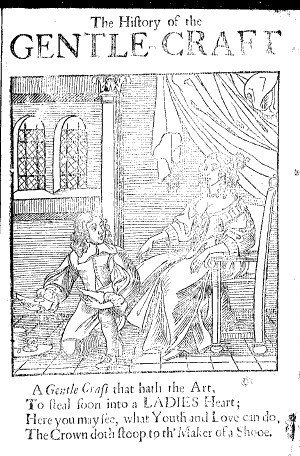
"Honour London streets with the fair fruit of your womb, and make me blessed by being father to the issue of your delicate body." Deloney is praised for the vividity of his dialogue, on which his fiction is highly dependent. He's fond of his shoemakers, who are always depicted as rather lucky fellows, who have a professional access to women's (lower) bodies. My illustration, from a 1678 edition of the first part of the book, captures those erotics. Earlier in the fiction, Long Meg of Westminster is involved in a piece of intense flirtation, and recites as she lifts her clothes (and is encouraged to lift them higher still):
Euery Carter may reach to the garter,
A Shoemaker he may reach to the knee,
But he that creepes higher shall aske leaue of me.

Harry's undeniably forthright pitch fails, for Mistress Farmer turns him down. But I do not think he is represented as foolish, rather that his carpe diem arguments (echoic of Venus and Adonis) are meant to sound eloquent, and his allusion to getting her pregnant - with its odd insinuation of a metropolitan version of patriotism, in which she first honours London, and secondly blesses him - was meant as well said. He rather goes off the rails after her refusal, largely because he is so winning in his ways with his later mistresses and their maids. Mistress Farmer accepts the offer of one of her shop's senior apprentices, after a series of trials of his patience, and his point blank advances on her. She tells him to join the army, he replies that: I had rather have my manhood tried in another place. Yfaith where quoth shee? by my troth said he, in your soft bed, which is far better then the hard field: why thou bold knave quoth she...

Till reading this part of The Gentle Craft, I don't think I'd noticed that it seems to have been customary for the mistress of a middle class house and premises to summon her servants using a whistle. There's an early allusion in the book, as two maids are fantasising about the pleasures of married life and being in charge of a household: 'she sets her siluer whistle to her mouth, and calles her maid to cleare the boord'. Mistress Farmer uses her whistle later in the book.

Tuesday, June 20, 2006

Surviving 105


On Sunday, as I was coming back from completing the 105 mile 'Circuit of the Cotswolds' Ride (I was rider 396) http://www.circuitofthecotswolds.org/2006/results.php
I called in at Brightwell Baldwin church in Oxfordshire to pay my respects to 105 year old Stephen Rumbold. If you heave aside a vast doormat in the Church porch, and dust a bit, there's his grave slab, with its splendidly confrontational quatrain:

"He liv'd one hundred and five
Sanguine and strong
An hundred to five
You do not live so long."

He lived from February 1582 to March 4th 1687: from before the Armada, almost to the Glorious Revolution, through the reigns of the later Elizabeth, James I, Charles I, the Commonwealth, Charles II, and on into the reign of James II.

There is apparently a Rumbold's Lane and a Rumbold's Copse locally. We are currently living through the last years of those exceptionally long-lived people who fought in World War One. These occasional centenarians really do seem to last into an eighth age of man, and were (and are) made much of, and rightly. Of course, early tombstones, with their regular 'hodie mihi, cras tibi' and 'such as I am, so will you be' mottoes did confront the reader uncompromisingly with mortality. But I have never seen was as cheerfully challenging as this, with old Stephen laying the odds just outside the church door. I do not know, but I'd guess that the gravestone which uses its inscription to remind the reader that he or she must die was a type which disappeared after World War One. Utterly unthinkable now, where prompting such thoughts has become bad taste. I like to think that the unknown verse-writer captured Stephen Rumbold's 'sanguine' character, maybe even one of his own jokes.

Brightwell Baldwin does well for inscriptions. Inside, now safe on the wall, is what might be the earliest recorded memorial brass in English: 1371, for John the Smith:
'Man com & se how schel alle ded li; wen yolk comes bad & bare
Noth have wen we away fare; All ye wermes yt ve for care;
Bot yt we do for god yr luf haue nothyng yare; hundyr
yis grave lys John ye Smith god yif his soule hewn grit.'

('Man come and see how shall all dead lie, when [youth? folk?] comes bad and bare
We have nothing when we go away, only the worms care for us.
Except what we [have done] for God's love, we have nothing ready [provided]; Under
this grave lies John the Smith God give his soul great heaven').

The idea here is that John Smith survived the Black Death, and bought up ownerless lands, became prosperous, and finally wanted a vernacular inscription - Latin had probably died in the parish with the priest. Blogger has put my blurry picture at the top of this post, my camera could not cope any better than that. As a final monument, in you lift the carpet in the aisle, there's one of the Cottesmore brasses, commemorating Chief Justice John Cottesmore, Amice his wife, and their eighteen children, five boys and thirteen girls.

History, human history accumulating in yet another 'accoutred frowsty barn'! (http://www.artofeurope.com/larkin/lar5.htm)

Saturday, June 17, 2006

Early Modern Nakedness


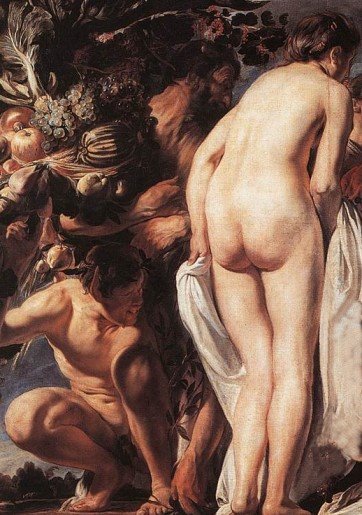
I’ve been unable to get on-line, my ISP having problems. I’ve anyway been reasonably busy with the effort to get degree results out after the lifting of the industrial action. My image is taken from a painting by Jordaens, because in this hot weather, I am offering you two passages concerning early modern nakedness.

“The same day sevennight he [Prince Henry] died, there fell out a very ridiculous accident. A very handsome young fellow, much about his age and not altogether unlike him, came stark naked to St. James’s whiles they were at supper, saying he was the Prince’s ghost come from heaven with a message to the King. But by no manner of examination or threatening could they get any more out of him, or who set him to work. Some say he is simple, others mad. He belongs to one of the Chancery. All the penance they gave him was two or three lashes, which he endured as it seemed without sense, and keeping him naked as he was all night and the next day in the Porter’s lodge, where thousands came to see him. The King sent to have him dismissed without more ado or enquiry.”

Diary of John Chamberlain, 19th November, 1612

“And in the mean while went the Lord Frederick secretly away, and came into the chamber, where she did unclothe her all naked saving a cloth before her members, and then came into the hall before the king and all his lords, and before all the other persons there being present, all naked, save that she had a kercher of silk before her members. And when she was come in, she went to the king and did him reverence. And when the king and his lords saw her, they marvelled greatly, wherefore that that fair woman came in naked before them… and therefore said the king to her, ‘Show you us what ye be and wherefore that ye come in here before us all naked in this manner.’ Then answered the woman to the king and said ‘I am the same person Lord Frederick that you spake on…’ ”

This second passage is from the narrative called Frederyke of Jennen (1518, 1520, 1560). It is the source narrative that you will find in the back of any decent edition of Cymbeline – the tale of the good wife whose partner has wagered on her virtue, who over-trustingly takes a trunk into her bedroom, from which a villain emerges to gather evidence that will win his bet that she can be proved lacking in virtue, the wife who then disguises as a man until the time comes for her dramatic way of revealing her true gender. A pity Shakespeare’s theatre prevented him from having Imogen cease to be ‘Fidele’ in this way (it would have done something for the popularity of the play). The theatrical conventions of the self-regendering moment are interesting – Luce in Thomas Heywood’s The Wise Woman of Hogsden stops being Jack the lad with this concise action and question to the bewildered man she is claiming as her husband: ‘She scatters her hair. What say you now?’

The first passage is an incident at the Jacobean court, rather well handled by King James, considering the offence he could have taken at this impersonation of his dead son. I suppose that at an early modern court, you had to do something to fix royal attention on you, and get them to listen to your petition. I like the way word gets out, and thousands go to take a look at the offender, though that he felt punished by this is perhaps open to doubt.

Sunday, June 11, 2006

A Recollection of Dame Helen


Posting on the number of the beast reminded me of Dame Helen Gardner - not that the late Merton Professor of English was in any way satanic herself: far from it, in fact. I knew her via an early form of staff-student committee in the Oxford English faculty, which she invited me to join, probably assessing me shrewdly enough as suitably ordinary and from nowhere special (and so credible to the role), but (when it came to any dispute about the degree) deeply compliant. Stories about her were rife in the student body, and we massed in her otherwise not particularly remarkable lectures, hoping to hear one of her fabled candid asides.
She once quenched a potential postgraduate pitching a research project on a Renaissance numerologist called (apparently) Pietro Bongo with the regal and disdainful query: 'And who is Bongo?' (tonally very much in the line of the earlier Oxford joke, 'What I don't know ain't knowledge'). Another Unlucky Jim in a similar position unluckily ad libbed at some point about 'God-botherers', to be told acidly: 'I consider myself something of a God-botherer'.

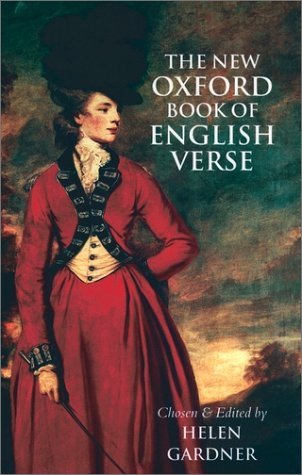
In 1972 this devout and learned lady edited the New Oxford Book of English Verse, all 884 poems of it, and so had to choose a poem to be number 666. Somehow she slipped into place, without apparent disruption of the chronological run of the book, this sonnet, Lucifer in Starlight, by George Meredith:

ON a starred night Prince Lucifer uprose.

Tired of his dark dominion swung the fiend

Above the rolling ball in cloud part screened,

Where sinners hugged their spectre of repose.

Poor prey to his hot fit of pride were those.

And now upon his western wing he leaned,

Now his huge bulk o'er Afric's sands careened,

Now the black planet shadowed Arctic snows.

Soaring through wider zones that pricked his scars

With memory of the old revolt from Awe,

He reached a middle height, and at the stars,

Which are the brain of heaven, he looked, and sank.

Around the ancient track marched, rank on rank,

The army of unalterable law.


And so, having put the devil in his place, she passed serenely on - if you wanted to carp about her victory, well, Meredith was born in February 1828, and Dante Gabriel Rossetti (the immediately prior poet in the anthology) not until the May of that year, and so technically he ought to appear in the book after Meredith. So she did cheat a bit. I doubt that anyone would have said as much to her when she was alive.


Thursday, June 08, 2006

The Wrong Number of the Beast


The world seems to have survived 6.6.06, despite those ominous words, ‘Here is wisdom. Let him that hath understanding count the number of the beast: for it is the number of a man; and his number is six hundred three-score and six’: Revelation, 13; 18).

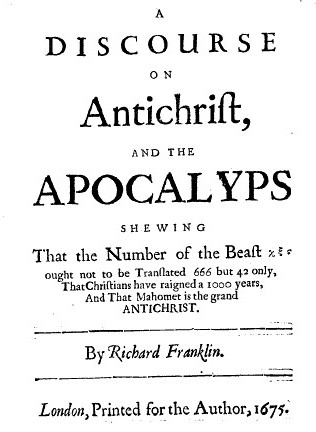
With the abrupt ending of the marking boycott, life is full of the business of moderating numbers, so here’s just a brief post based on Richard Franklin’s argument (from 1675) that the number of the beast had always been misunderstood, and should be construed as 42.


Yes, 42, one of the favourite numbers on the internet, with a whole website devoted to sightings of it at http://www.digitalthoughtsw.com/DTS/42/

That site is, of course, created in homage to Douglas Adams’ Hitchhiker’s Guide to the Galaxy, where the computer Deep Thought calculates ‘the Ultimate Answer to Life, the Universe, and Everything’. After seven and a half million years of computation, '42' is the answer Deep Thought comes up with. To the delight of Adams’ fans, 42 was subsequently strongly backed (at least for a spell) as the figure for the ‘Hubble Constant’ (which determines whether the universe expands, or is static, and so whether it will end entropically, or in a ‘Big Crunch’) For which see http://en.wikipedia.org/wiki/Hubble_constant

Richard Franklin based his argument about a different kind of end-of-the-world on reading the Greek 'chi xi sigma' not as denoting numbers, but as letters that are then to be decoded as numbers (on a simple scheme with alpha as one, and then onwards through the 24 letter alphabet of Greek to omega, so giving him signs in these three cases equivalent to 22, 14, and 6: the product of those numbers being 42). This he can then prove, at least to his own satisfaction, to be the number of Roman emperors prior to Constantine, the first Christian emperor. He goes on to argue that the Antichrist cannot be identified with the Pope, but has (in the 17th century way of these things) to be Mohammed.

What really is interesting here is that sense (again) that the press in the mid 17th century was very much their internet, their way of posting their crazy ideas. Once censorship had lapsed post-1642, and after the burst of urgent controversy in the mid 17thcentury, it looks as though lots of printing presses were chasing work. It clearly didn’t cost very much to publish a pamphlet, so all sorts of ill-advised stuff appeared, 'Printed for the Author'. Franklin apparently projected a life of Cranmer, but this little work seems to be all that's left from him. Among the class of writings that rave about Gog and Magog, it is relatively lucid, but 42 just didn't catch on - after all, compared to 666, it is such a banal number. How could anyone get excited about 42? Oh, yes, I've already answered the question. I think he must be right.

Saturday, June 03, 2006

A not quite early modern footballer


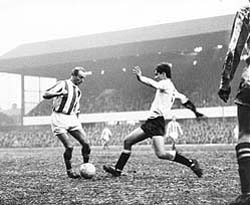
Some years back, we used to run ‘poetry seminars’ for our students. They were more a training for speaking up in class than designed to meet any syllabus. I used to do mine thematically, and would set the class off to find poems to bring to the seminar. One of these themes was heroes (and heroines), and I would produce as my text Alan Ross’s poem about Stanley Matthews (1915-2000), the first footballer ever to be knighted. I transcribe it before the overblown festival of footballing mediocrity that the World Cup will almost certainly prove to be.

A high art poem on a low art subject is a hard act to pull off, and perhaps Ross indulges some anxious cultural name-dropping that doesn’t quite work. Maybe the poem can be seen as ancestral to Karl Miller's notorious prose-poem on Paul Gascoigne. But as a mimesis or verbal opsis of Matthews’ movement on the pitch, the poem is good, and it is clearly (stanza three) the product of someone who has studied his subject intently. The black and white film of Matthews hardly gives any better sense of what he did, and what there was to see, than this poem does. As a highly modified love poem, one man to another (final stanza) it reveals something about the homoerotics of sport. People loved watching Matthews play, and were moved to the poetic by what they saw - his movement, in dribbling past a fullback, was compared to that of a dragonfly, that hovers, then swerves away with flickering rapidity.

Even young women (students), indifferent to football, were beguiled by a poem than can turn ‘Stoke City, Blackpool and England’ into such a powerful mantra.

I used to follow football, prior to the Hillsborough and Heysel stadium disasters, which made me give up. The contact that I had with football of the 50’s was early experience at school with leather caseballs, leftovers from a bygone era, hard and weighty, painful if you kicked them with poor technique, frightening objects if they came at you fast. Matthews was the genius at the kind of game they dictated.


Stanley Matthews


Not often con brio, but andante, andante,

horseless, though jockey-like and jaunty,

Straddling the touchline, live margin

not out of the game, nor quite in,

Made by him green and magnetic, stroller

Indifferent as a cat dissembling, rolling

A little as on deck, till the mouse, the ball,

slides palely to him,

And shyly, almost with deprecatory cough, he is off.


Head of a Perugino, with faint flare

Of the nostrils, as though Lipizzaner-like,

he sniffed at the air,

Finding it good beneath him, he draws

Defenders towards him, the ball a bait

They refuse like a poisoned chocolate,

retreating, till he slows his gait

To a walk, inviting the tackle, inciting it.


At last, unrefusable, dangling the ball at the instep

He is charged – and stiffening so slowly

It is rarely perceptible, he executes with a squirm

Of the hips, a twist more suggestive than apparent,

that lazily disdainful move toreros term

a Veronica – it’s enough.

Only emptiness following him, pursuing some scent

Of his own, he weaves in towards,

not away from, fresh tacklers,

Who, turning about to gain time, are by him

harried, pursued not pursuers.


Now gathers speed, nursing the ball as he cruises,

Eyes judging distance, noting the gaps, the spaces

Vital for colleagues to move to, slowing a trace,

As from Vivaldi to Dibdin, pausing,

and leisurely, leisurely, swings

To the left upright his centre, on hips

His hands, observing the goalkeeper’s spring,

heads rising vainly to the ball’s curve

Just as it’s plucked from them; and dispassionately

Back to his mark he trots, whistling through closed lips.


Trim as a yacht, with similar lightness

- of keel, of reaction to surface – with salt air

Tanned, this incomparable player, in decline fair

to look at, nor in decline either,

Improving like wine with age, has come far –

born to one, a barber, who boxed

Not with such filial magnificence, but well.

‘The greatest of all time,’ meraviglioso, Matthews –

Stoke City, Blackpool and England.

Expressionless enchanter, weaving as on strings

Conceptual patterns to a private music, heard

Only by him, to whose slowly emerging theme

He rehearses steps, soloist in the compulsions of a dream.


Philip Larkin included this poem in his resolutely retro Oxford Book of Twentieth-Century Verse (1973), which is where I came across it.

http://www.netmemorials.co.uk/Sir%20Stanley%20Mathews.htm

http://ftvdb.sigmer.net/show/summary/title/517949/

http://www.oxforddnb.com/view/article/73782 (if you have access to the ODNB on-line)

Tuesday, May 30, 2006

Charlie's Chaplain

Two Royal chaplains are buried at the Parish church in Eversley, in Hampshire,

http://www.stmaryseversley.org.uk/

They are Alexander Ross, chaplain to Charles I, and Charles Kingsley (more famous as the novelist and social reformer), but who was chaplain to Queen Victoria, and sometime tutor to Edward VII.

I do not know if there has ever been a study of the intellectual mentors of the famous (a mixed history that might start with Seneca’s disastrously temporary hold over Nero). It is hard to imagine that Alexander Ross was anything other than a bad influence on King Charles, for Ross was a cantankerous fanatic, who struck out at any new idea that he encountered. A medieval-style Aristotelian, he attacked Thomas Hobbes, Sir Kenelm Digby, Sir Thomas Browne, William Harvey, and published a late (the last?) refutation of the crazy new (-ish) notion that the earth revolved around the sun, in The New Planet no Planet, Or, the Earth no wandering Star, Except in the wandring heads of Galileans (1646).

Ross also collected and catalogued religious heretics, and this orthodox man’s obsessive interest in what he saw as the heterodox perhaps led him to some involvement in the first English translation of the Koran. He might in fact have been the translator, the work coming into English via a French translation. The prefatory matter that he certainly did contribute (because he signed it) is a characteristic performance. He knows that the project cannot (by his own narrow principles) be justified, but he also cannot quite resist adding this prize example to his manic collection of (as he sees it) departures from the true faith.

His self-conflict is captured in this passage, from amongst his list of justifications for publishing the work:

“We cannot do better service to our Countrymen, nor offer a greater affront to the Mahometans, than to bring out to the open view of all, the blind Sampsons of their Alcoran, which have mastered so many Nations, that we may laugh at it” (sig d4).

This, of course, casts his Christian readers as the Philistines, foolishly jeering at the undaunted captive who will bring down the roof on them all. Ross cannot quite conceal from either himself or from us his unease about what he is doing. Is he, the staunchest defender of things as they are, introducing the potent force that will demolish everything?

Charles Kingsley was perhaps stranger still. His inner heretic was Darwinian, and he had suffered the full 19th century ‘doubts’, before rallying to settle on his version of manly Christianity. He is buried outside the Church with his somewhat older wife, Fanny, beneath a white cross whose design they had jointly agreed. The inscription reads ‘Amavimus, amamus, amabimus’ (‘We loved, we love, we shall love’). It is more than a piece of Latin declension. When a young woman, Fanny had been drawn to the idea of establishing a Protestant celibate sisterhood. Charles seems to have managed to supersede this with a doctrine in which the orgasm was interpreted as a foretaste of the similar joys of heaven. The immense, almost doctrinal importance he gave to sex as an earthly manifestation of the divine might have made him (in the unlikely case of their consultations ever touching, in some remote fashion, on such matters in a Christian marriage) congenial as a Chaplain to Queen Victoria, who was frisky enough when young. A 20th century memorial window to Kingsley depicts a couple of water babies (I think, though I cannot see that the external gills the story specifies have been included) at either side of St Elizabeth of Hungary, whose status as a married saint made her extremely important to the writer.

But Eversley church takes us back to the Koran again, in a brass memorial plaque to the remarkable Mary Kingsley (Charles Kingsley’s niece). It is a surprise to see in an Anglican Church an inscription in Arabic, even more of a surprise to find that it translates the Koran saying ‘I seek refuge in the Lord of the Daybreak, / From the evil of that which he has created, /And from the evil of the intense darkness when it comes.’ Theologically tough-minded stuff, this: I think only Isaiah 45, 7 is anywhere near as candid in allowing the Bible’s God to be responsible for the whole shooting match, good and bad. One can only suppose that Mary Kingsley was so far off-the-scale in her unconventionality (West African travels, condemner of missionaries, unflinching defender of local customs up to and including slave trading) that they felt they had to rise to the challenge.

History seems to gel, congeal, and aggregate in certain places. The final surprise in Eversley Church is to lift a trapdoor in the floor and discover a sarsen stone glistening darkly beneath the Christian fabric. Was it accidentally there, a mere freak of geology, or did the church get there because this stone had served in a previous form of worship?

http://www.stmaryseversley.org.uk/Virtual_tour.htm

Saturday, May 27, 2006

Well, it smites my lyre anyway

I have been listening, over and over, to Handel’s 1707 ‘Dixit Dominus’: I’ve got a version performed wonderfully by The Sixteen Choir and Orchestra http://www.chandos.net/details05.asp?CNumber=CHAN%200517

Apart from a gruesome ‘midi’ file, I’m afraid that I cannot find an mp3 on the net. Anyway, once it had got under my skin, I wanted to know what it was about. Handel was setting the Latin text (from the Vulgate) of what became Psalm 110 in the English bible. I was aware of other settings of this psalm, notably Monteverdi’s. There’s a list at http://www.cpdl.org/wiki/index.php/Psalm_110

To see what the text of this glorious music actually says is a shock. In the fifth and sixth sections, Handel is setting ‘confregit in die irae suae reges’ (‘hath broken kings in the day of His wrath’) and ‘conquassabit capita in terra multorum’ (‘He will crush heads in the land of many’ or (AV), ‘he shall wound the heads over many countries’). To ‘confregit’ and, even more markedly, ‘conquassabit’, Handel gives an exultant setting. The sopranos shriek, the tenors shout (all in their highly modified way). Violence was (surely) never celebrated with such beauty. The sentiments are those of a savage tribe, but delivered in such a way that you have to love and admire humanity: the special genius who can score such music, and the men and women who have nurtured their talent till they can perform with such intensity and precision.

Psalm 110 is power-worshipping, the kind of power that smashes enemies abroad. The version in The Book of Common Prayer enthuses: ‘He shall judge among the heathen; he shall fill the places with the dead bodies: and smite in sunder the heads over divers countries.’ It celebrates the inauguration of a king as being, simultaneously, high priest ‘for ever according to the order of Melchisedech’. For this moment of union of temporal and sacred power, Handel again supplies a canon (I think) of astonishing beauty. When Henry VIII passed the Act of Supremacy, he didn’t know it, but this was what he had in mind. And yet, and yet: because Handel sets in a Christian tradition, while there may be a residual sense of power embodied in a here-and-now mortal priest-king, as that priest-king really has to be Christ, the psalm (as set) also expresses, exuberantly, the destruction of all temporal kingship: kings as footstools, broken kings, a new reign in which ruling has been swept away.

Psalm 110 achieved its cultural prominence through a misunderstanding: ‘Dixit Dominus Domino meo’, it starts: and this was inevitably read as ‘The Lord (God) said to my Lord (Jesus)’. With that poorly-evidenced doctrine of the Trinity to shore up, here was a text with God speaking to His Son. What might have begun as a praise-song by a court poet about David, or might have been David’s own song about Solomon (or some future leader), and what was certainly a psalm that acquired a very special personal application in the reign of Simon Maccabeus, then went on to be quoted repeatedly in the New Testament. Heralding a messiah, it was inevitably recruited by Christians as being a messianic text about Jesus. This is Isaac Watts’ 1719 version (opening):

Thus the eternal Father spake
To Christ the Son, ‘Ascend and sit
At my right hand, till I shall make
Thy foes submissive at thy feet.’

Watts’ title for his version of the psalms was candid enough: The Psalms of David, imitated in the language of the New Testament, and applied to the Christian state and worship. He translated by choosing those interpretations of the text which were to his mind the “most evangelical and most beautiful”. Watts found the psalm so important, that he gave it three iterations, and interpolated into the text as he thought fit: “Thro' the whole earth his reign shall spread, / And crush the powers that dare rebel” – Christ as the conqueror.

Yet as Watts indulges these sanguinary but devout fantasies, he acknowledges the actual gospel narrative. The last verse of the Latin psalm is obscure (‘De torrente in via bibet: propterea shall He lift up the head’ – ‘He shall drink of the torrent in the way: therefore shall he lift up the head’). Mary Sidney (1561-1621) translated expansively, and swings deftly from the bloodily triumphant, to the Messiah being victorious in death:

Thy Realm shall many Realms contain:
Thy slaught’ed foes thick heaped lie,
With crushed head ev'n he shall die,
Who head of many Realms doth raign.
If passing on these ways
Thou taste of troubled streams:
Shall that eclipse thy shining rays?
Nay, light thy glories’ beams!

Isaac Watts pushed that ‘torrent’ still further into metaphoric paraphrase:

Tho' while he treads his glorious way,
He drink the cup of tears and blood,
The sufferings of that dreadful day
Shall but advance him near to God.

There’s a story that the birth of English Literature as a discipline had something to do with World War I: that a generation of classicists forgot their Greek while serving in the army prior to going to ‘Varsity’, and so a new subject was devised to suit their shortcomings. Looking into psalm interpretation made me think that our kind of interpretation took root after people lost faith in 19th century forms of Bible interpretation (or that form of scholarship just became too difficult/vexed/mad). Just have a gander at Professor Hildebrandt’s footnote density!

http://faculty.gordon.edu/hu/bi/Ted_Hildebrandt/OTeSources/19-Psalms/Text/Articles/Bateman-Ps110-BS.pdf

http://www.bible.org/page.asp?page_id=1573

(My picture is Kind David harping, from a painting by Jan de Bray.)

Wednesday, May 24, 2006

"I have nothing of new to direct you in"


Imagine scholarship without the OED (if you can). Now that the power of the computer has been integrated so consummately with that dictionary’s vast resource, just what a resource it has become.

A feature of the online OED which I find irresistible is the search facility for ‘first cited author’ and ‘quotation author’. My last posting was a Charles Cotton poem, in which he is amused (I take it, because he knows that ‘chambre’ means bedroom) by the term ‘valet-de-chambre’, which sounds nicely naughty to him.

The first recorded use of ‘valet-de-chambre’ in English is in a letter from Charles I to Henrietta Maria (so it was quite a new term for Cotton). This set me off looking at Charles’ other potential contributions to the language. The readers who compiled quotations for the OED tended to spot rare words, and also to be drawn, Dr. Johnson-like, to striking quotations. But whoever read Charles I, did so attentively (and without any obvious bias towards noble utterances written by or reported from the King).

Charles had a French wife, and so certain words not recorded prior to his usage may well be very early or even actual first usages. There’s that ‘valet-de-chambre’, and his idiom ‘nothing of new’ is one that the editors suggest may stem from French usage. He adds a new usage to the surprisingly early loan word ‘vogue’ with the idiom, ‘in vogue’. ‘Apostil’ (to annotate or write marginal notes to) failed as a loan word, but is a very characteristic type of usage, for of all kings, Charles was involved (to say the least…) in politics. New political applications of words, fresh military ones, and a vocabulary for the scrutiny of documents (and the characterisation of them) all feature prominently:

A ‘cabalist’ (one who cabals), ‘engage’, ‘anti-monarchical’, ‘agitate’, ‘round-dealing’, ‘misunderstanding’, ‘illiberal’, ‘distractions’ are all entries with developed senses not recorded before Charles’s usage. For military words, ‘home-defence’, ‘enquarter’, and ‘forage’, and from Charles studying documents and attempting to characterise positions taken, words like ‘absolute’, ‘demonstrably’, ‘unconfutable’, ‘counsellable’, ‘paraphrase’, and ‘hyperbolic’ have significant quotations, illustrative of the word’s semantic development, from Charles.

The King’s characteristic usages are recorded: ‘malignant’ meaning ‘sympathetic to the Parliamentarian cause’ seems to have been habitual. His complaint about “The malignant Party which have … begot this Misunderstanding between us and our good subjects” has ‘malignant’ in new sense 1 c and ‘misunderstanding’ in new sense 2 together in one utterance. Charles, a man with a developed aesthetic sense seems (probably) to have regularly used ‘unhandsome’ to deplore something he disapproved of (“his unhansom quitting the Castell and forte of Bristol”). That he is first recorded user of ‘picture-drawing’, in a personal reference for Mytens, seems very appropriate (“Wee, having experience of the facultie and Skill of Daniel Mittens in the Art of Picture draweing…” – and doesn’t this sound exactly the note of a kiss-off reference, Charles having found Van Dyke?)

I didn’t really see Shakespearean usages crop up in this great reader of plays, but sensed that you might have a basis for claiming that Charles had spent a lot of time listening to John Donne, from whom he might have picked up ‘pre-pardon’ and ‘refractariness’.

My doctored hagiographic portrait has one of Charles’ locutions, as picked up by the dictionary. But it isn’t ‘periclitation’ that was the new word there (it seems to have had some circulation among these classically-educated men of the 17th century for ‘nearness to danger’), but ‘necessitate’ as a verb which is the potential new usage.

Rather beguilingly, I had to search for Charles’s quotations as both ‘Charles I’ and ‘Chas I’, for the dictionary was compiled in an earlier age, and without electronically introduced internal consistency (as the search guides point out).

With his tendency to stutter, Charles I is not associated with any great moments of eloquence or outbursts, and his words may well have undergone loyal working-over. But the situation he found himself in seems to have made him a more varied linguistic performer than one might have expected from a king more famous for iconic than verbal self-projection.

http://dictionary.oed.com/

Saturday, May 20, 2006

The Mistress-Master of his passion?


Charles Cotton again … I’ve always considered Orsino a character delivered in Shakespeare’s highest style of comedy. But students tend to dismiss him automatically (‘in love with being in love’ is held against him, as if this were the worst of emotional depravities). His final speech in Twelfth Night is his best moment, when he seems to contrive to marry everybody (‘A solemn combination shall be made / Of our dear souls’), moves in with Olivia at last (‘We will not part from hence’), and assigns an undiminished role for Viola, who can continue to play ‘Cesario’.

At the end of Cotton’s ‘Amoret in masquerade’, the poet puts the question that he has pondered throughout this poem to a beguilingly pretty boy who has caught his attention:

… Come, tell truth,

Are you not a cloven youth?

See, he laughs, and has confess’d,

God-a-mercy for the jest:

Monsieur Amoret let me

Your Valet de Chambre be,

I will serve with humble duty

Both your valour and your beauty,

You shall all day Master hight,

But my Mistress, Sir, at night:

Which if you will please to grant

To your humble supplicant,

Since you wear your wig so featly,

And become your clothes so neatly,

He has sworn, who thus beseeches,

You shall always wear the breeches.

Cross-dressing masquerades do not sound plausible social occasions for the 17th century Peak District: this is a literary piece, from a culture that has had time to assimilate Shakespeare, and all the ‘page-boys’ of Jacobean stage romances. This little fantasy of safe same-sex attraction has its charm: I like the rather unexpected way that a mid 17th century girl has to put on a wig to make herself masculine. Of course, Cotton was unreconstructed: ‘cloven’ is his usual way of denoting specifically female anatomy, but it’s a word that has rather markedly diabolic associations, while that final line promising that she will ‘always wear the breeches’ gets its point from misogamistic discourse (Cotton has a satirical ‘Joys of Marriage’ poem). She can be, day-time, a boy wearing the breeches, as that turns him on, but she conspicuously isn’t a wife with any potential for wearing (metaphorically) the breeches in the household. Perhaps most betrayingly of all, Cotton uses for this set of verses the same heptasyllabics he deployed for Matty his pine marten. ‘Pretty’ and ‘little’, quite acceptable in a poem about a pet, become leering in a poem which miniaturises and de-genders a woman.

But that goes too far: imagining a girl as a surpassingly beautiful boy excites Cotton to a strong restatement of her hidden gender. This is earlier in the poem:

My heart tells me, to those eyes

There belongs a pair of thighs,

'Twixt whose iv’ry columns is

Th’Ebon folding door to bliss:

And this sprig, all that we see

Strut with such formality,

Huff, and strive to look so big,

Is but Pallas in a wig;

And though his count’nance he doth set

To a good pitch of counterfeit,

Yet he cannot hide the while,

Venus’ dimple in his smile…

(Beresford’s 1923 edition has ‘Ebor’ where I’ve put ‘Ebon’ (‘Ebor’ isn’t in the OED, but ‘ebon’ connotes dark, etc), and reads ‘spring’ where I’ve substituted ‘sprig’ - as a regular term for a young man).

‘Venus’ dimple’ giving the true gender of the boy away reminds me of Donne’s ‘All will spy in thy face / A blushing womanly discovering grace’ (Elegy XVI), that marvellous moment when Donne for once allows a young woman’s beauty into his poetry (before being impelled to efface it: ‘Richly clothed apes, are called apes…’).

Cotton’s more famous poem about a ‘Doubtful Gender Masculine is his ‘On Annel-seed Robin, the Hermophrodite’, in which he casts Robin as a henotic being (one flesh, man and wife at once). It’s again faintly Shakespearean, being like ‘The Phoenix and Turtle’ this time: ‘in this Chest Entombed are, / The wonder of a single pair’. But why ‘Annel-seed’?: my guess is from ‘anil’, indigo – as purple mixes two colours, Robin mixed two sexes. Could it be something to do with aniseed?

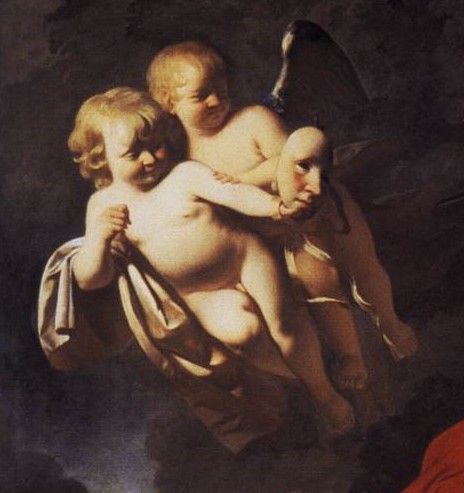
I couldn't find a convenient image of an early modern transvestite girl, so I took the putti with a mask from a bad painting by Everdingen. Maybe someone with more courage at the internet browser can tell me where to find one.

Wednesday, May 17, 2006

Early Modern Advertising Again (or how not to write a Girls’ School Prospectus)


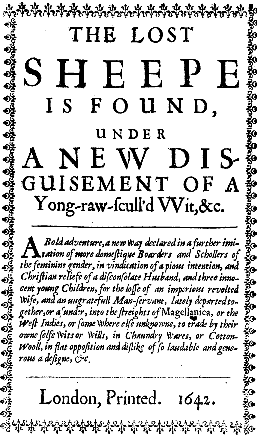
It was 1642, and Ben Agar had ambitious schemes to set up, in
Kingston-on-Thames
, ‘a private Schoole or Nursery, for the generall education of female youth only, at, or from the age of eight yeares, or thereabout, with all convenient and delightfull appurtenances thereunto belonging’. The curriculum will be of ‘Latine, French, and writing by Letter and Cyphers, as also for other Morrall, Civill, and Religious discipline, with the teaching of sundry sorts of Needle-work, Tent-worke, or the like, Musicall instruments, and Dancing.’

Unfortunately, the schemes of this over-sensitive gentleman were put back by his wife absconding with a man he intended to employ in the school, leaving the unhappy pedant determined to do two things in just the one pamphlet: advertise his girls’ school, and re-assert his virility. This is not an easy combination of aims. For instance, he will undertake, he says:

“To breed up and religiously educate, three dozen at least of pure Virgins, and yet turne and returne them all safe and secure to their severall indulgent Parents, after foure or five yeares exercise of their young and tender inclinations, as chast and pure, and surely more perfect and cleare, then they came or were delivered into my charge, maugre all those imputations of my frozen imbecilitie that way, cast upon me by my lustfull wife, who (after almost twentie yeares experience) declares me scarce so able for her satisfaction as an Euenuch.”

One subject at a time would have been better, wouldn’t it? He can’t quite resolve whether it would be better for his boarding school to declare himself impotent, or whether he should as a husband contradict the charge laid by his absconded wife. He ventures into metaphor, to predictably unhappy effect:

“Notwithstanding all the insultant premises of an ungracious wife; I have had by two wives, six children; though now (through lazie negligence or other accidentall impediment) I have so seldome, and timorously frequented the two-leav’d dore of my stately habitation; that my present wife hath been unwillingly constrained to run thorow the back-yard of Concupiscence behinde her husbands great house, to perswade her lusty man to perform his Masters office at home and abroad.”

Once started, Agar lets it all hang out: when it comes to not delivering on the marriage vows, he will tell the predictable husband’s tale, of a man “who hath been hitherto detained from her, and bated of her own and due benevolence, three quarters, at least, or every whole yeare, for almost twenty yeares together”.

The title page of this ill-judged publication seems to introduce the hopeless confusion of aims. He called it The Lost Sheepe is Found, but the sub-title then explains that his “imperious revolted Wife” and her paramour the “ungrateful Man-servant” had departed together “into the streights of Magellanica, or the West Indies, or some where else unknowne” – there’s a Lost Sheep that sounds to have exited fairly conclusively from the fold.

Poor old Agar! Simultaneously presenting himself as the reassuringly continent schoolmaster, and sex-denied husband, eager to advertise his scheme, but conforming to every traditional satirical hit at schoolteachers: touchy, self-absorbed, blind to reality, issuing promises to look after dozens of young women, but made to look an utter fool by just one.


I wonder how many of the couples who joined the early colonies were driven to go there, as the ex-Mrs Agar so understandably was, by the unavailability of divorce in
England?

Saturday, May 13, 2006

Early Modern Pets


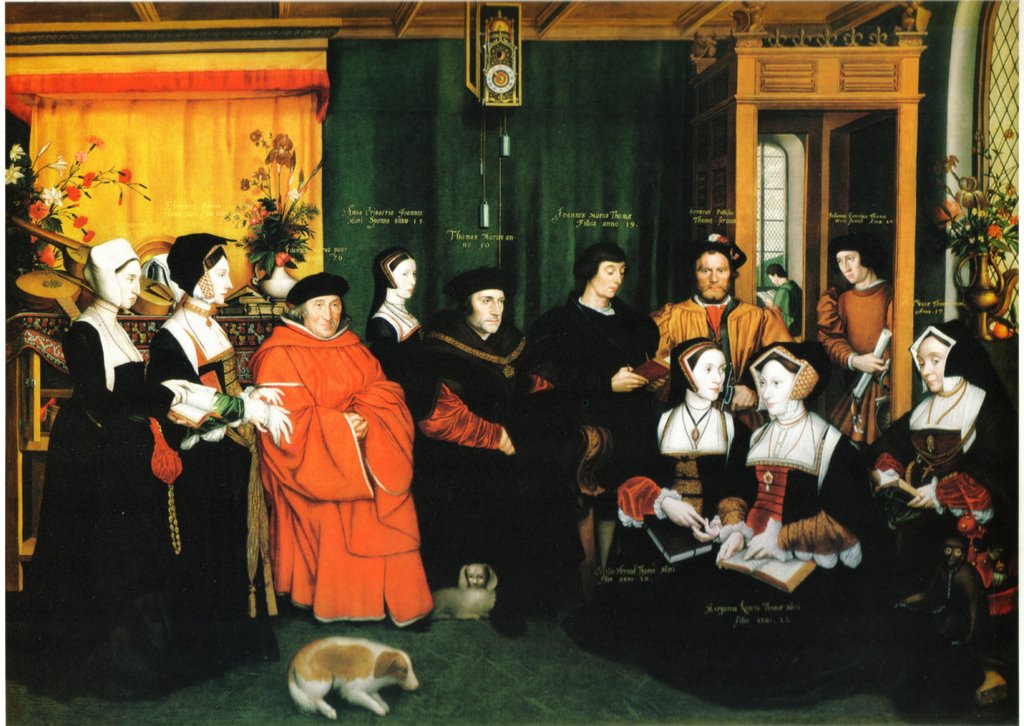
I was thinking again about Sir Thomas More and his household: that grave company of clever adults (two or three of the young women present do seem to be pregnant, but no actual children intrude on the scene). Instead, three honorary children appear, supplying an unexpectedly frivolous shrub-layer to this forest canopy of mature intellects: the animals, two dogs, and tucked away in the right hand corner, like a marginal antic-work in an illuminated manuscript, an ape.

Early modern pets always included exotics – those delightful and faintly subversive popinjays! – but I want to post today about the wider range of native animals people kept as pets. Charles Cotton (1630-87), gentleman poet and angler, who lived on the Staffordshire side of the Peak District, had a pet pine marten, which he wrote about in a set of verses, ‘On My Pretty Marten’.

The poem seems to have a twofold purpose: a self-indulgent burbling about the merits of the animal, and an attempt to convince a woman partner that this is an acceptable animal to have around. Towards the end of the poem:

Here sweet beauty is a creature

Purposely ordained by Nature,

Both for cleanness and for shape

Worthy a fair lady’s lap;

Not her bosom would disgrace,

Nor a more beloved place.

As you see, the poem is familiar to the point of being cheeky, provoking her with the inevitable and immemorial associations of small furry animals.

Cotton commends his marten as a courtly animal, superior to other favoured pets:

Then for fashion and for mien,

Matty’s fit to court a Queen;

All his motions graceful are …

Which should ladies see, they sure

Other beasts would ne’er endure;

Then no more they would make suit

For an ugly pissing-coat

Rammish cat, nor make a pet

Of a bawdy marmoset.

Nay, the squirrel, though it is

Pretti’st creature next to this,

Would henceforward be discarded,

And in woods live unregarded.

I wonder when the squirrel ceased to be a house-pet? Did it lose that ancillary role as it lost its wild territory to the grey squirrel? Marjorie Pinchwife (‘The Country Wife’) complaining that her jealous husband has threatened ‘to kill my squirrel’ comes to mind. Pine martens themselves have long disappeared from the Peak District, to survive only in Scotland and the very north of England.

The greater part of Cotton’s poem simply commends ‘Pretty Matty’:

And for beauty, Nature too

Here would show what she can do;

Finer creature ne’er was seen,

Half so pretty, half so clean.

Eyes as round and black as sloe,

Teeth as white as morning snow;

Breath as sweet as blowing roses …

Next his feet my praise commands,

Which methinks we should call hands,

Which so finely they are shap’d,

And for any use so apt,

Nothing can so dextrous be,

Nor fine handed near as he.

These, without though black as jet,

Within are soft and supple yet

As virgin’s palm …

He somehow omits the claws, doesn't he? One senses that there was a sceptical first audience, someone who had to be persuaded of the merits of this animal, when he goes out of his way to commend its smell:

Back and belly soft as down …

And of such a rich perfume,

As, to say I dare presume,

Will out-ravish and out-wear

That of the fulsome milliner.

I’ve taken my pine marten image from this website http://www.ionalister.com/pinemarten/pmfrontdoor.htm

and, in asking permission to use the photograph, drawn attention to this post about a marten as a pet. Maybe an expert will know if a marten smells pleasant at close quarters.

If Cotton’s first reader was an acute reader of poetry and men, she might have been struck by the facility with contemporary love poetry adapts to blazoning the looks of a small mammal. In the middle of the poem, Cotton praises the masculine virtues of his ‘little Cavalier’, and these tend to be its inner merits: Matty’s courage, constancy, chastity, justice, and judgment. He is

with such virtue bless’d,

That he chooses still the best,

And wants nothing of a wit

But a tongue to utter it:

Yet with that we may dispense,

For his signs are eloquence…

It doesn’t have the power of Smart’s ‘I will consider my cat Jeffrey’, or the pathos of Marvell’s ‘Nymph Complaining’. Cotton isn’t in the league of either of those poets. As a pet, a pine marten isn’t really as odd as those pet toads that seem to crop up in witchcraft pamphlets. But ‘Star Wars Galaxies’ has just popped through the door, and my son is pressing to get it installed. I have to give way to superior force. But I wonder if Cotton persuaded the lady to take to his pet?

Wednesday, May 10, 2006

Public Entertainment, 1650

This gentleman was a Frenchman called Floram Marchand, who arrived in England in with an unusual and apparently popular act. The confused little pamphlet which diligently exposes how he did it (The Falacie of the Great Water-Drinker Discovered) says that it is has been ‘published for the satisfaction of many of the Nobilitie and Ladies of this nation, and many eminent Gentlemen who have offered great sums of money to have the misterie discovered. As also to undeceive many thousands, who having seen the manner of it, have been amazed at the wonder but could not discover the secret’.

In brief, Floram Marchand’s act involved drinking water on stage, and vomiting up wine: “and at his vomit render not onely the tincture but the strength and smell of severall wines”.

The pamphlet informs us that Marchand would “take all the fouleness, and slime which would otherwise make thick the water, and offend the eye of the observer” by skipping breakfast, and drinking four or five pints of luke-warm water, off-stage. And he has taken a bitter purgative “about the quantity of a hazle nut, confected with the Gall of an Heifer & wheat flower baked” as a “cleansing pill”. Just before going on stage, he drinks a dye, made by boiling 2 ounces of “Brazile” in water.

He then would go on stage, and drink 24 glasses of luke warm water. His performance would follow rather rapidly: “the first vomit he maketh, the water seemeth to be a full deep Claret”, then by degrees, “the water that comes from him will grow paler and paler”.

But his clever extra involved carefully rinsing some of the glasses he puked into in white wine vinegar, which apparently developed the paler colour into more deep coloured ‘claret’, leaving him to vomit almost instantaneously into an unprepared glass, and so apparently deliver at pretty much the same time a white wine or pale ale.

Marchand learned his trick from an Italian, who had done it so convincingly in France, that Cardinal Mazarin threatened to imprison him until he disclosed the secret; two English entrepreneurs (Thomas Peedle and Thomas Cozbie) brought his disciple Marchand to England. They are the authors of the pamphlet, which must be their final effort to cash in on their success, and their recent association with Marchand gives it its authority.

London, 1650: not the kind of public entertainment you’d expect nobility, ladies, and gentlemen to be thronging to see. But that the man who devised this stunt was interrogated by Cardinal Mazarin gives a hint, if we needed one: the trick depended for its notoriety on being a kind of carnivalesque repetition of Christ’s first miracle, turning water into wine. So it combined the desire for entertainment and wonder with a 'recirculated' - very much recirculated, in this case - religious source for its 'social energy'.

I still wouldn’t want to watch it on late night television, though.

Friday, May 05, 2006

A book that says something about someone else: Margaret Roper reads her Seneca


Rowland Lockey's copy (so attributed) of the lost Holbein, 'Sir Thomas More and his Family', in the Nostell Priory version. The Utopian household, learned and harmonious. From the left, Margaret Giggs, his adoptive daughter, and Elizabeth Dauncey, More's daughter (21). More's father John (76), then Anne Cresacre, a fifteen year old about to marry More's son John. She has wandered into this family of early modern egg-heads, and was the one who unwisely asked for a 'billement of pearls' as a wedding present. Always ready with a jest at the expense of young women and vanity, More gave her a 'billement' of dried peas. More himself, central, but deferring a kind of centrality to his father (in the approved Utopian manner) through the brilliant scarlet of the older man's robes pulling the eye left. More is 50. John More the son (19). Then Cecily Heron (20), and to continue along the front row of women, Margaret Roper (22), and Alice, Lady More (57), seated in this version of the composition, and looking aside, rather than kneeling at prayer. As More's second wife, the More children in this group are her step-children. A back row of male servants: first of them Henry Patenson or Pattison, fool to the household, the one sitter who looks out at us (he seems to grip, left-handed, the scabbard of a sword at his belt). Some would have you believe that the man in the background, more reasonably identified as Dr John Clement (tutor to the children of More, and husband to Margaret Griggs), is one of the lost Princes in the Tower, living incognito in More's Chelsea household. It is almost 11am. The clock in the picture was reputedly at Nostell until the 19th century, when it was sold to an American, and has never been seen again. As there are peonies, carnations and lilies, it is early summer 1527. More has not yet replaced Wolsey as Chancellor; trouble is three years away, he will be executed eight years later.

As Susan Foister points out in her Holbein and England (2004), the picture has a quality of stillness. Holbein assembling the 11 sitters from solo drawings, so interaction was not easily caught. But to the point of this post: Margaret Roper is reading Seneca. My memory failed me in my earlier post: it is a text of Oedipus, which I once deciphered by standing contorted in front of the painting. The passage which she points out is line 882 onwards, the Chorus at the end of Act IV: 'Fata si liceat mihi / fingere arbitrio meo...':

'Had I the chance, to shape my fate / To my desire, then I would trim my sail / To gentle winds, not fight against the gale / Till timbers trembled at its weight. / Not buffeted from side to side, / But borne by the light breeze's gentle force / On a safe middle course / My ship of life would ride.'

The Chorus goes on to repeat the tale of Icarus, and its final sentiment is: 'Wherever man exceeds the mean, / He stands upon the brink of danger.'

Not Holbein being amazingly prescient, but his later copyist's way of epitomising the daughter's view of her father's fate, the inability to compromise that doomed him. More's wife was incredulous at his folly: 'You have at Chelsea a right fair house, your library, your books, your gallery, your garden, your orchard, and all other necessaries so handsome about you, where you might in the company of me your wife, your children, and household be merry. I muse what a God's name you mean here still thus fondly to tarry.' By the quotation singled out for her, some of that incredulity has been transferred to More's more comprehending daughter.

Wednesday, May 03, 2006

A book that says something about you


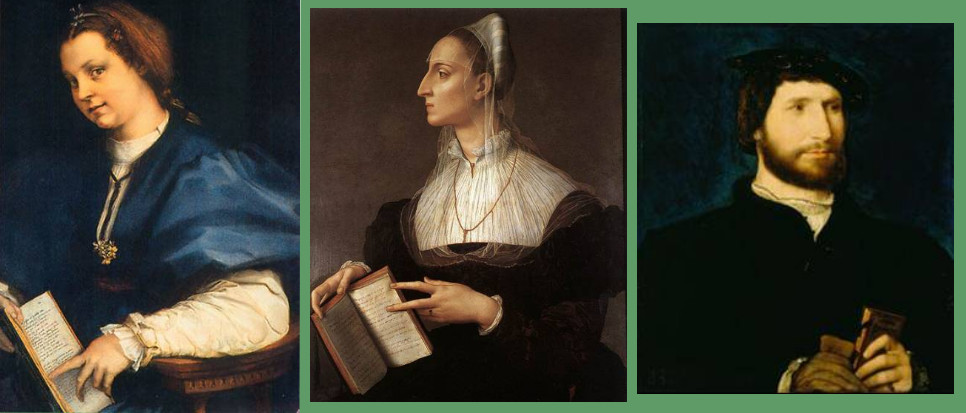
I was interested by this http://earmarks.org/archives/2006/04/19/91 posting on the 'Earmarks in early modern culture' blog. Off at a bit of a tangent, but these images (Andrea del Sarto, 'Lady with the Petrarchino', Bronzino's portrait of Laura Battiferri, and Jean Clouet's man reading) all advertise the importance of a particular book, and use Petrarch to say something about the sitter. Both lady sitters clearly invite the reader to locate a particular poem. There must be many more portraits like this, where a culturally prestigious text is hoisted into view. Not quite the same thing, but the Rowland Lockey copy of Sir Thomas More and his Family at Nostell Priory I have seen close up, where his daughter Margaret Roper points at a text of Seneca's (then attributed) 'Octavia' - a chorus about shaping your sails to gentle winds. At a cursory search, there's no good web image around of that painting, so I might scan my own reproduction as a future post. The Van Dyck portrait of Sir John Suckling with his copy of the Shakespeare folio daringly flaunts such a modern allegiance. Ahead of his time, was Sir John!

Monday, May 01, 2006

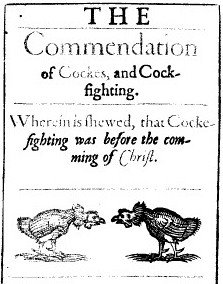
A Cock Fighting Man, 1607


“So it would incite, and cause them to say unto themselves, wee are induced and perswaded, nay, in a manner we are even compelled, and as it were inforced to love our husbands Cockes, and to make much of them…”

No, I have not found an early modern sex-therapist. This is, rather, George Wilson, The Commendation of Cockes, and Cock-fighting; Wherein is shewed, that Cocke-fighting was before the coming of Christ (1607), and a moment when the author’s obsession leaves him prey to total loss of his sense of humour. His conspicuous concern to put a positive spin for wives on having husbands who follow the sport (“they [i.e. cocks] doe shew unto them a good and a perswasive example, how they should love, regard, defend, and cherish us”) suggests to me that there was a Mistress George Wilson who was rather less than enraptured with her partner’s preoccupation.

Which is complete: Wilson’s little book is like one of those witty mock-commendations of a trifling activity or artefact that the Renaissance specialised in, but with the ‘witty’ and the ‘mock’ both omitted. He really means it, intensely, and may stand ancestral to generations of obsessive male hobbyists women have found ways of coping with ever since (“Now, therefore, for our owne parts, we will doe this from henceforth, we will rather want meate our selves, then the Cockes shall: and by this meanes, we shall allure our husbands to manifest their love towards us”).

Wilson, as his sub-title shows, sets out as a man of his age would, to commend cock-fighting by reference to antiquity. You can read between the lines his intense disappointment and chagrin that there is no gospel account of Christ and the disciples recreating themselves with their cocks-of-the-game, with intense side-betting on the outcome. Instead, he has to make do with a claim to a general ‘before the coming of Christ’ antiquity, and an honorary mention for the cock that crowed at St Peter’s denial: “the voice of the Cocke was (by Christs institution) ordained (like the voice of the Preacher) to call Peter to repentance”).

Having established the best possible Biblical role for the cock, after commending it as the best example of courage (especially for husbands), and after worrying whether the phoenix might have a claim to being a superior kind of bird (he thinks it isn’t, of course), Wilson arrives at the present “delectable pleasures” offered by ownership of game-cocks, and the latter part of his pamphlet consists of sanguinary anecdotes, where fighting cocks, blinded and broken, experience some trigger from the reptile cortex that stimulates them to vanquish at the last their apparently victorious opponent. He gives dates and places for some of his best fighting birds, and their names: ‘Jipsey’, victorious at Bury St Edmunds, his image put onto a painted cloth, with a quatrain of verse, then paraded round town with a volley of shot set off in his honour, and commends the cock Tarleton, named after the Elizabethan clown famous for his pipe and tabour (“because he always came to the fight like a Drummer, making a thundering noise with his wings”) for somehow killing his last opponent when blinded, beakless, and unspurred (Norwich, May 4th, 1602).

For my own part, I have always thought that the pro-hunting lobby should be asked why their blood-sport should survive, when the more proletarian forms have been banned. As for cock-fighting itself, a latterday Wilson might say that, as mammals, we can feel that birds have it coming to them, as reprisal for the prehistoric aeons in which birds were therapods, and either ate or suppressed our lineage (while turning mammal against mammal in the fox hunt is unnatural).

George Wilson does his best, but in his enthusiasm does reveal that what excited him so intensely was in actuality a barbaric spectacle.

But, from amongst his anecdotes, an early modern death-bed scene, one that makes you reflect how elastic piety can be:

“a man of good worship credibly informed me, that hee knew a Gentleman, that had many good Cockes of the game that he loved marvailously well, and wherein he took great felicitie and delight all his life time; and at the last falling into a grievous sicknesse, and lying upon his death-bed, he requested his kinred and friends which were about him, to place his Cockes with their Coopes so neere unto his beds head as possibly they could doe, which being performed according to his request, he heard them crowe; whereat he sayd, now have I obtained that which I desired; for these delectable voices shalbe my sweete-sounding trumpets, to admonish and put me in minde of my immortal, and celestiall Judge.”

http://en.wikipedia.org/wiki/Cockfighting