Saturday, April 29, 2017
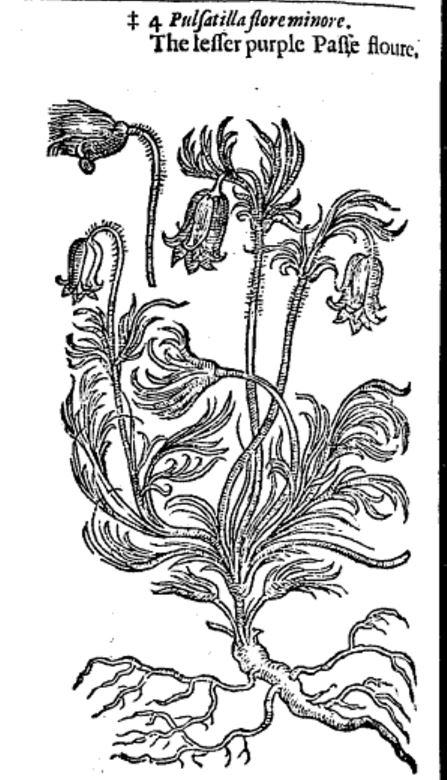
Pasque flowers, April 19th
I never really thought I'd ever see such a rarity. Last year I heard reports of a couple of flowers at the Hartslock Nature Reserve. My wife and I went along on the 17th, and though we saw an unhybridised Lady Orchid, no Pasque flowers were to be seen.
Better information came via a friend who had found a FB group. The directions took me off the nature reserve, and round into the neighbouring sheep pasture. There were 25 or 26 flowers on maybe 15 different plants. I love that moment of disbelief: you see a flower of the right colour, approach half expecting it to be a violet (in this case), but there they were.
Gerard's Herbal:
The herball or Generall historie of plantes. Gathered by Iohn Gerarde of London Master in Chirurgerie very much enlarged and amended by Thomas Iohnson citizen and apothecarye of London (1597).
(THE SECOND BOOKE OF THE HISTORIE OF PLANTS)
CHAP. 79. Of Bastard Anemones, or Pasque floures.
¶ The Description.
1 The first of these Pasque floures hath many small leaves finely cut or jagged, like those of Carrots: among which rise up naked stalkes, rough and hairie; whereupon doe grow beautifull floures bell fashion, of a bright delaied purple colour: in the bottome whereof groweth a tuft of yellow thrums, and in the middle of the thrums it thrusteth forth a small purple pointell: when the whole floure is past there succeedeth an head or knop compact of many gray hairy lockes, and in the solide parts of the knops lieth the seed flat and hoarie, every seed having his owne small haire hanging at it. The root is thicke and knobby, of a finger long, running right downe, and therefore not like unto those of the Anemone, which it doth in all other parts very notably resemble, and whereof no doubt this is a kinde.
2 There is no difference at all in the leaves, roots, or seedes, betweene this red Pasque floure and the precedent, nor in any other point, but in the colour of the floures: for whereas the other are of a purple colour, these are of a bright red, which setteth forth the difference.
3 The white Passe floures hath many fine jagged leaves, closely couched or thrust together, which resemble an Holi-water sprinckle, agreeing with the others in rootes, seedes, and shape of floures, saving that these are of a white colour, wherein chiefely consisteth the difference.
†† 4 This also in shape of roots and leaves little differs from the precedent, but the floures are lesser, of a darker purple colour, and seldome open or shew themselues so much abroad as the other of the first described, to which in all other respects it is very like.
5 There is also another kinde with leaves lesse divided, but in other parts like those already described, saving that the floure is of a yellow colour something inclining to a red. ††
¶ The Place. Ruellius writeth, that the Passe floure groweth in France in untoiled places: in Germanie they grow in rough and stonie places, and oftentimes on rockes.
Those with purple floures doe grow verie plentifully in the pasture or close belonging to the parsonage house of a small village six miles from Cambridge, called Hildersham: the Parsons name that lived at the impression hereof was Mr. Fuller, a very kind and loving man, and willing to shew unto any man the said close, who desired the same.
¶ The Time. They floure for the most part about Easter, which hath mooved mee to name it Pasque Floure, or Easter floure: and often they doe floure againe in September. †† The yellow kinde floures in May. ††
¶ The Names. † Passe floure is called commonly in Latine Pulsatilla: and of some, Apium risus, & herba venti. Daleschampius would haue it to be Anemone Limonia & Samolus of Pliny: in French, Coquelourdes: in Dutch, kneckenschell: in English, Pasque floure, or Passe floure, and after the Latine name Pulsatill, or Flaw floure: in Cambridge-shire where they grow, they are named Couentrie bels.
¶ The Temperature. Passe floure doth extremely bite, and exulcerateth and eateth into the skinne if it be stamped and applied to any part of the body; whereupon it hath been taken of some to be a kinde of Crowfoot, and not without reason, for that it is not inferiour to the Crowfoots: and therefore it is hot and drie.
¶ The Vertues. There is nothing extant in writing among Authours of any peculiar vertue, but they serve onely for the adorning of gardens and garlands, being floures of great beautie.
Tuesday, April 18, 2017
The orphanage full of witches: Lille, 1652-1662
I return to George Garden’s An
apology for M. Antonia Bourignon in four parts, published in London in
1699.
The portrait of Antoinette Bourignon above comes from
the National Portrait Gallery:
The NPG simply lists this as anonymous,
18th century. It is one of the English copies of this portrait: https://www.rijksmuseum.nl/en/collection/RP-P-OB-51.082.
The NPG do not note that the quotation that has been added above the portrait
is rather interesting in itself, being from Paradise
Lost Book VI, 29ff:
Servant of God, well done, well hast thou fought
The better fight, who single hast maintaind
Against revolted multitudes the Cause
Of Truth, in word mightier then they in Armes;
And for the testimonie of Truth hast born
Universal reproach, far worse to beare
Then violence: for this was all thy care
To stand approv'd in sight of God, though Worlds
Judg'd thee perverse…
Abdiel has deserted and rebuked Satan:
at his arrival back in heaven, he is welcomed by God saying this from a golden
cloud.
But my interest is in the episode when
Bourignon discovered that every girl in the orphanage in Lille she had founded
in 1653 was a pacted witch. In Garden's hagiographic life, this is a defensively written episode. Settled belief in Bourignon (which adversely affected Garden's career), means that this has to be a very late expression of belief in pacted witches, attending sabbats, seduced by Satan.
The rest of the post will be the full account as given in
Garden’s book. I have done some re-lineation of the text, lightly modernised
spellings (‘-ed’ for -’d endings), and added some speech markings. My own
comments will use a different font and colour. I have inserted these as sectional headings.
Belotte, the first young witch to reveal herself in the orphanage
About three years after she was
thus shut up, one of the Girls of Fifteen Years having done some Fault, was
shut close up for a Penance in the Prison of the House. Within an Hour after
she came into the Work-House where
all the rest were, though the Provisor had locked her up within Three Gates,
and was gone to the Market, and had the Keys at her Girdle. A[ntonia].
B[ourignon]. upon enquiry, finding all this to be true, asked
her ‘How she got out?’
She said, ‘A Man had taken her out.’
And after dinner
having called her to her, and she giving the same answer.
She asked If she knew him.
She said, ‘Very
well, it was the Devil.’
At this A. B. trembled,
saying, The Devil is a Spirit, not a Man.
The Girl said, ‘He
comes to me in the form of a Man, and I calling him to help me when shut up,
he opened the Door and took me out.’
A. B. asked if
she had known this Man of a long time.
She said, ‘Yes,
all her Life, that her Mother from her Childhood had carried her to the Sabbath
of the Witches, which is kept in the Night, and that she being a little Child,
this Devil Man was then also a Young Boy, and grew up as she did, being always
her Lover, and caressed her Day and Night.’
A. B. could
not conceive this, for she had never heard of such things.
She immediately wrote for the Three
Pastors, the Overseers of the House, to whom the Maid declared that she had
given her Soul to the Devil, and denied God, and to confirm the Gift had
received a Mark in her Foot, which she did freely when Twelve Years of Age,
though long before this Lover had still entertained her and carried her to the
Sabbaths of Sorcerers in great Castles, where they met to eat, drink, dance,
sing, and do a thousand other Insolencies.
She put her out of the House the same
Day, fearing least the other Girls should be corrupted. It grieved her to see
the Devil had such Power, and yet she could not believe that this Bellotte (for
the Girl was so called) was a Witch, for she still thought they were filthy and
deformed Creatures, as she had heard they transformed themselves into Cats or other
Animals. She prayed to God to discover her unknown Sins, and continued in her
pious Exercises, believing she had purged the House of such Persons.
The second and third witches are discovered
About Three Months after, another Girl
of Fifteen Years was going to be imprisoned for Stealing, she said the Devil
made her do it; and she was immediately put out of the House that it might be
purged of such. But Three Months after, another of Eleven Years was going to be
whipped for the same Fault, and she said ‘Do it not, and I will tell who made me do this Evil.’ And A. B. taking
her to her Chamber, she said it was the Devil; that being Young and playing
with the Girls of the Town, they asked her if she would go with them to the
Dedication, that she should have good Cheer and a Lover, how soon she was
Content, the Lover came on a little Horse, and took her by the Hand, asking if
she would be his Mistress; she consenting, was carried through the Air with
him, and the other Girls, into a great Castle, where they had all sort of
Feasting and Mirth, that she has been there ever since, Three or Four times a
Week: That at the Age of Ten Years she gave her Soul to the Devil, renounced
God and her Baptism, and received a Mark in her Head, which was afterwards
found to be insensible; for they put a Pin the length of ones Finger into her
Head without her feeling any Pain.
Every young woman in the orphanage is a witch
The Pastors having examined this Girl,
thought not fit to put her out of the House, till it were discovered from
whence his Evil might arise. She was kept in a Chamber apart, and Peter
Salmon, Pastor of St. Sauvear, undertook to examine
her daily, and to endeavour her Conversion; and asking her one Day, if there
were any other in the House like to her, she said there were Two who went with
her daily to the Sabbath. They being called, and spoke with separately in
private, confessed ingenuously that they were in Covenant with the Devil. These
Two said, there were yet other Two in the House, and being desired to name
them, each of them named Two different Persons, who being called, confessed,
each of these naming yet Two different Persons who were of the same Crew: So
that from Two to Four, from Four to Eight, it was discovered that all the Two
and Thirty Girls which were then in the House, were all in general, and each
one in particular bound to the Devil, of their own Free-will, having contracted
it diversely; some from their Fathers, others from their Mothers, some had
learned it by little Girls in playing together, as they declared both to A.
B. and to the said Pastor, who put in Writing all they said to him.
The pastors think that the young women can be saved, as they were so young when they made their promises to the devil. Eight months of failed efforts follow; their repentances are not sincere, so alluring are the pleasures offered by the devil
A. B. was in no
little Perplexity to be shut up in a House, from whence she could not get out,
with Thirty Two Persons who declared they had given their Souls to the Devil,
and that she must eat and drink with them, or what they made ready. She proposed to dismiss them by
degrees, but then feared to be guilty of the Mischiefs they would do to others,
for they confessed they had made both Men and Beasts die. The Pastors thought
it fittest to keep them; said there were Hopes they might be converted to God,
having been engaged to the Devil before the Use of their Reason, and promised
to come every Day to admonish and exercise them, and pray for their Conversion.
This was done for the space of Eight Months, in which the Girls made great
shews of Conversion, by Tears, repeated Confessions, Prayers, and attending to
the Admonitions given them, but without Sincerity. Their Hearts were wedded to
the sensual Pleasures which the Devil gave them. So that they had not the
Desire to change or leave those wretched Pleasures; as one of them, of Twenty
Two Years, said one Day to A. B.
‘No’ says she, ‘I would not be otherwise, I find too much Contentment in it to leave
it, I am always caressed: I have been so from Eight Years to Two and Twenty.’
At the devil’s sabbat, where there are crowds of people, male and female
Pastor Salmon wrote
down their Confessions, they declared plainly they had daily carnal
Conversation with the Devil, that they went to the Sabbath, where they eat,
drank, danced, and committed other Sensualities. Each had their Devil in form
of a Man, and the Men theirs in form of a Woman; that they never saw more
numerous Meetings in the City than at their Sabbaths, of People of all Ranks,
Young and Old, Rich and Poor, Noble and Ignoble, but above all, of all sorts of
Monks and Nuns, Priests and Prelates, and that everyone kept their Rank there,
as they are in the World. Many of them shed plenty of Tears when A. B. spoke
to them of the Judgments of God, of the Joys of Paradise, and the Pains of
Hell; and when she asked some of the most sensible of them, If those
Tears were sincere; they said,
‘They proceeded from a Grief of having denied God, and given up
themselves to the Devils; but this lasted no longer than they were spoke to, or
thought upon their miserable State, and then presently the Devil came and asked
them if they would leave him, and the Pleasures they had together, and so
caressed them, that they renewed their Covenant with him, forgetting all their
former good Purposes.’
More on why the efforts to reclaim them for heaven fail, and how their participation in divine service merely helps disguise their wickedness
She asked, If the Admonitions, Exorcisms,
and Prayers of the Pastors did not deprive the Devil of Power to keep them
subject to him.
They said, ‘The Devil mocked at
these things, and did ape the Pastors: When they kneeled to pray, he did so
behind them, and with a Book mumbled the same Words. When they preached, he used
the same Gestures, and also threw Holy Water, and Incensed as they did, aping
them always in Mockery.’
She asked, How they could pray
or sing so many good Prayers all Day, being in Covenant with the Devil.
They said, ‘He prayed and sang with
them, because their Prayers were without Attention; and instead of singing
Praises to God, their Intentions were to sing Praises to the Devil, in which he
gloried and valued himself’.
She asked, How
they could approach the Table of the Lord, and receive the Sacrament.
They said, ‘The Devil incited them to do it as often as they could, and the
greatest Penance she could ordain them was to make them abstain from the
Sacrament, which covered their Wickedness, and made them pass for good Persons
before Men: Besides, the Devil did his most mischievous Deeds with the
Consecrated Bread.’
She said, All this would assuredly
lead them to Hell.
They said, ‘They knew it very well; but the Devil promised them the same carnal
and sensual Pleasures there, that they had with him in this World.’
She asked, If they knew indeed
that it was the Devil that entertained them so, and if they knew there was a
Hell, and a Paradise before they came into her House.
They said, ‘Yes; for the Devil taught
them that, and had often catechised them, and taught them there was a God, a
Paradise, a Hell, and a Devil; that they who did his Will, could never see God,
but should be his Companions in Hell to all Eternity.’
How they became witches so early in life
She asked, How they could belong to the
Devil from their Infancy.
They said, ‘This
came from their Parents. When Fathers or Mothers give themselves to the Devil,
they give all that is theirs, and it is rare to see, when they have been
offered by their Parents to the Devil, even before they are born, that they
withdraw after they are come to Age, for the Habit in Evil becomes natural to
them; and the Devil entertaining them from their Infancy with Caresses and
sensual Pleasures, he so gains upon them, that they
would not quit him for anything, after
they have been so allured by his Sensualities, such as all Men could not give
them: For he contrives to make them eat all sort of Meats savoury to their
Taste, all sort of Liquors pleasant to their Throat, all sort of Music to their
Ears, of Odour to their Smell, of Ticklings to their Flesh, so that being
brought up thus, it is almost impossible to desire to leave them; and
therefore, say they, we would not change our Condition, for we find more
Pleasure in it than Men can give us.’
A revealing glimpse of the conditions of life in the orphanage: Bourignon tells the girls in effect that ‘If you were really feasting on non-illusory food with Satan at night, you would not eat your dry bread so hungrily in the morning’
She bewailed their Misery, and shewed
them all was but Deceit and Illusion: For Instance, that they had not
eaten nor drunken at their Sabbaths, they would have been very hungry in the
Morning, and eaten with good Appetite great Lumps of Butter, yea, dry Bread
when given them. And if they had been eating such dainty Meat, they would have
disrelished such gross Food.
They said, ‘They had nevertheless the
taste and pleasure of all these, and therefore would not leave them.’
Unless you compromise with the devil, he will stop you marrying and having children – this seems to be the outcome in these young women’s minds of Bourignon’s strong advocacy of celibacy and virginity
She asked, How it was possible
that Parents should thus offer their Children to the Devil, and not to God who
created them.
They said ‘Those who are thus bound to
the Devil, will have no other God but him, and therefore offer him all they
have that is most dear, and even are constrained to offer their Children, else
he would beat them, and hinder them from being married or having Children; both
which he can hinder by his Adheren[illegible]. That
when a Child thus offered comes to the Use of Reason, he then asks their Soul,
makes them deny God, renounce their Baptism and Faith, and promise Faith and
Fidelity to the Devil, after the manner of an Espousal. And instead of a Ring,
gives them some Mark, as with an Awl of Iron, in some part of the Body, which
Marks he renews as oft as they have a desire to leave him, and binds them more
strongly by new Promises, giving them those new Marks for a Pledge that they
shall continue faithful to him: And how soon they come to Age capable of having
Children, he makes them offer the Will they have of marrying to his Honour, and
therewith all the Fruit that can proceed from their Marriage, which they
promise willingly, that they may attain their Designs; otherwise the Devil
threatens to hinder them, by all sort of means from marrying or bringing forth
Children.’
Garden concedes that there were sceptics. Bourignon herself began as a witchcraft sceptics, till she got undoubted proofs. Confessions re-affirmed, and recanted among the young women. The devil will marry them to good men, so as to have access to corrupt their offspring. There are indeed incredible numbers of witches, as is clear from reports from Scotland, New England [Salem] and Sweden [Blokula]
Some can hardly believe that all these
Girls could have been in Compact with the Devil, far less that Declaration
of A. B. as from God, that so vast a multitude of People on
the Earth are in Compact with him. A. B. could as little
believe it as any, for she thought none but the vilest Miscreants were such,
till there were undoubted Proofs given her of it. The voluntary Confession of
all the Girls, the preternatural Acts done by them in her Presence, their
Agreement in their Confessions as to their Sabbaths, the manner of Devoting
themselves to the Devil, &c. Their Declaration of all this
to the Three Pastors, some of them still owning their Confession, (though
others were easily persuaded to deny it again, finding they were caressed by
the Magistrates for so doing) and the Attestation of the Truth of all this by
the Three Pastors (Copies of which are in the La vie Continuée, and
the Originals in the Hands of the Writer of it) are such Evidences as will
satisfy all, but they who will not be satisfied. And as for the other, we need
not think it so extravagant, if we consider that it is Satan’s earnest Desire
and Ambition to have Men devoted to him by express Covenant; that the more he
have of such, he is the more capable of doing Mischief to the rest of Mankind
than he can do by himself without them; that he obliges all who are so, to
devote to him all their Posterity; that he still labours to ally and marry them
with the Good, that so he may corrupt their Offspring, that they who are thus
devoted to him, being once habituated to all manner of sensual Delights, can
hardly ever will to be reclaimed again; that in outward Appearance they differ
nothing from others, but put on for the most part the greatest pretences to
Devotion; that whenever any of them are discovered and tried, if strict Enquiry
be made about them, their number appears incredible; witness the late Trials in
the West of Scotland, those of Sweden, New England, and
what the Learned Bodinus tells from his own Knowledge, That
when Pardon was granted to a Sorcerer upon Condition to discover his Complices,
he discovered so many of all Ranks, that at length he plainly told there would
be One Hundred Thousand in that Country.
Magistrates and – surprisingly for an orphanage - parents are alerted and intervene. Bourignon’s character is unimpeachable
About the end of that
time, an old Woman of Lisle importuned A. B. to
take into the House a Girl of Nine Years, who being discovered to be one of
the Coven, was immediately
thrust out again, telling the old Woman that all their Secrets were discovered
to the Regent of the Hospital. She run about immediately to the Magistrates,
and the Parents of the Children, telling how their Reputation was quite broken
by A. B. by saying they were Witches. She obtained of the
Magistrates that Enquiry should be made into the Life of A. B. without
her knowledge. And the Criminal Clerk took Informations upon Oath in the Town,
and neighbouring Towns and Villages, all which served only to make her
Innocence and Purity the more evident; for the Witnesses they had pitched upon
as most animated against her, could depone nothing but what was good and praiseworthy,
and could lay nothing to her Charge. Which he who received the Depositions admired;
saying, he knew no Body, who if their Life had been examined from their
Childhood, by Enemies, and with the same Rigour, could have undergone the Trial
so unblameably, without being guilty of something. She was afterwards allowed
Witnesses for her Exculpation, and when some of them were heard, he said, there
needs no more, for there is almost enough already for to Canonize her, and
declare her a Saint. All these Depositions are still in the Register of the
Town of Lisle [Lille].
Investigations into a death. Nothing taints Bourignon, not even the girls will speak against her
On the 9th. of February, 1662,
they sent the Lieutenant and Sergeants armed, and broke open her House, and
carried her violently to the Town-house, with a great Noise and crowd of
People, who imagined she was seized for a Witch, because of the Report spread
about the Children, where they examined her most strictly Six Hours, and made
her give an Account of all the Affairs that concerned the Hospital, which she
did with such a presence of Mind, as made her remember all, and answer most
pertinently; so they behoved to acknowledge they could not find any Fault in
her. Yet they brought her before them after the same manner at several times,
without granting her Request of calling her in the Evening to avoid Scandal.
They caused bring the Children also to see what they could draw from them
against her, but they could say nothing against her; only some of them said, a
Servant-Maid of hers had chastised one of the
Girls with a Wand, and not long after that she died. So they caused seize the
poor Servant as if she had killed the Girl, and resolved to do so to the
Mistress, under pretext that the Correction was by her Order; but four Persons
declared upon Oath that this was most false and that the Girl died by eating to
excess of green Fruits out of the Lodging. One of the Magistrates said to the
Children, ‘She accuses you of Witchcraft, and going to the Sabbaths; Why
do you not accuse her too?’ But the Girls, how wicked soever, trembling at such
a black Malice, said immediately, ‘No, No, our Mother, (so they called her) is
no Witch, she goes not to the Sabbath; Our Mother is a Saint, she is all full
of God.’
A large number of the same girls that will say no ill of Bourignon had in fact conspired with the devil to poison her. Bourignon leaves, the Jesuits take over, exonerating the girls and indicting Bourignon
They conspired in the House to take
away her Life by Malefices; the Devil had Meetings with Twenty Five of them,
how to effectuate it, and with their Consent made an Unguent of divers matters,
of which there were Balls given to put in her Broth. S. Saulieu was
at the Meeting, for he also kept the Sabbaths, and stirred them up to make her
away [Saulieu had demonised himself by a sexual pursuit of Bourignon, as noted in John Cockburn's attack on her in Bourignianism detected (1698), "famous Monsieur Saulieu, whom at first she took for a great Saint, pursued her so much, that she was forced to ask the assistance of others, to be delivered from him."] One of the eldest of them discovered it to her, and went with her to one
of the Girl’s Bed and found the Ball. She advertised the Pastors, and they the
Magistrates, and she was told if she was afraid, she might remove, and they
would place another in her room. She stayed till she discovered Fourteen
Children who had of these Balls to destroy her. She then chose a Regent and
retired, entering a Protestation before the Magistrates, that she did not
abandon the Regency, having left one in her Place. When the Magistrates examined
the Girls, the eldest declared all the Truth, and the Magistrates laboured to
make her unsay it, which she would nor. The others who denied all, they sent
away cheerful, saying [?- illegible] one
to another, the Magistrates are for us. Two Days after she retired, the
Magistrates thrust the Widow out of the Regency. The Jesuits got the Oversight
of it, there they placed one of their Maids, they admitted the Girls presently
to Confession and Communion, making them pass for little Saints, and A.
B. for Guilty.
She retired to Gaunt, and
from thence to Mechlin, [Mechelen?]
and formed a Process before the King’s Council at Brussels, against
the Magistrates at Lisle, [Lille]
for the Recovery of the Hospital, and though it did appear most evidently that
she was Innocent, and that they had acted against her
with inexcusable Violence, yet they would not venture to give Sentence for her
against a Party so Powerful, and far, more Considerable before Men, than was
the Innocence of a simple private Maid: So the Process remains undecided to
this Day, and she could no longer abide in Safety in Lisle, unless
in secret.
Wednesday, April 12, 2017
OED 'coven', noun
"An assembly, meeting, or company. Obs.
?a1513 W. Dunbar Poems (1998) 196 Lat anis the cop ga round about, And wyn the covanis banesoun.
spec. A gathering of witches; a ‘convent’ or company of thirteen witches; cf. convent n. 1, 2.
1662 in R. Pitcairn Criminal Trials Scotl. III. 606 Ther vold meit bot sometymes a Coven..Ther is threttein persones in ilk Coeven.
1830 Scott Lett. Demonol. & Witchcraft ix. 286 The witches of Auldearne..were told off into squads, or Covines.
1886 C. Rogers Social Life Scotl. III. xx. 278 To their covens or gatherings the foul sisterhood were borne through the air."
'Coven', meaning a gathering of witches, is a Scottish word, then, entering English at a late date. This is an original and not as yet updated OED entry, from 1893.
The OED is not at its best on this word form, for the very well attested sense 'coven' = fraud is not covered in its range of forms for 'cozen': "Forms: 15–18 cozen; also 15 cooson, coosin, ( cousinge, cossen, cussen), 15–16 coosen, cosen, coson,cousin, 16 cosin, cozon, coozen, cousen, couson, couzin, 16–17 couzen."
'Coven' with this meaning appears in early word lists: in Robert Cawdry's A table alphabeticall contayning and teaching the true writing and vnderstanding of hard vsuall English wordes gives "couen, fraud deceit" (1609).
An example or two of this usage: Thomas Phillips, writing about false Messiahs, in 1639: "what should the Church doe in such cases? how should shee discover the Coven and prestigious impostures of such, but by the Written Word?"
Sir Richard Hutton's The first part of the young clerks guide, or, An exact collection of choice English presidents according to the best forms now used for all sorts of indentures, letters of atturney, releases, conditions &c. (1649) illustrates multiple examples of a correct formula for trainee clerks to use :"without fraud or coven".
The other homophone of 'coven' was of course a common variant on 'convent', as in the form "Coven garden":
"Then have we Bedford Berry, commonly called the Coven garden, because there was a large Convent, or Monastery there in times pass'd, where there are many good structures, cloystered underneath some of them, with a large Piazza or Market place, and a Church that bears the name of Saint Paul, which, though within the Precincts of Saint Martins Parish, yet by Act of Parliament, it is now exempted", in James Howell, Londinopolis an historicall discourse or perlustration of the city of London (1657).
So, the senses 'coven=fraud' and 'coven=convent' are in wide usage. There are early references to a "convent" of witches. The OED cites John Gaule, in 1652 (this is the whole anecdote,for the sake of its witchcraft content):
"A certain Praetor or Judge, having sentenced divers malefactors to death, at the accusation of an Ariolist or Pythian vaticinator: at length he took upon him to tell him of one more, if he would not take it ill: the Judge earnest to know who it was, he insimulated his own wife, and prefixt an houre wherein he would shew him herin the convent of other Witches. But he (knowing his own wives integrity, and mistrusting the others calumny) at the time appointed had invited (unknown to the Ariolist) a many of his kindred and friends to suppe with his wife and him. And as they sate at supper, he took an occasion to rise, and goe with the Ariolist to the place, where he shewed him (in a spectrous apparition) his own wife in the company of other Lamian hagges. Enough to have deluded him, had he not returned, and found his wife at the table where he left her, with the testimony of all those at the table, that she had never stirred thence. Whereupon he caused the Ariolist himselfe to be executed."
So, when does 'coven' meaning 'a gathering of witches' appear first in English?
My candidate is in George Garden's An apology for M. Antonia Bourignon in four parts, published in London in 1699:
"About the end of that time, an old Woman of Lisle importun'd A[ntonia] B[ourignon] to take into the House a Girl of Nine Years, who being discovered to be one of the Coven, was immediately thrust out again, telling the old Woman that all their Secrets were discovered to the Regent of the Hospital. She run about immediately to the Magistrates, and the Parents of the Children, telling how their Reputation was quite broken by A. B. by saying they were Witches."
George Garden was Scottish. He is in the ODNB: see Stuart Handley, ‘Garden, George (1649–1733)’, Oxford Dictionary of National Biography, Oxford University Press, 2004; online edn, Oct 2007.
The source is Garden's hagiographic life of the visionary and ascetic Antoinette Bourignon (1616-80)
Though she features in Phyllis Mack's Visionary Women: Ecstatic Prophecy in Seventeenth-Century England in a more positive light, Antoinette Bourignon's record is blotted by her behaviour as regent in a girl's orphanage she had established in Lille in 1653. This lasted to 1662. Bourignon, in this case acting pretty much like a dangerous religious maniac left in charge of young people, had discovered that all the girls under her charge had made pacts with the devil. Her regime was harsh, and the girls enduring it were not driven by the same level of asceticism and morbid fear of sex as their regent. One had died after being whipped. The rest probably spoke as they had been taught about the temptations of the devil, but found themselves taken very literally. The case is an interesting one, and I will return to it in a later post. Despite the late date, George Garden has absolutely no problems with Bourignon's discovery that her orphans were all members of a coven. A margin note on the relevant pages (292-3) reads "No grounds to disbelieve this Story, or that the World swarms with such".
After the old woman alerted other the magistrates, and they started to investigate with a bit more common sense than the various pastors Bourignon had called in, Bourignon decamped, and took off to Ghent. Among her later successes was persuading the pioneer microscopist Jan Swammerdam to renounce scientific study.
Monday, April 03, 2017
What is the Shakespearean notepad shown on Antiques Roadshow?
I drew a Shakespearean colleague's attention to this intriguing item. The notebook is held open in the valuer's hand during the clip, so we got our early modern telephoto lenses out, and have tried reading what's visible.
In various screengrabs of this page one can read:
[above the binding gutter]
For such a warped slip of wilderness
Ne'er issued from his blood.
~ from III i of Measure for Measure
[Then on main page visible in this view, continued quotations from Measure for Measure]
I have laboured for the poor gentleman to the extremest shore of my modesty:
~ III ii
There is scarce truth enough alive to make societies secure; but security enough to make fellowships accurst:
~ III ii
To draw with idle spiders' strings
Most ponderous and substantial things!
Shame to him whose cruel striking
Kills for faults of his own liking!
~ from the Duke's end soliloquy in Act III, quoted with a little look back to the earlier couplet after getting the spiders' strings couplet down first.
thousand escapes of wit
Make thee the father of their idle dreams,
And rack thee in their fancies
~ start of IV (that stray moment of soliloquy, as the Duke continues to ruminate)
Sith that the justice of your title to him
Doth flourish the deceit.
~ IV i
As fast lock'd up in sleep as guiltless labour
When it lies starkly in the traveller's bones:
~ IV ii
he spurs on his power
To qualify in others: were he meal'd with that
Which he corrects ...
~ IV ii
At the top of this page view are qq's from Comedy of Errors, from Aegeon's speech in Act V. I can see bits of 'In sap-consuming winter's drizzled snow ... and all conduits of my blood froze up / yet hath my night of life'
Now, the 1623 Folio order runs:
Tempest, 2 Gent, Merry Wives, Mfor M, Errors, Much Ado, LLL
So after the compiler had done with Errors, the quotations naturally switch to Much Ado:
"Never came trouble to me in your likeness" adapts 'Never came trouble to my house in the likeness of your grace'.
Then we have :
"Pick out mine eyes with a ballad maker's pen and hang me up for a blind Cupid", missing out the '[hang me up at the door of a brothel house for the sign of] bit.
'and hang me in a bottle like a cat and shoot at me, and he that hits me let him be clapped on the shoulder and called Adam'
rendered as:
"and hang me FOR a bottle like a cat, shoot at me, and he that FIRST hits clap on the back and call him Adam"
Claudio's "Drive liking to the name of love"
and part of Don Pedro's response:
<'Thou wilt be a lover presently / And'> "tire thy hearer with a book of words"
and finally from Don Pedro's scene-ending speech
'and in her bosom I'll unclasp my heart' which may be rendered as:
"And unclasps my head in thy bosom", but it looks more like 'He unclasps'
We then jump to Act 1 scene iii, and Don John:
"apply a moral medicine to a mortifying mischief"
"and claw no man in his humour" (but looks a bit like 'he claw[s])
My screengrabs then start to go blurry, but I can see portions of:
'had rather be a canker in his hedge than a rose in his grace'
'I am trusted with a muzzle and enfranchised with a clog'
The last bits I can make out go forwards to Act 2 and Beatrice:
'I never can see him but I am heartburned an hour after'
and
'to make an account of her life to a clod of wayward marl.'
That's what I could make of these two pages; my colleague could see a similar set of seriatim quotations from Two Gentlemen of Verona in an earlier page held open.
So, what it seems to be, on the evidence that can be accessed, is someone who has got hold of a 1623 Folio, and is working through creating their own aid to discourse. Bits of Shakespeare to drop into his talk, or maybe re-word a little to sound like a witty or sententious talker himself. I assume a male, because it seems to me a very male thing to be anxious about your discourse in such a manner, making a conscious effort to load up the memory with aphorisms and clever-sounding stuff. He - if it is a he - seems quite drawn to Duke Vincentio in Measure for Measure . A sententious speaker attracting a sententious reader.
It very definitely represents reader reaction to the Folio. One cannot tell without a full transcript how far the reader got, or any sense of favourite plays. It's certainly material for the Reading Experience Database, and Shakespeareans should get a lot of fun from it. The BBC seems inclined to regard the note-taking as 'analytic'. I don't think what can be seen so far sustains that, but there are scores more pages.
Wednesday, March 29, 2017
Stone the crows, says Henry VIII
As our non-elected national leader presses on towards a future in which she forces legislation through using Henry VIII’s 500 year old form of government by proclamation - somehow not repealed in the half-millennium since - Early Modern Whale presents a sample of such legislation. It’s Henry VIII identifying in 1532 a set of enemies to the economy, certain black corvids, and without putting any state resources into the problem, forcing the nation to act, but doing all this without upsetting the interests of the landed.
Is there anything to admire here? Certainly not, if judged on the level of its lumbering and repetitious prose (or legalese). A possible source of state revenue has been glimpsed, and to encourage a gentle and pleasing cascade of pence to the treasury, a division of spoils is legislated in painstaking clumsy detail: half for the king, so much for the landowner, so much for the bird-catcher, and this much for those who inform on those who fail to heed the proclamation and endorse it with action.
The basic premise is probably flawed. The approximately 26,000 dovecotes on the estates of gentry landowners probably contained birds that were more of a threat to the corn and grain harvests [“No kingdom in the world has so many dove houses”), while rooks and crows are generally accepted by farmers as a positive in terms of the invertebrate pests they take from the fields. Birds Britannica notes the bucolic rhyme “One for the pigeon, one for the crow/ Two to rot, and one to grow” as embodying a certain resignation. Interesting about their depredations on thatched structures in the nesting season, though, and Birds Britannica does not note this emphasis (that great book does mention the legislation).
"For so much as innumerable number of rooks, crows & choughs do daily breed through this realm which yearly destroy a marvellous great quantity of corn and grain and that a marvellous destruction of the covertures of thatched houses / barns / ricks/ stakes and such like for remedy whereof it is enacted that every person occupying and manuring any lands or tenements shall do as much as in him reasonable is to destroy and kill all manner choughs / crows / or rooks haunting within their said lands upon pain of a grievous amercement to be assessed in form following, and if any offence be done contrary to this act by any person inhabited within the limits of the leets [a court meeting once a year], lawdays [a court meeting six-monthly], rapes [an administrative district of Sussex] or court barons [“The assembly of the freehold tenants of a manor under the presidency of the lord or his steward”], of any lords having such courts, that then upon a presentment made before the steward he with two of presenters to be named shall assess for every default presented such amercement as to them that shall seem reasonable and that to be to the use of the lord aforesaid to be levied by distress as other amercements for common annoyances presented in leets hath been accustomed to be levied. And if the offence be done by any which have the occupation of any such lands or tenements whereunto such leets, lawdays, rapes or courts belong, that then upon a presentment thereof had before the Sherriff in the towns the stewards in turn with two of the presenters to be chosen as it is aforesaid or the justice of peace or two of them at the least if the presentment be before them in their sessions shall assess the said amercement by their discretion to be levied to the use of the king by distress like as other amercements of common annoyances.
"And further it is enacted that every parish township hamlet borough or village wherein is the least [ten] households the inhabitants thereof shall before Michaelmas next coming and yearly [ten] years ensuing at their costs provide and make a net commonly called a net to take choughs, crows and rooks with all things belonging to the same and the same shall keep and renew as oft as shall need and with a shrape [a bait] made with chaff or other thing meet for that purpose shall lay at such time in the year and in such places as is convenient upon pain of forfeiture of [ten] shillings the one moitie to the king and the other moitie to the lords of the same courts, leets, lawdays or rapes to be levied of the foresaid inhabitants. And that every such net with all things requisite thereunto shall once a year at the least be presented in the court, before the steward to be viewed whether it be sufficiently repaired or not so that by the said steward and inhabitants a sure way and ordinance may be devised for the reparation, continuance and putting in execution of the said net at times and places convenient. And that such ordinance made by the said steward and inhabitants or by the most part of them for the said rooks, crows, and choughs shall stand good and effectual, and be put in due execution. And further be it enacted that as well all such persons [illegible] … shall … and have in his occupation any lands or tenements whereunto any such courts aforesaid appertain … the tenants and farmers inhabiting in them shall yearly during the said [ten] years at such times and places as by the steward shall be appointed assemble them self together to view and survey all the said lands and tenements where any of them shall inhabit and thereupon shall agree and conclude by what means it shall be possible to destroy all the young breed of choughs, rooks, and crows for that year and shall put the same in execution so that the said young breed may be utterly destroyed upon pain of forfeiture for every year omitting such assembly, endeavour and view making 20 shillings after presentment thereof had before the Justice of Peace the one half to the king and the other half to the presenters of the same offence to be levied by distress like as amercements for common annoyances have been accustomed to be levied. And be it further enacted that as well justices of peace in their sessions and Sheriffs in their turns [?] as stewards, mayors and bailiffs elected in their leets, lawdays, rapes and court barons shall give in charge to the inhabitants and all other appearing before them that they shall duly inquire and put into execution the effect of these premises so that this act may fully and truly be executed and the choughs, crows and rooks thereby destroyed in all places in this realm
And it is further enacted that it shall be lawful to every person minding to destroy the said crows / rooks / or choughs after request thereof made unto the owner or occupier of the same ground to enter take and carry away all such rooks, choughs and crows as he shall take in the same day in which such request shall be made without let or impediment of the said owner or occupier.
And it is further enacted that every farmer or owner having in his occupation any lands or tenements to the yearly value of £5 shall pay to every such person as take and offer him any old crows, rooks or choughs taken within the same ground 8 pence for every 12 old crows, rooks or choughs and every 6 [indecipherable] and for every 3 [an obulus]. And if he refuse to pay the said money to be levied by distress of the goods and cattles of every such farmer or occupier provided that no person by colour of this act take or kill any doves or pigeons upon pains limited by the laws and customs of this realm heretofore made for such offences an 24 Henrici 8 cap 10."
Such legislation against corvids was repeated by the Elizabethan parliament, and the Jacobean. “I never knew the execution of it”, said John Aubrey. But choughs were swept south westwards and finally out of the country. The habits of birds perhaps were altered: Birds Britannica notes without comment that Scottish and Irish rookeries tend to contain much larger aggregations of birds than English ones, but that could perhaps be related to local predilections for rook pie.
Wildfowl were a different matter for Henry VII and his compliant government. This was a matter of preserving birds for the landowner, who was required to practice his longbow skills in fowling for birds on his own land. Look at cranes, bustards and bitterns being protected:
"No person between the last day of May and the last day of August take any wildfowl with nets or other engine upon pain of a year’s prisonment and to forfeit for every fowl 4d the one half to the king the other to him that will sue for it by action of debt where no essoign protection nor wager of law to lie, and Justices of Peace to enquire thereof as they do in trespass.
"Provided that any gentleman or other that may dispend 40/- a year of freehold may take such wildfowl with their spaniels using none other engine but their long bow. And from the first day of march that shall be in the year of our Lord 1533 unto the last day of June then ensuing no person to destroy any eggs of wildfowl upon pain of imprisonment for one year and to lose for every cranes egg or bustard 20d, and for every bitterns egg, herons or shoveller, 1d the one half to the king the other to him that will sue therefore in form aforesaid and justices of peace have power to inquire and determine the same in form aforesaid.
Provided that this act extend not to any that destroy choughs, ravens, or bustards or any fowl not used to be eaten or their eggs. An 25 H8 cap 11."
http://www.telegraph.co.uk/news/2017/03/26/theresa-may-announce-details-ofbritish-legal-shake-up-next-week/
Monday, March 27, 2017
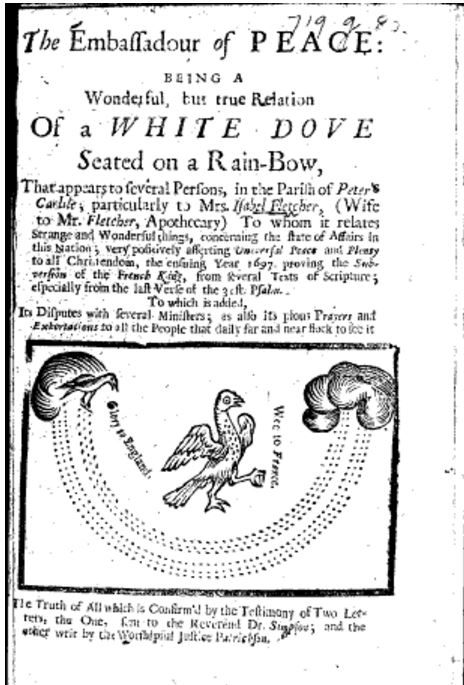
THE
EMBASSADOUR OF PEACE, Being a Strange and Wonderful Relation of a WHITE DOVE Seated on a Rain-Bow.
That Appears to several Persons, in the Parish
of Peter's Carlile; particularly
to Mrs. Isabel Fletcher, (Wife
to Mr.Fletcher, Apothecary.)
To whom it Relates Strange and Wonderful Things, concerning the state of
Affairs in this Nation; very positively asserting Universal Peace and Plenty to all Christendom, the ensuing Year 1697. Proving
the Subversion of
the French King, from
several Texts of Scripture; especially from the last Verse of the 31st Psalm.
It’s hard to make out what was happening up in Carlisle in 1696. The
pamphlet, at once credulous and anxious, appeared both in London and Edinburgh
editions. The clergymen who attest to the wonder are simultaneously worried
that the dove delivering prophecies to Isabel Fletcher may be a devil: “False
Christs, and false Prophets (saith the Holy
Evangelist) shall arise, and shall shew Wonders to seduce, if it were
possible, even the Elect.”
This is the beginning of the narrative of what was alleged to have
taken place:
"On Friday the
23d. of October last, a little after Sun setting the Wife
of John Fletcher and Apothecary in St. Peter's
Carlile, a Woman of good and pious disposition; being set in her
Chamber in a Melancholy thinking posture, with her Child in her Arms; felt on a
sudden and unusual Warmness about her Head, and, immediately after discern'd
the likeness of a White-Dove, as it were upon a Rain-bow: whereupon
she presently fell down into a Trance: But, at last, recovering herself, she
heard these Words uttered by it, in a shrill and powerful Sound, Isabel! be
not afraid, for I am a Messenger sent from GOD, to proclaim Glad-tidings to all England: yea,
even to all those that sincerely Love our Lord Jesus Christ; And so,
bidding her attend in the same place next Evening, it for that time
disappeared."
This would be easy
enough: a vision or trance for a woman who is agitated by what she has heard about
the Nine Years’ War and Louis XIV. The preamble to the pamphlet mentions "our
Modern Speaking Raven (a Miracle yet fresh in our
Memories)". I can find no further references to an oracular raven, it was
perhaps another local wonder. But any raven speaking prophecies would certainly
have run true to type as a bird of ill omen. The pious Mistress Fletcher is
inspired to bring in a dove, offering greater comfort (and obviously inspired
by Genesis 8). But the parish minister cited in the main part of the pamphlet
makes it quite clear that the apparition was seen by others:
"The Astonished Woman
acquainted her Husband with what had happened: whereupon he with several others
attended with her the Hour appointed; to whom the Dove or Spirit appear'd,
as aforesaid; Exhorting them to Prayer, Piety, and Repentance; as
that GOD was angry; that his Vials of Wrath were ready prepared to be poured
out on all the Children of Disobedience; that Rome had drunk
deep of the Blood of the Martyrs: and therefore must drink deep of the Cup of
GOD'S Wrath; That Peace and Plenty should
environ all Christendom; and that the present disturber of
the Welfare thereof, shall in the year Ninety and Seven, be
Cut off from among the Children of Men: Moreover it added, that the Kingdom
of Christ should shortly be Established throughout the whole World:
and that of Satan's totally Subverted and broken into Confusion."
How was it done? If its appearances were confined to one place, one
could imagine a simple mechanism, a painted rainbow (inspired by Genesis 9) being used to secure the bird and bring it into view. But is also appeared at other places. I suppose it was seen by those
who could see it, and Mistress Fletcher, casting her voice, made sure everyone
heard it:
"It is so
commonly seen, that it is known to every Body in the Neighbourhood; and
appears frequently in the day time: and when Three, Four, or more are present
it never fails to speak with a clear and audible Voice."
The parish minister,
Edward Knowls, challenged the ‘dove or spirit’ to prove its non-diabolic nature:
"It shows itself also
in the Neighbours Houses, exhorting to Repentance. At a certain time, being present,
with some others, I conjured it, by the Holy Trinity, to tell me what it was,
and wherefore it came. It presently replied, in the same manner as afore, ‘A
Messenger, from God, sent for the Conversion of Sinners’. And so, for that time
vanished."
He earnestly tries to
dissuade Mistress Fletcher: "I desired her to consider, That it was not a Good
& True Spirit; that she should refuse to Pray at his Command: For that,
under such Holy Representations, it might seduce her and others from the Word of God and
his Grace."
Despite such clerical
misgivings, crowds gathered in Carlisle:
"Here is such a
numerous Concourse of People that the Town cannot contain them, and if we
should countenance them, I am apt to think, they would set it up as an Idol or
Oracle; for as much as several repair hither to ask Council in doubtful
Matters."
Henry Patrickson was
the other clerical witness, though he seems to report the dove as having been Mistress
Fletcher’s visual experience alone:
"Sir, I cannot omit this
Opportunity of Acquainting you with a wonderful Apparition, that is here amongst us, to the
exceeding Amazement of Thousands of People, viz. A White
Dove, seated on a Rain-Bow, that daily appears to
Mrs Fletcher, an Eminent Apothecary's Wife. It
talks with her very much out of the Scriptures; applying especially these Places, The
Seed of the Woman shall bruise the Serpents Head. The Blood of Jesus, &c."
“It foretells the
total Subversion of the Ottoman Empire in a very small space
of time; and a signal Victory over the French in 97. And that Peace
and Tranquillity will thereupon ensue. It also speaks of the Affairs
between France and the Duke of Savoy.
It delivers its
Answers after a mysterious and ambiguous manner, as did the Oracles of old. The
common People take it to be an Angel sent from God, but
a Bishop and other of the Clergy hold it for a Devil. As for me I shall forbear
to pass my Judgement, till it appear what manner of a Spirit it
is.
Yours,
HEN. PATRICKSON."
The dove was surprisingly
like a foreign correspondent, if a bit behind the times on the Turks, who had
passed the apogee of their threat to Europe at Vienna in 1683. Even so, while Mistress
Fletcher could do scripture talk easily enough, she had a wider concern for the
state of Europe than one might expect from a late 17th century
apothecary’s wife in Carlisle.
The postscript to the pamphlet promises more to follow: “You shall
not fail of having exact notice of all ensuing Material, Passages relating to
this wonderful Prodigy, for it is so far from any likelihood
of Ceasing, that it daily appears, every day more visible than other freely
answering all Questions whatsoever."
"Several Atheists
flock thither, and are fully convinced of the Power of an Almighty
Being: And several eminent Persons have employed their utmost Skill
and Learning to find out whether it might proceed from some Natural Cause, or
not? but all in vain. So that all in general conclude, that it is no less than
the Finger of God."
The story seems to
end there, with that 'flock' of 'several atheists'. Maybe there was an awkwardness, an exposure of pious fraud, or maybe
she was finally persuaded of the ambiguity of her prophet bird. On the other
hand, it did seem to have got The Treaty of Ryswick correct for 1697, when
Louis XIV allowed Europe three years without war before triggering the War of
Spanish Succession.
Subscribe to:
Posts (Atom)