Showing posts with label cosmetics. Show all posts

Friday, December 14, 2007

Early Modern Teeth Veneers


Yesterday evening I was giving an M.A. class on Shakespeare’s so-called ‘Dark Lady’ sonnets. Instead of doing some solid class preparation, I’d spent a deal of Thursday afternoon frantically interrogating EEBO with keyword searches, ‘Mistress NEAR black’, ‘black NEAR beauty’, etc, as ever in the hope that something might emerge that had been missed by those diligent Victorian gentlemen who actually read the books themselves (well, what can I say? I have a busy life).

So I have looked at lots of commentaries on the Song of Songs, and being ‘black, but comely’, but on this last day of term I don’t have the energy to sum up early modern opinions about that smokingly hot Bible text. Instead, I dwindle down to one of the poets I turned up, John Collop.

Collop’s vauntingly titled Poesis rediviva, or, Poesie reviv'd (1656) was not up to the aim projected in its title. Perhaps part of his notion of ‘reviving’ poetry involved echoing earlier writers rather closely:

‘Prophanum vulgus. The People.’

“Th'rabble's an echo made 'twixt Knave and Fool,
To work his ends, the politician’s tool:
While he the Devil’s quilted Anvil is,
On which he frames all that we find amiss…”

That’s a direct crib from Webster’s Bosola in The Duchess of Malfi:

“A Polititian is the divells quilted anvil,
He fashions all sinnes on him, and the blowes
Are never heard”

but with Collop rather witlessly losing the point of the silent fashioning of sins on that ‘quilted anvil’. In the book as a whole, after our poetaster has aired his opinions about various preachers, sects, doctors and treatments, he gets onto the subject of women. Not having anything much to say, he falls back on praising yellow skin, ‘Ethiopian Beauty’, the larger lady (in ‘To Dionysia the plump Lady, S D.’), etc. - anything on which he can jangle out a few conceits and paradoxes.

One poem did strike me:

‘On Pentepicta: A Lady with enamell'd Teeth, black, white and yellow. F.W.

The wiseman teeth call'd flocks of sheep;
Sure Jacob’s speckled flocks here keep.
Where teeth are checker'd black and white,
Nay gilt too to enrich delight:
Her mouth ope, you at Chess may play,
With teeth resembling night and day.
Each fondling reach will praise what's white;
Is there in Chalk such strange delight?
Give me the mouth like th'Temple floor,
With speckled Marble paved o're,
Or - oh more rich! - in gold thus set,
A row of pearl, then one of jet.

I think that this is just a burlesque (any foolish poet can attain the praise of white teeth, he says) but it does seem that you could get your stained teeth enameled. In the poem by Royall Tyler (there’s a name for you!) below, jeering at the cosmetic construct that is ‘Flirtilla’, one 18th century practitioner of this particular aid to beauty is actually named. White enamel is obvious, gold quite conceivable, but having your teeth enameled black seems altogether implausible. Another stray reference in a play of 1655 by William Rider turns up a character writing a burlesque poem to a ‘loathly lady’, whose teeth are enameled with blue, black and yellow (i.e., simply discoloured: but the reference does suggest that white enameling existed as a practice).

[Collop’s opening line took me back to the Song of Solomon anyway: ‘Thy teeth are like a flock of sheep that are even shorn, which came up from the washing; whereof every one bear twins, and none is barren among them.’]

Royall Tyler, 1757-1826: ‘To Miss Flirtilla Languish’

Flirtilla, the pride of the street,
Oh listen to Tippy's fond lay;
I swear, by my shoe bows, so neat,
No beauty was ever so gay.

Her pudding is puff'd to her chin,
Her chignon is frizzled with taste,
Milk of roses has soften'd her skin,
And her neck is white over with paste.

The rouge on her cheeks spreads its rose,
Her braids on her neck sweetly play;
No waist has my love to her clothes.
And her hair is, with Marechalle, gray.

With a grace my Flirtilla trips in,
Her umbrella display'd to the wind,
From her ruff in and out bobs her chin;
And her spencer keeps bobbing behind.

Of the mouse's sleek skin are her brows,
And her eyes they so languish beneath;
She is scented with Jonquil and rose
And GREENWOOD enamel'd her teeth.

I have found out a gift for my fair,
To LANE'S sweet scented shop did I go,
I there bought her a Tete of false hair,
But she pouted at all I could do.

For he ne'er could be true, she oft said,
Who a present could make to his fair;
Who could purchase a Tete for her head,
Without any braids to the hair.

To see, when my charmer trips by,
Some beau point his Opera glass;
How he looks down Cornhill, with a sigh,
As a shopping Flirtilla doth pass.

On him she may leer, if she please,
Or nod as she passes the street;
But let him not kiss her, or squeeze,
For he'll rub the Carmine from her cheek.

I'd give my Canee and Bootees,
My Pantaloons, Pudding and Vest,
If once my Flirtilla would please,
To press me to what once was her breast.

In wedlock I'd keep her from harm,
No nurs'ry should spoil her soft health,
Fleecy hosi'ry should keep my dear warm,
If I failed for to warm her myself.

My image is from the Web Gallery of Art, and is Goya's 'Out Hunting for Teeth!' The commentary there suggests that the young lady is pulling teeth from the jaw of the hanged man for purposes of witchcraft. This is wrong: witches are never depicted as disgusted at what they do. Rather, she is collecting nice white teeth to push into the gap the barber surgeon is about to make in her own discoloured smile. Like 'Waterloo teeth'.

Sunday, October 07, 2007

Plague prediction from the behaviour of children, and coffee as a remedy, 1665


In sprucing up a lecture I came across the little pamphlet The prophecie of one of His Maiesties chaplains, concerning the plague and black-patches with Mr. Gadburies happy and joyful predictions, for the decrease of the plague both in the city and suburbs; the time when; the manner how; by God's permission, and according to natural causes; the effects and motion of the planets, and what every week may produce for the thrice-happy and welcome abatement of this sad and dismal pestilence; and the city of London to be wholly acquit thereof about (or before) Christmas (1665).

This ill-founded announcement of hopeful news ( the pamphlet gives both the astrological reasons for the outbreak, and repeats the hopes Gadbury had raised for an amelioration in August when ‘the fortunate Planet Venus … may so happily contemper the fury of it’ by entering into ‘a Trine of the Sun’ – no such luck, of course) brings together several oddities. Taking me back to some of my earliest postings on the fashion for black face patches, the pamphlet mentions a royal chaplain denouncing them as connected to, and in some sense responsible for, outbreaks of plague:

“And 'tis worthy of serious consideration, that about 20 years ago, one of the Chaplains of his late Majesty King Charles the First of ever blessed memory, did preach at Bristol upon this Text out of Gen 4.15 (‘And the LORD said unto him, Therefore whosoever slayeth Cain, vengeance shall be taken on him sevenfold. And the LORD set a mark upon Cain, lest any finding him should kill him’) And in his Sermon did speak often against black patches and beauty-spots; and, among other things, said they were Fore runners of other Spots, and Marks of the Plague; and presently, within a very little while after, the Plague broke out among them, and all those persons that did wear them, fled the Town.”

If fashion can be connected to the plague, so can all kinds of behaviours. Arguing rather unconvincingly that God in His infinite mercy (!) sends warning signs (but the plague nevertheless tends to arrive ‘unawares’), the author runs through a few of the bad signs to look out for:

“Though the Plague cometh unawares, and seizeth upon a man on a suddain, yet such is the infinite mercy of God, and the providence of Nature, that it giveth always warning enough to any one that will diligently observe it …

… First the Reader may be pleased to observe, the Signs immanent and approaching of great Mortality; Mr Kelway in the third Chapter of his Treatise of the Plague printed at London 1593 hath these words: When we see young Children flocke them selues together in companyes, and then will faine some one of their company to be dead amongst them and so will solemnize the buriall in a mournefull sorte, this is a token which hath bene well obserued in our age, to foreshew great mortallitie at hand.

The allusion is to Simon Kellwaye’s A defensatiue against the plague contayning two partes or treatises: the first, shewing the meanes how to preserue vs from the dangerous contagion thereof: the second, how to cure those that are infected therewith. I in fact had to fill out the faintly-inked quotation in the 1665 text from the 1593 source.

So, it’s a bad sign if you see the children out playing at funerals. I find this interesting, and, I must confess, to have a faint possibility of plausibility, like those stories of animals predicting disasters. William Lilly, in his manuscript ‘History of his Life and Times’ (I read the 1822 printing of this fascinating work) firmly believed in this indication of bad times ahead. (I concede that Lilly firmly believed in all kinds of indications of bad times ahead – that was his stock-in-trade.) But here he is on the 1625 outbreak (and, at first, on what has to be a smaller outbreak from his earlier London years, 1620 onwards):

“I will relate what I observed the spring before it broke forth. Against our house every night there would come down, about five or six of the Clock, some hundred or more boys, some playing, others as if in serious discourse, and just as it grew dark would all be gone home; many succeeding years there was no such, or any concourse, usually no more than four or five in a company. In the spring of 1625, the boys and youths of several parishes in like number appeared again, which I beheld, called Thomas Sanders, my landlord, and told him, that the youth and young boys of several parishes did in that nature assemble and play, in the beginning of the year 1625 ‘God bless us’, quoth I, ‘from a plague this year’.

Was there some unrecorded lore among 17th century children, some observation they had made? Boys were perhaps close observers of the behaviour of rats, as a source of sport. Had they noticed (as used to be the case with local tribes when the plague was still confined to the steppes) that the population of rodents was diminishing? Before the plague got out of central Asia, the people there knew that if the marmots were sick, you stayed well away. I read somewhere that the Chagatai horde led by Timur-i-Leng (Tamburlaine) swept through, knowing nothing of this, and freed the bacillus into circulation across the hemisphere.

The 1665 pamphlet offers the usual desperate remedies – wood fires, dosing yourself with vinegar, and coffee. Yes, coffee.

“Kindle a wood-fire in the Chimney, to consume and destroy all the infectious vapours… Venice-Treacle, Vinegar is a most excellent Antidote against the Plague, and to drink 2 or 3 Spoonfuls in a Morning is very good … Coffee is commended against the Contagion.”

What a pitiable life they led!

Thursday, April 20, 2006

Piety and patches


‘These are the ears which have hearkned to so many base, scurrilous, profane, lust provoking songs’.

A stray comment on my blog repeated the quite frequently made point that it would be interesting to have women’s replies to certain notorious poems by Donne. I was still reflecting on the impossibility of any woman writer in the early 17th century sparring with Donne on his Ovidian home turf (it took Aphra Behn to come along and expose in female-authored Ovidian poetry sexual inadequacies in the male) when I came across William Tipping addressing young women in 1647. He is imagining how the general run of young women will feel on the day of judgment, having listened to sinful poetry and music. And as for their eyes, these women will on that last day say to themselves, ‘These are the eyes which shot forth so many envious, amorous, lascivious glaunces’. All the senses they abused will present to them at the Day of Judgement, Tipping affirms, knowledge of the ‘everlasting woe and sorrow’ they face. It all goes together: poetry provokes lust, and hell beckons for the young woman who listens to it.

Tipping, a Puritan, has been describing, in contrast, an exemplary life and death, that of Apollina Hall, a young widow, who died at the age of just 21. (The Remarkable life and death of the Lady Apollina Hall Widdow, deceased in the 21st year of her age, 1647). Mis-educated by her evidently non-Puritan Grandmother, Apollina lacked proper religious fervour till she was 18. She cannot have had much to repent of, but at that age, repent she did (acknowledging your sins was the required Puritan formula), and she fell into habits of the strictest Protestant observance, writing up her spiritual balance sheet at the end of every day. I think I have seen cited before somewhere her particular triumph of austerity and emotional self-denial, as faithfully recorded by Tipping:

‘She was exceeding solicitous and fearfull over her self, least any created comforts (the Danaes of corrupt men) should creep into, and take possession of her heart, as appeared by this; that being moved by a certain person about her, to send for her childe, in which she was much delighted; she durst not, she answered, trust her deceitfull heart, lest it should be immoderately let out upon her childe, as formerly it had been upon her dear husband.’

In her mortal illness, she fell into what Tipping can stretch to oxymoron to term ‘holy repining’ at the medical fees she has had to pay, the money being merely ‘cost and charge … upon a rotten carcass (that was her own expression)’ - even Tipping blenches a little at this, and has to make it clear in his parenthesis that he is just reporting her words. The money she has spent on herself, she said, ‘might have comforted many a poor christian’.

She duly died with a number of appropriate utterances, which Tipping has to record: ‘finding death to approach; this is the joyfullest day (saith she) that ever mine eyes beheld.’ She comes through a bout of ‘extream convulsions’, and of course regrets survival: ‘I had I thought I should have been with my Saviour before this time’ she says.

‘My joyes are unspeakable’, she says, as death comes close. ‘In this her last and extream struggling with death, she often cried out, Come Lord, come Lord, when Lord, how long Lord’.

Not all of this is to our taste, of course: refusing to indulge your carnal nature by seeing your own child makes the Puritan lady set on meeting her saviour look entirely self-focussed; her faith has circumscribed her emotional life. Yet for a very young woman to die with such acceptance is impressive in its own way.

After this painful account, Tipping then turns to admonish other young women, who are in the main racketing along the way to hell-fire and damnation. As usual with a seventeenth century man, the effort of praising one individual woman will be compensated for by an eloquent attack on women in general. Suddenly, he sounds like Tertullian, and his particular bugbear happens to be face patches:

‘Away with your base and lustfull baits, those black and infamous patches in your faces, which render you odious and scandalous in the world, and in every wise mans eye disfigure you’. He offers the piously sarcastic thought: ‘Should the Lord in the naturall composure of their faces, have ingraven such black spots in them, as now their fancies adde, surely they would have looked on themselves as monsters.’ I doubt whether any woman could have replied that if the Lord had thought fit to engrave her face with the pits left by smallpox, and she reserved the right to make the best of things.

He indignantly adds that ‘ the very Indians (amongst whom the Lord hath lately vouchsafed some dawning of the Gospel) do so abhor the naked brests of women, and hair hanging loose, or cut as mens hair is, that they have made some Laws against them. Oh that our English Ladies should grow so bold, as to practice that which Indians abhor, which miserable heathens count their shame.’

In part, the author can be excused by historical circumstance: he regularly refers to the recent civil war, and clearly feels that everyone should be as self-mortifying as poor Apollina Hall had been.

As with earlier Protestants like Phillip Stubbes, the denunciation tends to betray his horrified fascination, an obsessiveness. Look at that expression about ‘created comforts’: ‘the Danaes of corrupt men’. The classical allusion shouldn’t really be there, and it doesn’t fit his argument. Danae was seduced by gold, rather than being a seducer. But Tipping is so very over alert to female allurement. By the end of his account, he is thundering damnation, but he does at least imagine and formulate a reply, making the girls in their wicked face patches sound like one of the more jaunty passages of the Bible:

'Now if any of this sex to whom I direct this discourse shall reply and say, I will walk in the wayes of my heart, and light of my eyes; I will rejoice in my youth, and my heart shall clear me in my youth: I will say no more but this; Thou that art filthy, be thou filthy still; thou that art profane, be profane still … but take the close, hear thy doom, know thou assuredly, that for all these things God will bring thee to judgement.’

The rather charming assemblage of lore republished on the web at

http://www.thebookofdays.com/months/nov/19.htm

asserts that the earliest mention of face patches is in ‘Bulwer’s Artificial Changeling’, of 1653.

This reference is to the splendidly titled Anthropometamorphosis, man transform'd, or, The artificial changeling historically presented in the mad and cruel gallantry, foolish bravery, ridiculous beauty, filthy finenesse, and loathsome lovelinesse of most nations, fashioning & altering their bodies from the mould intended by nature : with a vindication of the regular beauty and honesty of nature and an appendix of the pedigree of the English gallant / by J.B.

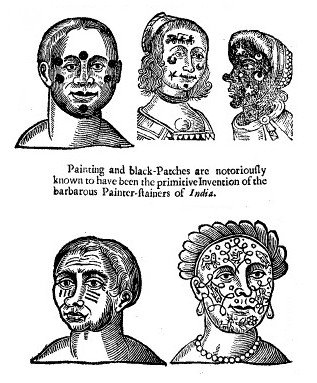
This was John Bulwer’s suitably demented account of the way humankind has decorated (or mutilated) bodies (“the eye-browes abused contary to nature”, etc), and from that source I take his image of face decorations. It is interesting that, like the Puritan Tipping, Bulwer uses native cultures as a form of perspective on his own, though Tipping makes his native people into moralists, Bulwer merely has them as equally mad.

But as for the mention of face patches, the Puritan beats the ethnographer-satirist by a matter of some years, Puritans being such devout followers of fashion.

http://www.prm.ox.ac.uk/cosmetics.htm

gives a picture of a surviving contemporary box used to keep your face patches in (the Pitts Rivers Museum, Oxford).


Tuesday, March 14, 2006

Blood of Bat: 17th century cosmetic preparations

I’ve been reading Cosmeticks, or the beautifying Part of Physick (1660), which claims to have been written by John Jeams Wecker, with its translation into English at the behest of the herbalist Culpepper. These seventeenth century cosmetic preparations are addressed by its author to ‘Ladies’. Its lotions and remedies fall within in a triangular field defined by Body Shop style herbal placebos, magic, and the downright dangerous.

The majority are preparations for the hair: getting it growing, stopping it growing, changing its colour, improving its condition. The reader is expected to have a go at concocting these remedies for herself, as the title page says 'Being familiar remedies, for which every one may be his (sic) own Apothecary'. You were not expected to be squeamish in your determined pursuit of beauty: ‘the oyl of earth-worms doth increase the hair’ (p. 55). A water against shedding the hair (p. 9) reads in full: ‘Take of pure honey, candy wine, a boyes urine, milk, each one pint, and distil a water, with which you must wash the places from whence the hairs fall’.

Some of the preparations sound amazingly like a witches’ brew: Of ointments that hinder the growth of hair (p. 70) ‘Take the blood of Bats, the juice of Ivy, the juice of radish, Goat’s suet, each a sufficient quantity, mix them, and make an ointment’. This one is a depilatory: ‘Take of Ants Eggs, Juice of Henbane, hemlock, seeds of Fleawort, the blood of a Bat, of a Tortoise, each a sufficient quantity, mix them and anoint the place’ (p. 77). Anointing yourself in a hairy place with henbane and hemlock probably did have quite an effect. Just the occasional note like ‘another free from all danger’ suggests that not all the recipes are to be applied carelessly.

The 17th century pharmacy must have been an interesting place to work. Animal testing wasn’t in, but animal products certainly were: ‘Take a live green lizard, boil it in wine and oil’ (the start of a preparation against ringworm). Or you are told to take ‘earth snails fifty, bruise them all’ (p.18) – quite a messy job. A water to make the face very fair begins more like a stew: ‘Take two young pigeons, two pound of veal…’ Quicksilver, mouse turds - the ingredients are baffling in their variety, their arbitrariness.

As there always are in 17th century books, there are delights of language usage ‘an ointment to illustrate the face’ (p.102) is rather wonderful. There’s An ointment for clefts of the Nibbles…(we would say, dully, ‘cracked nipples’).

And there are the differences of expectation. The author finally comes to a section Of ointments that adorn the breast. All of these preparations, all of them, are concerned to make the breasts smaller. It can’t just be the author having a thing about small breasts, a cultural expectation speaks, and woman are expected to be doing something about themselves. Remedy (as he sees it) after remedy is a recipe 'To keep the breasts small' or 'To make the Brests decrease or grow less' (‘The juice of hemlock mixt with Camphure layd on, makes them less’), or ointments to inhibit breast growth ‘to hinder the growth of the breasts, to make the breasts less, and hard. Not a single one on augmentation, the modern mania.

Occasionally, how hard and squalid people's lives could be strikes the reader, as in a series of remedies to get rid of Lice in the eyebrows.

The ointments to take away the marks of small pox remind us of the horrors from which we have been delivered. This is the poet Richard Corbett, writing about small pox in his poem on the death of Lady Haddington:

Oh thou deformed unwoman-like Disease,

That plowst up flesh and blood, & sowest pease

And leaves such prints on Beauty, that dost come

As clouted shoes do on a floor of loam

Thou that of faces honey-combs dost make.

And of two breasts, two colanders, forsake

Thy deadly trade...