Sunday, April 16, 2006

To find the mind's construction in the face


Richard Saunders was one of those astrologers who published an annual almanac, and I suppose that back in those days of almanac buying, you found a style of almanac that suited you, in the range between the dryly factual and the apocalyptic, and stuck with the writer, or his ghost writers, year after year.
Saunders had a side line in palmistry and physiognomy (metoposcopy is his favoured term for what he does), and between 1663 and 1676, his major work in this area acquired increasing numbers of illustrations. I have grouped seven of them into the two jpegs above. The semiotics of the face can read simplistically: straight lines across the forehead meaning plain and honest, oblique lines in an asymmetrical countenance, bad behaviour. If you have wavy lines, fear death by drowning, and a cross in your forehead gives you the Tyburn mark, and your destiny is to be hanged. Others are quite capricious and opaque - a line with a wart predicting dangerous falls (plural!) from high places.
My puzzle for anyone looking at this posting, is who was the man at the bottom right? Here, Saunders shifts from invention of typical faces to including the face of a real man: 'an excellent man' but 'mightily tost on the waves of misfortune' 'When by the Divine Grace and favour, he seemed to arrive safe at his haven of rest ... he was beyond expectation, by the contrary tempest of adverse fortune, again hurried into the depth of perplexities'. Clicking on the image gives a larger jpeg, of course.
Saunders added 'A Treatise of the moles of the body of man and woman', offering 'Rational Judgements by the moles of the body'. The discussion begins with a facial chart, for Saunders asserts that (something like acupuncture or reflexology), a mole in a particular part of the face will always have a corresponding mole on some part of the body. According to the places, Saunders lets his reader know which star governs the person so marked; while the shape and colours of the mole add levels of meaning. As ever, men have more forms of destiny open to them, while the female destiny often comes down to her marriage, chastity, and the like. Thus, a mole in the middle of the forehead under the lines of the sun (formula 18) 'shews a man to have a great voice, to be a good Oratour, yet luxurious and addicted to gluttony' while in a woman the same mole 'denotes a woman given to lust and lascivious courses'. As with any fortune-telling, predictions of wealth and status are important. A mole on the right side on the end of the line of Mars 'prenotes a man to thrive by Playes' - unless it happens to be black, when 'let him avoid Playes'. Nothing so complicated for women: 'it signifies Inheritance from Parents.'
All bizarre and arbitrary, but I can imagine his system being revived tomorrow. All this talk of moles reminds me of Donne, in Elegy 18:

her Chin

Ore past; and the streight Hellespont betweene

The Sestos and Abydos of her breasts,

(Not of two lovers, but two loves the nests)

Succeeds a boundless sea, but yet thine eye

Some Island moles may scattered there descry...

No amount of anguishing about woman as territory, reification and the rest, will ever quite get me to relinquish these lines as true to erotic experience. Saunders sticks chastely to the face, and simply says that a mole on the body will be present if there is one in some part of the face. Where would romance plots have been without these 'blots of Nature's hand', which individuate and indentify people as securely as fingerprints. Iachimo spies Innogen's 'mole cinque-spotted', and tortures Posthumus with the lie that 'By my life, / I kiss'd it', as the little mark of melanin hovers between embellishment and blemish. But I am wandering from my subject.

Wednesday, April 12, 2006

Titus Andronicus in Egham


The anonymous Three Bloody Murders (1613) deals with three savage murders which offer little purchase for a satisfactory Christian moral. The main business of the pamphlet is to defend the character of William Storre, a Parish minister at Market Raisin, hacked to pieces by a young man from a wealthy family angered by his siding with the townsfolk in a dispute over the ownership of common land. The assailant succeeded in getting bail, absconded abroad, then his connections seem to have launched a sustained attack on the character of the murdered minister. He returned to London where his victim’s wife and children were living on charity, and tried to buy her off from an appeal against him, then slipped back abroad. This grim account, and the solemn reprinting of testimonies to the victim’s character, is the major business of the publication.

But it is the section
‘The Cruell Murder of a yong Maiden, committed by Elizabeth James, of the Parish of Egham in
Surrey, most strangely revealed by a dogge, and a dumb-woman’
that has long interested me. Years ago in the Bodleian Library, I did the kind of thing that you do on Google these days, and looked up my then partner’s name in the Bodley catalogue. My idle curiosity, scanning the early printed book, was quickened when I saw the full title page, for having got my teaching job at Royal Holloway, I was just about to move to Egham to live there with a young woman also called Elizabeth James. 20th century
Elizabeth was really rather unhappy with this coincidence. As I read quite regularly Sharon Howard’s excellent and hugely inclusive Early Modern Notes blog http://www.earlymodernweb.org.uk/emn/, this crime pamphlet recently came back to mind.

‘Let us look with wet eyes, and heavy hearts, upon the cruelty of Elizabeth James, a keepers wife of the Parish of Egham in Surrey…’

Elizabeth James’s victim apparently arrived at her house by chance: a pretty young wench, and handsomely apparreled’. This girl, never named, was possibly running away from home: the author reports nothing about her or where she came from. She begs to be taken in as a kind of working lodger till she finds service in the vicinity. The gamekeeper’s wife agrees to this, and is all kindness to her lodger at first. But the girl has a store of money with her, and bit by bit, Mistress James borrows from her, and gets the fine clothes too, and will make no restoration. The girl complains to the husband, who has an argument with his wife, and forces his wife to return all the money and goods. The next day, the pamphlet tells us, Mistress James dragged her maid by the hair into an inner room,drew her knife, and told her that now shee would be soundly revenged upon her for the hard words, and blowes, that she had received from her husband’. The girl begs for mercy, and says that she will leave without saying a word, but the other woman cuts her throat, cuts off her head with a hatchet, ‘then by the divell prompted still, to the very utmost of this most horrid impiety, she cut her poore wounded body into many small peeces, some of which she burnt, some broild, and some in the dead time of night, she buried in her garden.

The narrative says that when her husband returned, he just assumed that the girl had moved on of her own accord. Something like a Shakespearean ‘double time’ has operated, allowing Mistress James plenty of time for her dismembering, broiling, and the burial of body parts by night, before her husband returns. And life goes on, Mistress James preventing her husband from gardening in one particular bed, or it would have done so – but here the narrative has a surprise:

Thus, for a time, this bloody murther lay concealed, though to reveale it a poore dumb woman, that saw the cruelty acted, many times, and to many persons, by her signes, and dumb shews, so well as she could did labour her best to bewray it. But from all her signes, as pulling her selfe by the haire, drawing her hand ore her throate, stabbing her selfe (as it were) upon the breast, wringing her hands, weeping or any thing that she could doe, they could not gather any thing that they knew how to make any matter of’

The dumb woman vividly enacts the murder she has witnessed, but the stolid burghers of Egham ignore her. Either she only does this in Mistress James’s absence, or she ignores her too. Heavens only knows what they were thinking, if anything. Maybe the dumb woman was simply very bad at her ghastly charades, or had mental problems that made them accustomed to ignoring her strangenesses. In the end, heaven, trusty old heaven, intervenes, and a dog, digging in the garden for something to eat, one day comes into the house with the severed head, and deposits it in front of Goodman James, Mistress James, and some of the neighbours. It is hard not to think of this as the ultimate Egham dinner party, ‘most admired disorder’ in its suburban form. Prompted by this, the dumb woman falls back into her Lavinia act, and indicates where in the garden more remains can be found, the slowly-revolving mind of Goodman James at last delivers a thought, when he remembers how his wife had stopped him digging there, and they excavate the rest. The neighbours take Mistress James off to the Justice, and her trial follows swiftly, but not her execution, as she is pregnant, and must await her delivery before facing the gallows.

Taking this extraordinary story at face value, what we have is a report without any curiosity, into a community of oblivious inhabitants, who insist on living normal lives despite having the adverse evidence shrieking at them. Nobody asks any questions, nor does the narrative anticipate its readers having any questions about who heard and reported the words it assigns to the murderess and her victim. The dumb witness to the crime is locked up behind illiteracy and an astonishing lack of initiative. Whether the husband did or didn’t beat his wife hangs unresolved, is something of no importance. Did Elizabeth James act alone – a pregnant woman murder and dismember a younger woman old enough to be out in the world on her own seeking work? It is hard to imagine that the dumb woman hadn’t in fact assisted Mistress James in her butchery of the corpse, and the husband may have had a larger knowledge and role than his wooden behaviour suggests. What really drove Elizabeth James to her desperate crime?

This narrative seems to remind the writer of another 'dog finding a corpse' story, when a courting couple in Finchley, with another hungry dog in their company, find that the dog has discovered a corpse: ‘the eyes pickt cleane out of their places, and (as some say) the empty holes, were fill’d up with the dung of birds’. (‘Those are pearls, that were his eyes…’) Nobody can bear to approach the corpse because of the smell, and, because of its condition, mutilated before death and corrupted since, no-one can identify the victim as he lies for four days by the roadway. He is finally buried where he was found. ‘But here see the certainty of the sacred word of the Almighty; which says, that he that smites a man that he die, shall die for it, Exod. 21’, our author had reflected, when God sent that hungry dog digging in the Egham garden. But the author is stretching a thin membrane of piety over injustice, brutality, and horror, and it takes more than a divinely-directed dog or two to mitigate their unmistakeable forms.

At the end of his pamphlet, the author rallies after contemplating this murder of an unidentified victim by persons unknown: 'howsoever they do yet ly hidden from the eyes of men, from the all-seeing eye of the almighty God, they do not.' Citing a 'Reverend Doctor', the author affirms that 'there is an eye above us, that sees all we doe, an eare that heares all we say, and a booke, in which all our words and deeds are written'. Impeccably orthodox - but, heavenly records aside, when God is leaving hungry dogs to find corpses, the author has started, here and there, to write that book himself, telling us what Mistress James and her victim said to one another, categorically making her solely responsible: the insidious tropes of the omniscient author doing the work of the omniscient being.

Friday, April 07, 2006

The early modern fossil-collector: 'proselites to Nature's wonders'

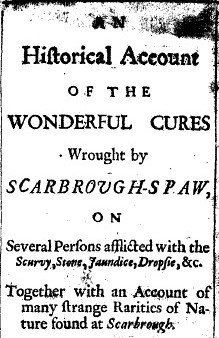
William Simpson's book (1679, 1680) is mainly concerned to boost Scarborough as a spa town, but once you had recovered your health, then Scarborough had to offer something to see, and, at the very end of his book, p. 123 onwards, Simpson is game to tell his readers of its natural wonders, the 'The Rarities at Scarbrough'.

In the following passage, Simpson wonders at belemnites, which, as calcitic fossils, always stand out strikingly against their (commonly) mudstone matrix. The common local explanation he relegates to a parenthesis, though he half-retains in his language an idea that they are some kind of projectile:

To see some Pyrites or fire-stones (some call thunderbolts) inclosed in other textured rocky stones, so shaped and figured as if shot in by some unseen hand, as well as invisible bow; which (although both are Stone) yet the former as much differs from the stony soyl of the latter they are planted or grow in, as a vegitable plant differs from the earth is springs from, such an object I say can beget no less than wonder.

A belemnite is a most un-organic looking fossil. But other things to be seen in the foreshore rocks look like petrefactions of living things. So he tries to account for the other common fossils, the pectens and ammonites of the Yorkshire coast, attempting to imagine how the rock containing these things was formed:

To see (by viewing again) Cockle or Muscle-shells inclosed in great bulky stones … To see others, viz. Cockles in their intire form inclosed in and perfectly walled about which (sic) lesser stones like as if involved in stony bags or petrifick cases. Also to view other stones (there found) like boulders to inclose the perfectly wrought bodies of Snakes and Serpents Spirally wrought up in a small compass, where the Snake stone has left such an impression upon its case or print as if it had been the mould, about which clay or some succulent stone had been so wrought and then hardned or petrified by the Salt-water and nitreous air.

Two pages later, Simpson gives what may be the first account on record of people beachcombing for these ‘rarities’, but is now retreating from speculation into the neutral (and issue-avoiding) view that these are 'sports of nature':

To see each Proselite to Natures Wonders searching for Rarities upon the Sea-shore … either some curious stones, or some Marcasite with a Cockle or Serpent wrapt therein, which when the petrifick shell is broke, appear plain to view in their intire and curious form, or some pretty Sea-Plant; for after every flood, a new scene of Rarities in one sort or other appears, where are to be seen those Ludicra Naturae, in which Nature sports her self in great variety.

In his closing remarks, Simpson wraps up the matter with reference to God. He advances a point of view in which the Creator is (perhaps strangely) more obvious in these 'petrified' rarities than in other things:

Whose Superscription is upon it, or whose Image doth it bear? … that of the great King of Heaven and Earth; who as he hath stamped the character of his Wisdom and power upon every visible created object, so more particularly some things seem to bear bolder shadows of the Divine Pencil, and to retain more vigorous impressions and lively drafts of the Image thereof.

Simpson was writing in the age of the first geological publications - Thomas Lawrence, friend of Sir Thomas Browne, is just about the earliest in English, in his brief
Mercurius centralis, or, A discourse of subterraneal cockle, muscle and oyster-shels found in the digging of a well at Sir William Doylie's in Norfolk many foot under ground and at considerable distance from the sea / sent in a letter to Thomas Brown by Tho. Lawrence. (London, 1664).

So, which comes first, the publications, or the presence of 'proselites to Nature's wonders' on the Yorkshire coast? Do publications prompt the search, or vice versa? Really, what comes first is there in Simpson's title: a Spa, the quest for health, when a largely urban elite find a reason to go somewhere where people had always known that there were strange things to be seen in the rocks. And once the chattering classes find something to talk about, there will soon be rival theories.

Tuesday, April 04, 2006

The Operator for the Teeth


I went to the dentist today. A rear top molar broke last Sunday. I was expecting that the dentist would tidy up the hole with amalgam, but out it had to come. This took three sessions, with ten minute breaks for the dentist's grip to recover its strength. Of course, I had had an injection, but if pain had gone, there was plenty of sensation as root by root it surrendered. In between wrenchings, he explained the alternatives: a denture at £250, and insert at £1,500, or nothing, which would cost me nothing. I went for the nothing option, there being no cosmetic or very practical reason to do otherwise.

Back in the 17th century, however:


Besides this artificial way of repairing the loss of Teeth, there is another which may be called the natural, which is done by taking out the rotten Teeth or stumps, and putting in their places sound ones, drawn immediately after out of some poore body's head: which thing (though difficult) I know to be feasible enough ... However, I do not like that method of drawing teeth out of some folks heads, to put them into others, both for its being too inhumane, and attended with too many difficulties, and then neither could this be called the Restauration of Teeth, since the reparation of one, is the ruine of another; it is only robbing Peter to pay Paul ... And that I may contribute something towards the improvement of so useful and invention, I think one is, to proceed with it somewhat after this manner. First, I would choose an Animal whose Teeth should come nearest to those of the Patient; as a Dog, a Sheep, a Goat, or a Baboon &c...

From Charles Allen, Curious observations in that difficult part of chirurgery, relating to the teeth (running title, 'The Operator for the Teeth'), Dublin, 1687, pp. 20-1.

I suspect that even though Allen cautions he would only have 'the thing be undertaken and carried on by one that at least knows something of
Anatomy' he has neither tried this, nor had looked in the mouth of any of these animals.

This is not making me feel better. The image at the top is a pelican, appropriated off
http://www.bda-dentistry.org.uk/museum/museum.cfm?ContentID=346
though Allen, being Irish, calls it a 'polican' in his book. The slightly dissimilar arms with the semi-circles, the bolsters, and the slightly dissimilar lengths of the rotating double-ended claw gives you four different closing widths. I think that then you put the last straight part of the bolster (outside the semi-circle) on a sound tooth,
trapped the outside of the tooth to be pulled with the part of the bolster that turns at an angle at the extremity, then clinched the claw up tight against the inside of the tooth to be pulled, then levered out the tooth using the sound tooth as your fulcrum.

... Then Allen would have you do the same on a suitable looking tooth in the mouth of the baboon which you have strapped down ready for that purpose, and insert it into the hole you have just made in your patient's dentition.

The whole left side of my head is hurting.

Saturday, April 01, 2006

The D'Oyley Tomb, Hambleden


With Spring finally arrived, out for a walk near Henley on Thames, watching red kites playing in the wind above Fawley, and then descending down to Hambleden. Here the stream, confidently shown on the OS map, has not run for two years; a local told me that two years of significant rainfall was needed for the stream to run again, so low has the water-table in the Chilterns sunk.

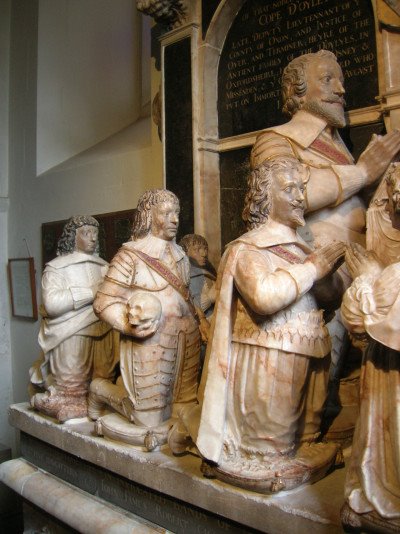
In the church at Hambleden, a monument to Sir Cope D’Oyley (1571-1633) and his wife Martha, ‘who received the crown of glory in the year of Grace 1618’. She died shortly after the birth of their 10th child, and 5th little girl: for they had ‘lived together in inviolated bands of Holy Wedlock 22 years, and multiplied themselves into five sons and five daughters, viz. John, James, Robert, Charles, Frances, Martha, Mary, Dorothie, Elizabeth & Joan.’

As is usual, the boys kneel in front of their Father, the girls in front of their mother, both sets facing one another, as the parents face one another in prayer.

Here are the verses beneath, first for Sir Cope:

Ask me not who’s buried here

Goe ask the commons, ask the Shire

Goe ask the Church, they’l tell thee who

As well as blubbered eyes can doe

Goe, ask the Heraulds, ask the poore

Thine ears shall heare enough to ask no more

Then – if thine eye bedew this sacred urne

Each drop a pearle will turne

T’adorne his Tombe, of if thou canst not vent

Thou bringst more marble to his Monument.


And again, for Martha:

Woulds’t thou, reader, draw to life

The perfect copy of a Wife

Read on, & then redeeme from shame

That lost, that honourable name

This Dust was once in spirit a Jael

Rebecca’in grace, in heart an Abigail

In works, a Dorcas: to the church, a Hanna

And to her spouse, Susanna

Prudently simple, providently wary

To the world a Martha, to heav’n, a Mary.

This was a family with connections to literature: Martha was the sister of the poet Francis Quarles. The verses might be locally written – that sounds to me like a South Oxfordshire rhyme of ‘here’ and ‘shire’. But the last lines of the Sir Cope epitaph, that rebuke to the stony-hearted reader who fails to weep, are very well turned. It could be his brother in law writing, but it is not among Quarles’s published works (Quarles is fond of 'marble' conceits, and has a striking Martha and Mary poem). Then Martha: five couplets matched to his five, but suddenly the poet had recourse to that all too ready cultural despair about women. Sir Cope is just a good man, prompting no need to make general reflections about men. Martha, however, gets praised in the usual way the 17th century could praise a woman, as a glorious exception to a general rottenness. Conversely, you could say, look how high the bar was raised. Sir Cope is an individual who can call on the testimony of everyone locally, from all ranks of society, to witness his virtues. But Martha is measured against, first, other wives, and she surpasses them, to be ranked with eight women from the Bible. Her achievements as a person are at once resonant, and beyond normal reality, so she is placed among a Biblical elect, just as their virtues had been alive on earth in her. It is the man who is wept for, the woman who is admired (that Sir Cope's was the recent death influences this). Once again, our poet knows how to end a set of verses, with that flash of wit in the play between her earthly and heavenly identity. Can personality emerge from this pageant of Bible heroines? ‘In spirit a Jael’ – could that allusion to the Bible’s fiery murderess have been welcomed as an excellent way to convey what her real temper was like? Is ‘Susanna’ totally inseparable from a faintest suggestion of one of the Bible’s sexier women?

They had 10 children, four of them dying young. John, the eldest boy, was a royalist, while Charles, the fourth son, fought for the other side, commanding Lord Fairfax’s Life Guard at the Battle of Naseby, where he offered the bare-headed Fairfax – a wildly courageous man from a military family – his own helmet in the midst of the battle. The two brothers seem to have come close to fighting one another in smaller local actions, but both survived the war.

I post an image of the elder sons. The Church guide asserts that John, the eldest, and James, the second brother, are dressed as Cavaliers, while the three younger sons are dressed as Puritan roundheads. The first thing about John is that he is a mature man, scaled at two thirds the size of his father, that was the conventional way to sculpt a tomb like this. He is barbered and dressed for court, his next brother ‘died young’, but was presumably intended for the army, for he is in 17th plate armour. The last three boys are indeed in plainer attire, the simple linen flap falling down square over the shoulders, and in two shorter lozenge shapes at the open front. But how was this done? How could a monumental mason carve in alabaster in 1633 the outward form of the boys’ political persuasions in the 1640’s? No, the three younger sons are just in the neutral attire of younger sons of an Oxfordshire gentleman, their careers neither settled nor projected.

I usually tell my students – the young women at least – what their reproductive career might have been had they been born 400 years before. None of them remotely contemplates that 5-7 children average. Martha came from a Puritan family of 8 children, her brother Francis and his wife managed 18. What nets of kinship they must have had!

Wednesday, March 29, 2006

Two broadside ballads, 1652

It is always stimulating to come across an early modern text that feels (as we say) transgressive. In the mid-seventeenth century, press censorship temporarily lapsed, and the printing presses were numerous and nimble enough to let all sorts of voices speak. Broadside ballads had always allowed a broad range of robust sentiment, these two texts both have a transgressive spirit, stronger and truer than in most of the elite writing from which we so carefully refine it these days.

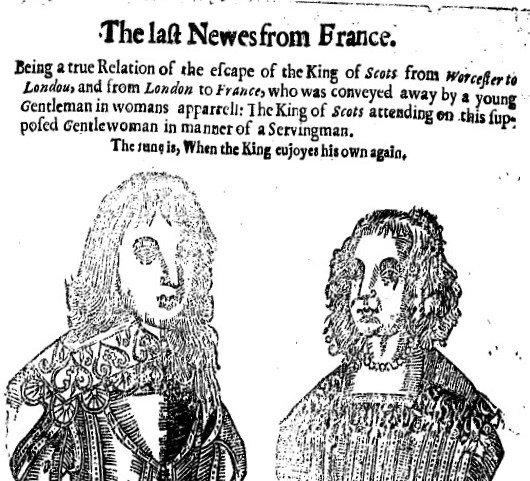
The Last News From France purports to tell a story of how the future Charles II escaped after the Battle of Worcester. The gender switchings are harder to keep in mind than those in As You Like It: in the main, Charles dresses as a servingman, whose Lady, ‘Mistress Ann’, is actually a young gentleman in disguise. You only learn this fact from the ballad’s heading: in the ballad itself, the speaker has effectively become female. At one point in the ballad a maximum of reversal is enjoyed: ‘He of me a service did crave / and often-times to me stood beare / In womans apparel he was most brave / and on his chin he had no hare’. First, the ‘King of Scots’ stands bare-headed to his Master-Mistress, the next moment, he is dressed as a woman. That ‘Womans’ adds such confusion that one half wonders if it was a misprint (but, say, a ‘servingman’ could not dress up ‘most brave’ without Charles starting to look like himself again, even if without a Cavalier’s Van Dyke beard). During the historical Charles's escape, the main problem was his distinctive height: forces were searching for 'a tall black man, over two yards high'. But the ballad writer isn't troubled by plausibilities of disguise, and pops him into 'womans apparel'.

Anyway, in the ballad, the two pass (most implausibly) through London, visit (and weep at) the place of the execution of Charles’s father, take a boat from Queenhithe, and reach France. And all the way through, the refrain line is ‘And the King himself did wait on me’. The ballad ends with the speaker wishing well to the King, who has (the ballad blithely announces) been invited to Denmark to take up the throne there: and the little flurry of subversion ends with a perfect example of ‘containment’: ‘But as for my part / I’m glad with all me heart / That my man must now my master be’. In a different country, everything will be as it should be.

But even so, in this defiantly, even cockily Royalist ballad (it was written to be sung to the tune ‘When the King enjoys his own again’, Matthew Parker’s definitive ballad for the Stuart cause), there is this heady, even sexy pleasure in the King becoming a servingman. During the romance of escape, he even becomes a woman. See, though, a kind of delicacy: to enjoy this kind of royal servitude to him, the speaker has had to become ‘Mistress Ann’. As the son of his courtly father, Charles can (it seems) with more seemliness ‘serve’ a woman. ‘Where ever I came / My speeches did frame / So well my Waiting man to free’: if, as a necessity to set the King ‘free’, the King has to be made subject, and ordered around, well, a woman can just about permissibly do this.

The Wanton Wife of BATH is an absolute ripper: ‘In Bath a wanton wife did dwell / As Caucer she doth write’ (it begins). And you might think that, once you have got over this casual re-gendering of Chaucer, things will settle down a bit. In fact, they get wilder and wilder. The Wife of Bath dies, and her soul goes a knock-knock-knocking on heaven’s door. The first to answer is Adam, who tells her that there is no place for a sinner like her there. She gives it to him straight: ‘Thou wast the causer of our woe / our pain and misery / And first broke Gods commandements / in pleasure of thy wife’. Adam reels away, and in comes Jacob to tell her to go to Hell: she tells him he was a ‘false deceiver’. Lot tries, and is roundly told off for his drunkenness and incest, Judith arrives to see if she can do any better, is denounced as a murderess, and departs blushing, King David had adultery and trouble-making hurled at him, while King Solomon, in the Wife’s unflinching view a whoremaster and idolater, never stood a chance. Jonah, Thomas and Mary Magdalen are scolded away for their various turpitudes, nor has she forgotten the persecutions of Paul, ‘Then up starts Peter at the last / and to the gate he hies / Fond fool, quoth he / knock not so fast / thou weariest Christ with cries’, but this gets a searing rejoinder about her never having denied Christ ‘as thou thy self hast done.’

I suppose that only in bits of medieval drama do you hear this voice of outrageous commonsense response to the Bible and its gallery of doubtful customers. It has been biting pretty close to the bone: Chaucer’s Wife of Bath is fighting her corner all too well, establishing herself as the moral equal or superior to a mixture of patriarchs, biblical kings, and disciples. The raunchiest voice in the Canterbury Tales seems ready to instate the text from which she comes - when it comes to teaching morality - ahead of the Bible.

Of course, all this subversion ends with containment, in its perfect form: Christ himself comes to hear what the fuss is about. Of him, she craves mercy, she repents, agrees humbly to all his charges about her lewd life and not living to his teachings, but still has the courage to cite the precedents: the thief on the cross, the prodigal son forgiven, the strayed sheep. And Christ forgives her soul, and lets her enter into joy.

I can only imagine a clergyman biting his lip at this gleeful invention, in which the unruliest woman in an English book denounces the Bible as a rogues’ gallery, and makes an unanswerable case for mercy based on precedents, not morality. Maybe quite a few copies of both these ballads were torn up by vexed readers, but it is pleasant to imagine a folded up copy being taken out of an apron pocket, and somebody starting to sing either ballad to listeners that she knew would approve.

Saturday, March 25, 2006

Two Interiors


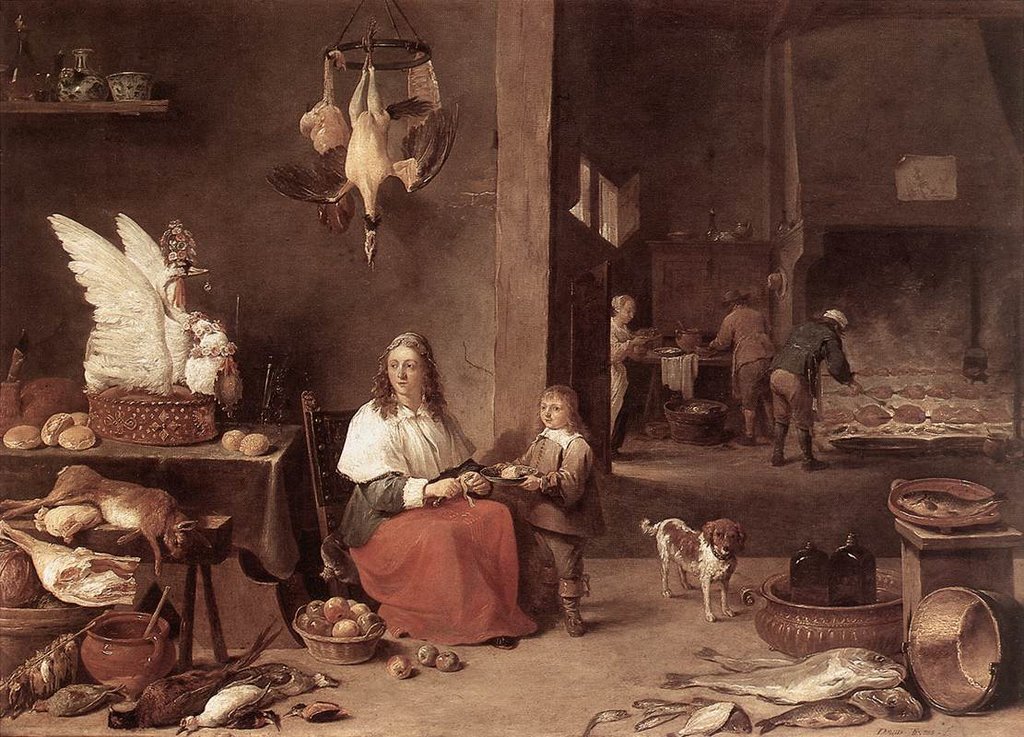
Two interiors by David Teniers the Younger (1610-90), one a kitchen scene, the other, witches preparing for a sabbath. What amuses me is, which is the scene of horror? Mrs Teniers sitting peeling apples among a hecatomb of slaughtered animals, or Mrs Teniers getting ready to meet Satan? The swan pie, decorated with a floral crown and (I think) with the bird’s beak gilded (for that was the classy way to serve swan) is scarcely less grotesque than any of the zoomorphs and serras in the witchcraft picture. The dead things hanging overhead are merely brought back to life as transitional beings in the sabbath scene, the hag making witches’ brew is just another cook preparing soup, in both interiors, the chimney has prime importance: wide enough to roast birds on spits six in a row, or to fly up, preceded by a spirit in animal form. And Mrs Teniers, demurely looking round in both pictures: is that her husband arriving, or is it the Devil?

That the ‘embarrassment of riches’ looks so like the chaotic accumulations of witchcraft perhaps indicates that Teniers was doing these pictures rapidly, reproducing poses that he knew, quoting himself. I see that he is the 9th ‘most stolen’ painter in a list inevitably headed by Picasso: lots of minor, ill-guarded galleries must have pictures by this indefatigable and long-lived artist. What he lacked in outright quality, he made up for in quantity. Yet Teniers could be subversive: another kitchen scene is populated solely by macaques, as if he did see the strangeness of ordinary things, and then the ordinariness of the strange.

The town of Reading still has a proper game butcher, Vicars: not everybody is affronted by meat still in its fur, or feathers. Black blood shows at the nostrils of hares, sometimes a few redder drops show in the sawdust. Tell me, I say to my students, lecturing on Hero and Leander (‘Even as a bird, which in our hands we wring / Forth plungeth, and oft flutters with her wing…’ – that most subversive appeal to common experience, as Leander finally gets his way with Hero), has anyone here ever had to kill an animal to eat? And sometimes, someone has had to do that, in the normal course of things on the farm. That kitchen, in the painting, is so close to the exterior world - in through the open door and onto the spit it goes. In supermarkets, the meat counter is always far from the daylight, the rain and the wind.

(The Teniers picture of the kitchen and that of the apes are at http://www.wga.hu/index1.html

if you enter 'Teniers' in the 'Author' search box.)

Friday, March 24, 2006

Oh, Mr Porta, what shall I do?

This is me all over: because I once supervised a postgraduate working on cosmetics in English Renaissance Drama, and because I can do anybody’s work but my own (and then only years after it would have been useful) some more cosmetic practices. These are from the English translation of Giambattista della Porta, Natural Magick (1658) an encyclopaedia of wonders (he claims he wrote the first of its many editions when he was 15), with a ninth book ‘How to adorn Women, and Make them Beautiful.’ This was not a book aimed solely at women – the cosmetics chapter ends with a section on how to play jokes on women who have been painting themselves (see below). Della Porta had once fallen foul of the demonologists, who accused him of being a magician and conjurer. Much of the cosmetics section has a resemblance to the grimoires, books of spells, which often seem to me to have been self-validating by means of specifying unobtainable ingredients or unendurable processes. For instance, if something like the Petit Albert tells you that to procure impotence in a man, as your first ingredient you need the foreskin of a freshly-killed wolf, the spell makes itself un-falsifiable, safe in the realm of ‘it might work’. A mystique is preserved, the crucial gosh-wow factor for your reader. Meanwhile, any potential user of a book like this thinks, ‘Leeches steeped in red wine for 60 days might do the job very well, but I want to get rid of these grey hairs I’ve just noticed right now’, and opts for something that comes to hand.

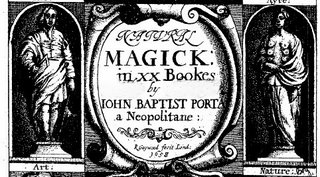
Conversely, serious suffering to be beautiful clearly did occur. Maybe Della Porta’s wildly hazardous remedies spring from their belief that God created everything for human use, so, as even poisons are there for some good purpose, you just have to use them wisely. You see glimpses too of that profuse natural world, where getting hold of lots of leeches, for instance, might not be the stumbling block to a remedy (I think of Wordsworth’s ‘Leech-Gatherer’ struggling to collect his stock-in-trade). Here, that early modern world, thick with flora and fauna, is slowly being replaced by our world, rich in substances. The alchemists are turning up elements and compounds, new materials are coming in from observation of medical practices in the New World: the modern pharmacopia is starting to overtake the natural cornucopia; 'Art' on that engraved title page is starting to usurp the multi-breasted 'Nature'. But to such as Porta it is still all to be called ‘Natural Magic’, benign to mankind, its hazards foggily conceived and side-lined. A dream of beneficial results still tends to occlude even known hazards (rub oil of vitriol on your teeth, and they will be very white, but so will your gums be if you rub too far).

The author begins with the usual quasi-moral rationale for actually allowing cosmetics:

“When God, the Author of all things, would have the Natures of all things to continue, he created Male and Female, that by fruitful Procreation, they might never want Children: and to make Man in love with his Wife, he made her soft, delicate and fair, to entice man to embrace her. We therefore, that Women might be pleasing to their Husbands, and that their Husbands might not be offended at their deformities, and turn into other womens chambers, have taught Women, how, by the Art of Decking themselves and Painting, if they be ashamed of their foul and swart Complexions, they may make themselves fair and Beautiful.”

Here’s the recipe for ‘hoary hairs’ (there's a way to make going grey sound even worse!):

“It is worth the while, to shew such as are ashamed to seem old, how to dye their hoary Hairs black. How Gray Hairs are dyed Black. Anoynt your Hair in the Sun with Leeches that have lain to corrupt in the blackest Wine sixty daies, and they will become very black. Or else, Let a sextary of Leeches stand in two sextaries of Vinegar in a Leaden Vessell to corrupt, for sixty daies; and as I said, anoint your Hair. Pliny saith, It will dye so stongly, that unless they hold Oyl in their mouths, when they dye the hair, it will make their Teeth black also…”

~ I like the way Porta just leaves that problem mentioned by Pliny hanging: just imagine, you have had your leeches rotting in red wine for sixty days, you are ready to rediscover that younger you – but do you or do you not have to have a mouthful of oil while you apply?

Here’s a gem for the dissatisfied new mother: you’ve had a baby with staring blue eyes, when you wanted a baby with nice dark ones:

“But if you would Change the colour of childrens Eyes, You shall do thus: anoint the fore part of their Heads with the Ashes of the shells of Hazel-nuts and Oyl…There are many experiments to make white and gray Eyes black, and alter the colours. But I shall let them pass, because those that want them will not so lightly endanger their Eyes…”

~ again, his non committal way of dropping a question (just how dangerous is this?)

As in my previous posting on cosmetics, the helpless squalor of early modern life sometimes speaks loudly:

“Ringworms will so deform the face, that nothing can do it more: sometimes, they run upon other parts of the Body, as the Arm-pits and Thighs: there drops forth of them, a stinking water that will foul the cloths.”

And, again, he gives only recipes to minimise breast growth, none to maximise it:

“Chapter XXVI To hinder the breasts from augmenting Amongst the Ornaments of women, this is chief, to have after Child-bearing, round, small, solid, and not sagging or wrinkled Brests. Bruise hemlock, and lay a Cataplasm thereof with Vinegar to womens brests, and it will stay them that they shall not increase; especially, in virgins.”

~ I like the way that the remedy sets off with its usefulness after childbearing, and ends by saying that this works very well in virgins.

But it is the slopping around of hazardous chemicals that amazes. Here’s the start of a recipe for spots: To take spots from the Face Put Quick-Lime into hot water; mingle them, and stir them for ten days…” ~ I promise I have not altered that quotation.

Or: A common Depilatory, Which men use commonly in Baths. It consists of Quick-Lime, four parts made into Powder, Orpiment one part: boyl them. Try with a Hens Feather; when that is made bare with it, it is boyl’d: take heed you boyl it not too much, or that it stay not too long upon you skin, for it will burn.”

~ yes, it would, wouldn’t it?

Della Porta is keen on quicksilver:

“I said, that there was nothing better than quick-silver for womens paints, and to cleanse their faces, and make them shine. Wherefore, I shall set down many ways to prepare it, that you may have the use of it to your desire. Take one ounce and half of pure quick-silver, not falsified with lead: for if there be lead mingled with it, all Your labour is lost…"

But some will not away with quick-silver, by reason of the hurt it commonly doth to the teeth: but use other water. Yet there is no better water … and the face anointed with it, shines like silver: it draws the skin handsome, and makes it soft.”

~ But can this be the same writer who lets slip this in giving his list of dentifrices?

“There is nothing held more ugly then for a woman to laugh or speak, and thereby to shew their rugged, rusty, and spotted teeth: for they all almost, by using Mercury sublimate, have their teeth black or yellow.”

His book concludes with ‘Some sports against women’: jokes to play on women. They include sub-Middletonian tricks that will let you know if a woman has been painting on her ‘complexion’ or not. This one relies on her face having ended up being so chemically primed, that you can trigger a precipitating reaction on it:

“If you would know a painted Face, do thus: Burn Brimstone in the room where she is: for if there be Ceruse or Mercury sublimate on her Face, the smoak will make her brown, or black.”

I can imagine the chemistry working, but doubt if anyone ever pulled off this stunt - it has to be a joke, derived from an observed process, solemnly reported. Nice idea, though.

Wednesday, March 22, 2006

Bird Brains


Scholar!
Are you desperate to find an unrecognised significance in an early modern text?
New Age Practitioner!
Do you want some suggestions to help keep you ahead of the pack?


Find your fortune here:


FROM:

John Gaule, A Collection out of the best approved authors (running title, ‘the Mag-Astro-Mancer posed and puzzl’d’ (1657), pp. 165-6.

"Stareomancy, or Divining by the elements; Aeromancy, or Divining by the air; Pyromancy, by Fire; Hydromancy, by water; Geomancy, by earth; Theomancy, pretending to divine by revelation of the Spirit, and by the Scriptures, or word of God; Daemonomancy, by the suggestion of evill daemons or Devills; Idolomancy, by Idolls, Images, Figures; Psychomancy, by mens souls, affections, wills, religious or moral dispositions; Antinotomancy, by the entrails of men, women or children; Theriomancy, by Beasts; Ornithomancy, by Birds; Icthyomancy, by Fishes; Botanomancy, by herbs; Lithomancy, by Stones; Cleromancy, by lotts; Oniromancy, by dreams; Onomatomancy, by Names; Arithmancy, by numbers; Logarithmancy, by Logarithmes; Strenomancy, from the breast to the belly; Gastromancy, by the sound of, or signes upon the belly; Omphelomancy, by the navell; Chiromancy, by the hands; Paedomancy, by the feet; Onychomancy, by the nailes; Chephaleomancy, by the braysing of an Asses head; Tuphramancy, by ashes; Capromancy, by smoak; Livanomancy, by the burning of Frankincence; Carromancy, by melting of Wax; Lecanomancy, by a basin of water; Catoxtromancy, by looking-glasses; Cartomancy, by writing in papers; Macharomancy, by knives or swords; Chrystallomancy, by glasses; Dactylomancy, by rings; Coseinomancy, by seives; Axinomancy, by sawes; Cattabomancy, by vessells of brasse, or other metal; Roadomancy, by starres; Spatalamancy, by skins, bones, excrements; Sciomancy, by shadowes; Astragalamancy, by dice; Osnomancy, by wine; Sycomancy, by figgs; Typomancy, by the coagulation of cheese; Alphitomancy, by meal, flour, or branne; Crithomancy, by grain, or corn; Alectromancy, by Cocks, or Pullen; Gyromancy, by rounds or circles; Lampadomancy, by candles and Lamps; And in one word for all, Negromancy, or Necromancy, by inspecting, consulting or divining by, with or from the dead."

'Gastromancy' by the sound of the stomach strikes me as being as good a means to foretell the future as any, in a strictly local kind of way. But 'by the coagulation of cheese'? Some of these John Gaule, a writer given to a rhetorical display of 'copia', may be making up. Others are still known about, and practised.

~ All this reminded me that long ago, in the days of the football pools, we tried ‘alectromancy’, using the family budgerigar. The ‘pools’ involved selecting 16 teams out of the English and Scottish leagues, and each Saturday, you hoped that your selected team numbers would include, ideally, just the 8 scoring draws of that day (for an optimal win). So I wrote 92 numbers on pieces of paper, screwed them up into balls, set the bird in their midst, and we all waited until Bobby pecked at 16. Unfurled, these were our set numbers, for years. They never came up.


Monday, March 20, 2006

Doctor Lamb's Darling

I read a lot of scholarship about the witch scares of early modern Europe; I also read lots of the source texts. What bemuses me is the distance between the description given by the historians and the nature of the sources they are describing. The historian, of course, works to extract the general pattern, to systematise, and (that most seductive of projects) to explain. Texts are minced into thousands of footnotes to a well-ordered illustrative account (step forward, Keith Thomas), an overall argument smoothes out the anomalous. But if you go back to the sources, some of them can reinstate a sense of irreducible oddity and utter unaccountability. The most responsive historical scholarship is in books like James Sharpe’s The Bewitching of Anne Gunter, where a single case is opened out and displayed at length, as a complementary study to his more synoptic Instruments of Darkness.

I introduce my ‘Witchcraft and Drama’ course with a lecture on the Throckmorton children (The most strange and admirable discovery of the three witches of Warboys,1593), and ask my students for their responses (how did three teenage sisters, aided by their younger siblings, come to destroy the Samuels family, mother, father and daughter, by pressing an accusation of witchcraft with such pertinacity?). They are fascinated, but baffled.

I’ve recently been reading Edmond Bower’s Dr Lambe Revived, Or, Witchcraft Condemned in Anne Bodenham (1653). The booklet poses the usual reading challenge: the author has an absolutely settled opinion, and fits the events into a master narrative – but it is one that we repudiate entirely. So we try to read through his representation, and penetrate into the opacity behind a report which was a clear case to him.

The accused was the local ‘wise’ or ‘cunning’ woman. She is reported to have been 80 (‘80’ often seems to be used as a vaguely suitable assigned age, in these reports). A Catholic, a great gossip and teller of tall tales, alcohol dependent, and capable of enhancing her ‘cures’ and predictions with props sufficient to impress a servant girl, Anne Styles.

Meanwhile (and here I plunge into conjecture), in the Goddard household, an intense power struggle has developed. The central figure is Mistress Goddard. On one side are her household servants, led by Mistress Elizabeth Rosewel; and on the other side, her daughters-in-law. Mistress Goddard sometimes laughs at the idea, but does seem to be troubled by fears that someone was trying to poison her. One assumes she was ill in some undiagnosed way. The servants, if they are not actually poisoning their mistress themselves and aiming to pin the blame on the daughters-in-law, certainly advance a long way towards poisoning those daughters-in-law. This plot the servants seem to represent as a way of delivering the exemplary punishment that will reveal to the world the corruption of their mistress’s relatives.

The dupe, the step-and-fetch-it, is Anne Styles, who goes backwards and forwards between the busily conspiring servants and the oracular Anne Bodenham. The latter only had to perform a bit of mumbo-jumbo to set the girl’s imagination off: Anne Styles comes back with breathless accounts of Mistress Bodenham’s supernatural CCTV into the Goddard household, spirit boys dancing with cat and dog familiars and the rest. Illiterate herself, she excitedly reported that Mistress Bodenham conjured out of books: one seemed to have a picture of the devil in it. Among the things she reports seeing in Mistress Bodenham’s green scrying glass, is her mistress’s bedchamber, and poison under the bed bolster. But Mistress Rosewel will not investigate this.

Mistress Bodenham next foretells that an attempt will be made to poison Mistress Goddard when a cup of sage ale is served to her. (Visit http://www.gallowglass.org/jadwiga/SCA/cooking/sage_notes.html
for a work in progress on every folk remedy using sage - including sage ale, a health drink of the period.)

The ale is prepared on the day foretold. Rosewel gets Styles to check it: to her, it looks contaminated. But Rosewel carries it to her mistress. Styles asks if Rosewel duly told their mistress, but only gets the enigmatic reply: ‘her Mistris knew well enough of it by her looks’.

What was going on? I assume that Mistress Bodenham knows all about the sage ale because she has herself prescribed it, for whatever symptoms Mistress Goddard manifested. (Like everyone in the household, she sent Styles to consult the ‘witch’ on her behalf.) The cure was not working. The servants want to represent this cure as containing poison, put in it by the daughters-in-law. Why Rosewel cannot voice her suspicions to her mistress is unexplained. She was either poisoning her mistress, and wanting to incriminate the relatives, or had to deliver the sage ale under surveillance by the daughters-in-law, and can only mime her suspicions. The response from the servants to this confusion is muddled and callous: Anne is sent to procure a powder to put (as retaliation) in the broth of Mistresses Sarah and (another) Anne, the two daughters-in-law. It then proves that they cannot administer the powder, so Anne is sent again to Bodenham, for some other way to ‘make the young Gentlewomen exemplary’.

At this dangerous moment, Mistresses Sarah and Anne counter attack with all the effectiveness granted to rank against mere servants. Having heard a story that they are mentioned as purchasers of poison in nearby Sarum, they set about finding out just who has been buying poison. In the Goddard household, the servants see that they have over-reached, and are compromised. Mistress Rosewel and another maid persuade Anne Styles that she must flee to London. Easily imposed upon, Anne consults the ‘witch’ about transportation, refuses an offer that would have got her there by supernatural flight in less than two hours, and ends up being intercepted en route (as Mistress Bodenham predicted). Anne at least has the wit to fall into paroxysms of terror. Her fits (which were perhaps encouraged and covertly supported by Rosewel and the rest) serve as the buffer between any investigation and the activities of the servants operating behind this pawn.

Not that investigation seems to have happened, for Edmond Bower is entirely prepared to locate the evil in Anne Bodenham. Anne Styles’s horror that she might have sold her soul to the devil during one of her consultations with Bodenham is the drama that flamboyantly occupies all the foreground. Bower’s way of thinking is perhaps best revealed by the moment when he suddenly remembers from reading Scot’s Discovery of Witchcraft that one way to find out a witch is to bring the suspect into the presence of the person she is afflicting. Anne Styles (of course without having the chance to see Anne Bodenham being ushered into the room) of course falls quiet on cue. But that Bower only recalls from Scot’s withering attack on the credibility of the ‘witchmongers’ a piece of the witchmonger’s glib and easily falsified lore betrays what he is.

His investigation, such as it is, of Anne Bodenham, duly turns up her books, which prove to have nothing at all to do with magical practice (though he still hopes that a more incriminating text remains to be found). Bower plies Mistress Bodenham with ale, and to get that small solace, she plays along with him to an extent, offering to find lost treasure for him. Bower wants her ‘to confesse other Witches, and to tell things they had done’: he is starting to witchhunt, in the manner of Hopkins or the continental inquisitors. He reports confirmation of Jean Bodin’s cruel imputation about accused witches pretending to cry: Bodenham was ‘never seen to let fall a tear; but yet many times she would make such an artificiall noyse, that one would have thought she wept’. The great revelation is that Bodenham confesses that she was formerly a servant to Dr. Lambe’: the astrologer, hated as the client of the Duke of Buckingham, had been beaten to death by the London mob back in 1628. This becomes the main sensation in Bower’s account: the Sarum witch was what a chapbook plagiarising this pamphlet later in the same year would inventively call Doctor Lambe’s darling. (Bodenham in Bowers, who can only produce quite irrelevant books, asserts that her grimoire, as yet unrevealed, came to her from a ‘Doctor Johnson’). The accused is searched by three women, who judge her to have two supernumery teats, then a talisman is found round her neck at her trial (perhaps the strongest proof in the story that Anne Bodenham believed in her own nonsense). Found guilty, her end is pathetic in the extreme. She denies her guilt, and wants to die drunk. On her way to the gallows, she asks for, and also offers to buy ale at every house she passes, but everyone she solicits refuses it to her. On the scaffold, she tries to speed up her execution, while they are anxious to delay her until the pious formalities have been properly gone through. Finally, the hangman asks her forgiveness, but with a pithy ‘Forgive thee? A pox on thee, turn me off’, she leaps off the scaffold to her death.

Bower pauses once in his narrative to consider the people whose murky manoeuvres led to Bodenham’s death and Anne Styles’ distress: he says he only names these people, who are doubtless very sorry for repeatedly consulting a witch, as incidentals necessary to his 'discovery' of the witch. In his epilogue, he says in more general terms that the purpose of the work is to show people the evil consequences of consulting 'wise-women'.

The enigmatic figure is Elizabeth Rosewel. What was she up to? She is glimpsed by Styles in Bodenham's scrying glass ‘standing in her Mistriss Chamber, looking out of the Window with her hands in her sleeves’. She consults Bodenham (by proxy) ‘to enquire concerning sweet-hearts, when she should be marryed, and how she should dis-ingage her self from her sweet-hearts that formerly had solicited her in way of marriage’. That first detail looks subversive to me, in a way Bower has not recognised: in Styles's dream image lurks a recognition: Elizabeth looks like she has supplanted her mistress: she isn’t at work in that room, but watching. Her ambition might be one to be achieved erotically: she wants to get clear of suitors that were acceptable enough to her earlier. I jump to the conclusion, you see, that she was beginning to see herself in her mistress’ place. Working at second hand, she was (perhaps) on the way to getting the obvious impediment to her ambitions out of the way, and suspects for the death already lined up. She didn’t succeed; her instruments failed her, but she got away unscathed. Anne Bodenham was foolish enough to play along boastfully with someone who was (like Frances Howard before her) determined to gamble very seriously. The man in this fraught household emerges as a little more than a cipher, and may not have been party to Elizabeth Rosewel’s scheme. Which might not have existed...

Tuesday, March 14, 2006

Blood of Bat: 17th century cosmetic preparations

I’ve been reading Cosmeticks, or the beautifying Part of Physick (1660), which claims to have been written by John Jeams Wecker, with its translation into English at the behest of the herbalist Culpepper. These seventeenth century cosmetic preparations are addressed by its author to ‘Ladies’. Its lotions and remedies fall within in a triangular field defined by Body Shop style herbal placebos, magic, and the downright dangerous.

The majority are preparations for the hair: getting it growing, stopping it growing, changing its colour, improving its condition. The reader is expected to have a go at concocting these remedies for herself, as the title page says 'Being familiar remedies, for which every one may be his (sic) own Apothecary'. You were not expected to be squeamish in your determined pursuit of beauty: ‘the oyl of earth-worms doth increase the hair’ (p. 55). A water against shedding the hair (p. 9) reads in full: ‘Take of pure honey, candy wine, a boyes urine, milk, each one pint, and distil a water, with which you must wash the places from whence the hairs fall’.

Some of the preparations sound amazingly like a witches’ brew: Of ointments that hinder the growth of hair (p. 70) ‘Take the blood of Bats, the juice of Ivy, the juice of radish, Goat’s suet, each a sufficient quantity, mix them, and make an ointment’. This one is a depilatory: ‘Take of Ants Eggs, Juice of Henbane, hemlock, seeds of Fleawort, the blood of a Bat, of a Tortoise, each a sufficient quantity, mix them and anoint the place’ (p. 77). Anointing yourself in a hairy place with henbane and hemlock probably did have quite an effect. Just the occasional note like ‘another free from all danger’ suggests that not all the recipes are to be applied carelessly.

The 17th century pharmacy must have been an interesting place to work. Animal testing wasn’t in, but animal products certainly were: ‘Take a live green lizard, boil it in wine and oil’ (the start of a preparation against ringworm). Or you are told to take ‘earth snails fifty, bruise them all’ (p.18) – quite a messy job. A water to make the face very fair begins more like a stew: ‘Take two young pigeons, two pound of veal…’ Quicksilver, mouse turds - the ingredients are baffling in their variety, their arbitrariness.

As there always are in 17th century books, there are delights of language usage ‘an ointment to illustrate the face’ (p.102) is rather wonderful. There’s An ointment for clefts of the Nibbles…(we would say, dully, ‘cracked nipples’).

And there are the differences of expectation. The author finally comes to a section Of ointments that adorn the breast. All of these preparations, all of them, are concerned to make the breasts smaller. It can’t just be the author having a thing about small breasts, a cultural expectation speaks, and woman are expected to be doing something about themselves. Remedy (as he sees it) after remedy is a recipe 'To keep the breasts small' or 'To make the Brests decrease or grow less' (‘The juice of hemlock mixt with Camphure layd on, makes them less’), or ointments to inhibit breast growth ‘to hinder the growth of the breasts, to make the breasts less, and hard. Not a single one on augmentation, the modern mania.

Occasionally, how hard and squalid people's lives could be strikes the reader, as in a series of remedies to get rid of Lice in the eyebrows.

The ointments to take away the marks of small pox remind us of the horrors from which we have been delivered. This is the poet Richard Corbett, writing about small pox in his poem on the death of Lady Haddington:

Oh thou deformed unwoman-like Disease,

That plowst up flesh and blood, & sowest pease

And leaves such prints on Beauty, that dost come

As clouted shoes do on a floor of loam

Thou that of faces honey-combs dost make.

And of two breasts, two colanders, forsake

Thy deadly trade...

Sunday, March 12, 2006

Early Modern Zoophilia

I was trying to knot my shoelaces yesterday without getting Lupin the rabbit's whiskers caught in the bow: she was, as ever, right up there with the action, working out what was going on at a hazardous proximity. Then my son and I had to run back from the bus-stop, having seen a red kite circling right over our back garden, where Lupin was roaming around chomping the scenery, as ever (and, we assumed, representing to a kite the living equivalent of a hot pie on a plate). Whether she has enough instinct left after generations of captive breeding to scan the skies for trouble I really doubted. No harm was done.

This sense of stupidity in your pet made me think of a lurid 17th century pamphlet I had come across, A true narrative of the proceedings at the sessions-house in the Old-Baily (1677), in which a married woman in her thirties, 'a person of lewd conversation', is charged that 'having not the fear of God before her eyes, nor regarding the order of Nature ... to the disgrace of womankind, did commit ******* with a certain Mungril Dog.' The witnesses against her are two women who are (reading between the lines) quite accustomed to spying her extra-marital adventures through holes in the wall that divides their insalubrious-sounding lodgings. The woman denies it, and with her husband, alleges malice on the part of the witnesses. So the dog is brought into court: 'and being set on the Bar before the Prisoner, owned her by wagging his tail, and making motions as it were to kiss her.' The dog having so completely done the wrong thing, silly boy, she is found guilty. 'Yet cannot the Bearded Sex, though pretending to a stronger reason, justle on this unhappy President upbraid the Weaker Vessels' (the pamphlet continues, rather oddly, but the intended sense is clear enough), as the next case involves a man charged with a similar offence against two mares in a field. He gets off, as the witnesses were 60 yards away, even though he says something highly self-incriminating about having meant no harm. The mares were not brought into court against the man (one supposes that, as females, they would have had to shun their abuser to secure his conviction, while the dog only had to behave like a dog does to convict the woman).

Wednesday, March 08, 2006

A Young Lady Makes an Decision


For reasons obscure even to myself, I have started to collect old postcards of people with their bicycles. There are hundreds and thousands of these, dating from a time when a bicycle was a prestigious possession, one that indicated independence, modernity, fashion. People had their photographs taken in studios, with a backdrop, or outside, standing with their machine. The photograph taken would often by printed on a postcard, which the subject could keep, or send to a friend. Occasionally the cards are adapted with some form of seasonal greeting.

Many of these date from years when the postal service in Britain was at its highest point of excellence, with three or four deliveries and collections a day. In some of my postcards, people are using a card to announce a safe arrival, or arrange a ride together, confident that the addressee would have it in their hands later the same day.

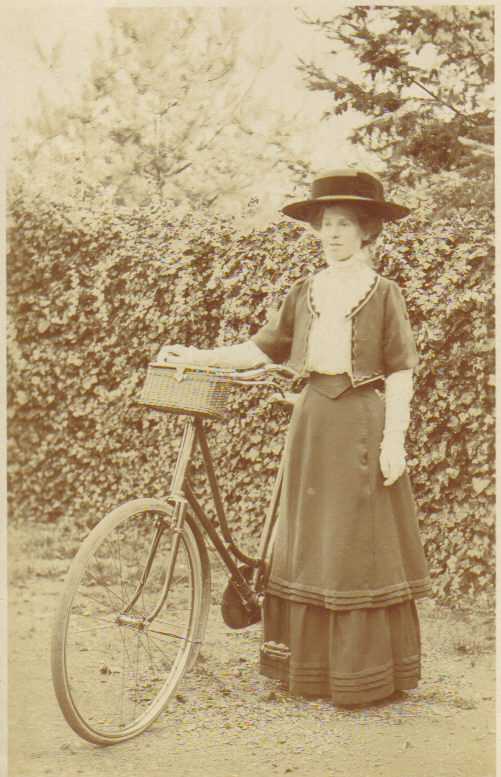
But look at this young lady. I think her dress dates the card around 1910 (for obvious reasons, the card was not stamped and addressed, but must have been put in an envelope and sent). She isn't wearing the mutton-leg sleeves of earlier Edwardian fashion, but a short jacket, double skirt, high-necked blouse, white gloves, and a large straw hat with a band. She stands, slim and erect, beside her bicycle, looking to the photographer's left. As often with these images, the bicycle looks as though it may be brand new.

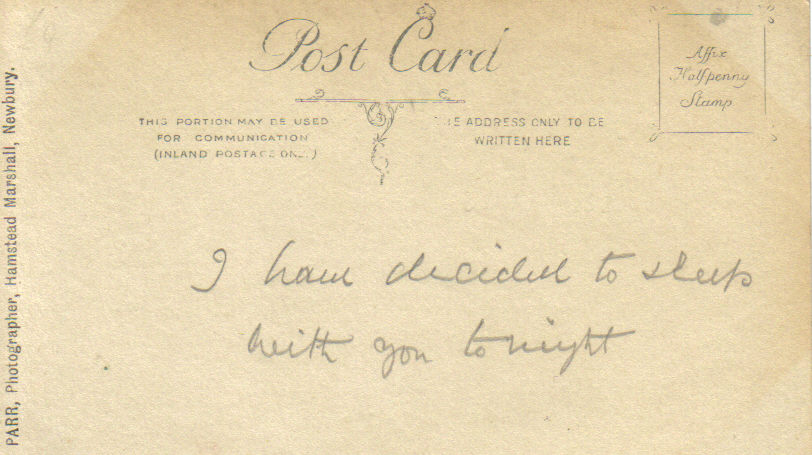
On the reverse, the message that must have thrilled the recipient when he opened the envelope: 'I have decided to sleep with you tonight'. Nothing else. No, 'Dear ****', no 'love', no signature: she just announces the decision she has come to, without any fuss. What a story! How Lawrentian! It is easy to imagine their discussions, their meetings, how she would go away and think about it, how they knew what they would do if she did. He doesn't have to be told where (one will, I imagine, be cycling to meet the other for their tryst).

The photographer was 'Parr', based at Hamstead Marshall, near Newbury. The social history of cycling stresses, as in H G Wells' novels, the bicycle as creating social mixing. It reputedly rescued deepest Norfolk from generations of catastrophic inbreeding. But rarely is the bicycle as an instrument of personal, sexual liberation so directly caught.

I hope they were happy. The young lady had courage and passion. How strange that the passional moment of a lost life survives, and is so eloquent.

http://www.rogerco.freeserve.co.uk/pl27/index.htm
has some really fine old photographs of late 19th century cyclists.

Saturday, March 04, 2006

Between Two Worlds


I have become interested in early advertising materials. I have posted about some early single sheet ‘bills’, including some by doctors. As the 17th century advanced, doctors began to produce quite lengthy pamphlets which described their diagnostic skills and curative regimes. I have a professional interest in materials related to witchcraft. Yesterday, I came across a pamphlet which, remarkably, combines the two, and which stands as a bridge between two worlds, the early modern, and a world that is something recognisably like our own.

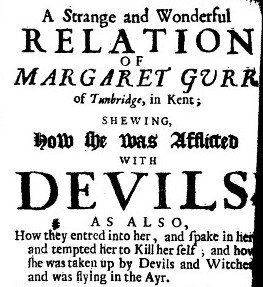
It is by Dr John Skinner, who describes himself as a ‘Student in Physick and Astrology’. ‘Astrology’ is perhaps as far as he dare go in advertising his real skills, as a private exorcist (as well as a being a doctor). The date is 1681. By this date, belief in witchcraft was well on the wane, at least in educated circles, but Margaret Gurr (his main subject, of Tunbridge in Kent, a servant) was accosted by two devils, who tempted her to commit suicide. This was quite a normal way for people to rationalise their worst impulses; to externalise them as diabolic in nature. One devil wants her to hang herself from the ‘Clock-Lines’ in the room (I’m not sure what they can be), while the other prompts her to thrust knitting needles into her ears. This was on the 19th July; on the 4th August, one of the devils enters into her, followed by a witch who also possesses her, saying: ‘Do as I say, and do as I would have you, and (be) as I am, for I am a Witch, a Witch, I am a Witch, do as I say and be as I am, and you shall be well.’

So far, so vivid, and plausible in its kind. The material consists, purportedly, of words ‘taken from her mouth Verbatim as she spake them’. But Skinner’s guiding hand appears when the witch says ‘I would not have you go to Doctor Skinner that Devil for help’. Poor Margaret gets worse, being tempted to curse at prayer time, and acquiring a rictus. On August 6th, as she is fetching pails of water. The devils abduct her aerially: ‘I was catcht up with the Devils, and was carried about with them, flying in the air’. This is a surprisingly normal symptom: it was the 17th century version of alien abduction. Skinner has clearly been consulted, and has told her to pray whenever she is tempted (it seems, tempted to yield to the Devil in another episode of flying). The Witch speaks from inside her again: ‘Go you not to that Devil Doctor Skinner for help, for if you do, I am utterly undone.’ (The forces of evil do not seem very subtle!)

Unassisted prayers do no good, the voices inside get more incessant, and she is ‘carried up and down with the Devils’ in perhaps further episodes of what she experiences as flight. Then, suddenly: ‘But with the Blessing and help of God, Doctor Skinner cast out the Devils and Witch out of my body, and also Cured me of the scurvy and Gout, and all within the compass of twelve days’. Furthermore, with her cure has come a spiritual benefit: ‘I knew not any Letters in the Bible or Testament, but since my enduring this heavy punishment … I can now learn my Book, and am wonderfully delighted in Reading and spending all my spare time in Prayers.’

Between two worlds: in this grubby little pamphlet, the world of Institoris and Sprenger is breathing its last: devils, witches, aerial abduction. A self-appointed expert leads on the simple and afflicted woman, coaxing her to say the words he wants her to say: but not to get her to confess to her pact with the devil, so as to burn her as a witch, but (and here the modern world appears) rather to secure a testimonial from her, so that he can start to make some real money. Two devils and a witch exorcised, scurvy and gout cured, and (no doubt with heaven’s help), a miraculous attainment of adult literacy: what more could anyone want from a doctor?

In the rest of the pamphlet, Skinner deals with another case of possession, and two more purely medical emergencies. The other possession case is almost as interesting as Margaret Gurr’s: a pious 17 year old servant boy, to whom the devil appears and astonishes him with the dire words: ‘You must go into Virginia.’ The devil tempting you to go to America probably made a lot of sense – he was ‘led on and tempted to strange things, as to go to sea, and matters that he was not able to mention’: a bored and disturbed adolescent might well have put such impulses as a diabolical visitation. With the boy’s concerned master paying half up front, and the rest on the completion of the cure (for Skinner cleverly insinuates how he expects to be paid), the boy is delivered from all diabolical urgings to go to America within eighteen days.

Skinner has been adroit enough to see that if he dresses up his advertising material as a case of witchcraft and possession, it will be read more avidly. In this horror movie of his own directing, he is himself the product placement. Four witnesses sign to Margaret Gurr’s testimony, exactly as would be done in those adverts based on ‘unsolicited testimonials’. But if the suicidal Margaret was restored to physical and mental help, Skinner’s odd mix of ‘Physick’ and exorcism wasn’t solely exploitative.

In Edward Ravenscroft’s play, Dame Dobson; or the Cunning Woman (1684), a servant girl, after much cajoling, finally manages to get out that she would like the cunning woman to create a magic potion that will enlarge her ‘bubbies’.

I always enjoy seeing these odd reflections of the present in these old and tarnished mirrors.